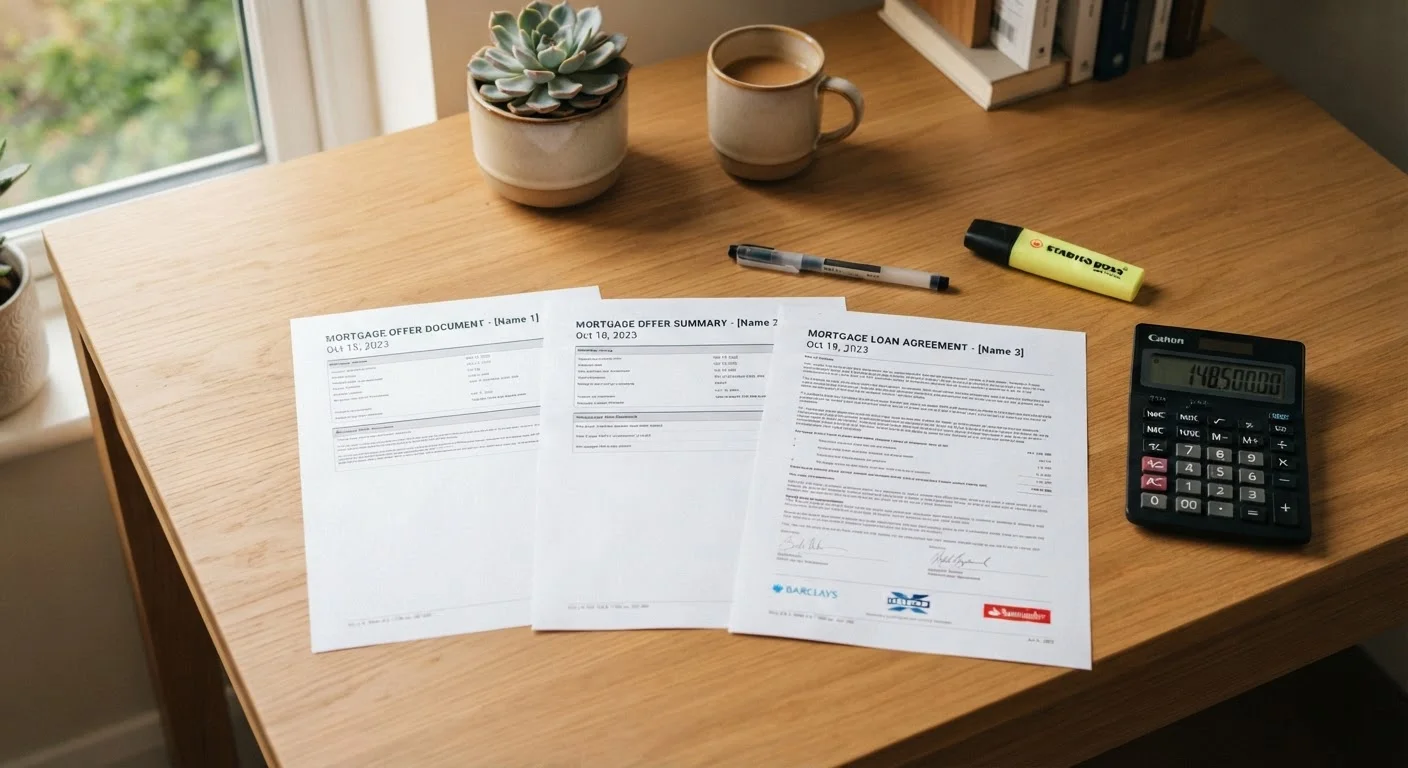
Why Mortgage Offers Are So Hard to Compare
A mortgage quote isn't a single number - it's a bundle of rate, fees, points, insurance requirements, and loan structure. Lenders have wide latitude in how they package these elements, which is why two offers for the same loan amount can look similar on the surface but differ by tens of thousands of dollars in total cost over time.
The federal Loan Estimate form, required under the TRID (TILA-RESPA Integrated Disclosure) rule, was specifically designed to give borrowers a standardized way to compare offers. But even with a consistent format, knowing which numbers to prioritize - and what trade-offs to look for - still requires a systematic approach.
What you will need
For a solid foundation before diving in, review key mortgage terminology so the figures on your Loan Estimates make immediate sense.
This Is General Education, Not Financial Advice
The guidance in this article is for informational purposes only and does not constitute personalized financial, mortgage, or legal advice. Mortgage decisions involve significant financial risk and individual circumstances vary widely. Consult a licensed mortgage professional, HUD-approved housing counselor, or financial adviser before committing to any loan.
Step-by-Step: How to Compare Your Offers
Follow these steps using your Loan Estimates side by side. The goal is to move beyond the headline interest rate and reach a true total-cost picture for each offer.
Request Loan Estimates from all lenders on the same day
Interest rates change daily. To make a fair comparison, submit applications to all lenders within the same one- to two-day window. Each lender is legally required to provide a standardized Loan Estimate within three business days. Using the same loan amount, property address, and down payment across all applications ensures the numbers are directly comparable.
Compare APR, not just the interest rate
The interest rate determines your monthly payment, but the Annual Percentage Rate (APR) folds in most upfront lender fees - origination charges, mortgage broker fees, and certain closing costs - expressed as a yearly rate. A loan with a lower interest rate but high fees often carries a higher APR than a loan with a slightly higher rate and minimal fees. Understanding the difference between rate and APR is essential before evaluating any offer.
Examine origination charges and discount points separately
On page 2, Section A of the Loan Estimate, you'll find origination charges - what the lender charges for making the loan - and any discount points you've agreed to pay to buy down the rate. One point equals 1% of the loan amount. Points are a prepaid cost that lower your rate; whether they're worth it depends on your break-even period. Our guide on mortgage points and break-even calculations walks through the math in detail.
Total all closing costs - not just lender fees
Page 2 of the Loan Estimate breaks closing costs into three categories: fees the lender controls (Section A-B), services you can shop for such as title insurance and settlement (Section C), and prepaid items like homeowner's insurance and escrow reserves (Sections F-G). Add them all together. Two offers with identical rates can differ by thousands of dollars in total cash needed at closing.
Calculate total interest paid over your expected hold period
Run each offer through an amortization calculator using your expected loan term and the number of months you plan to keep the loan. Add total interest paid during that period to total closing costs to get a true cost-to-own figure. This single number often reveals which offer is genuinely cheaper for your situation, not just on paper. If you're considering refinancing later, factor that into your hold-period assumption.
Check loan type, term, and structure for hidden differences
Confirm each offer is comparing the same loan type. A 30-year fixed and a 5/1 adjustable-rate mortgage (ARM) are not equivalent even if one has a lower initial rate. Review whether mortgage insurance is required and what it costs monthly - this is particularly relevant for FHA loans or any conventional loan with less than 20% down. Our loan type comparison can help clarify structural differences.
Negotiate and ask lenders to match competing offers
Once you've identified the most competitive offer, contact the other lenders and share the competing Loan Estimate. Many lenders will reduce origination fees or adjust the rate to retain your business. Always get any revised offer in writing on an updated Loan Estimate - verbal promises are not binding.
Use a Simple Comparison Spreadsheet
Create a table with each lender as a column and each key figure - rate, APR, points, origination fee, total closing costs, monthly payment, and cash to close - as a row. This visual layout makes patterns and trade-offs immediately obvious without mental math.
Rate-Shopping Window Is Time-Sensitive
Multiple hard credit inquiries for mortgage applications within a short window - typically 14 to 45 days depending on the scoring model - are usually treated as a single inquiry. Spreading applications over several weeks could result in additional credit score impacts. Check with your lender on the specific scoring model being used.
For context on how different loan programs affect your comparison, the Property & Mortgages hub covers the full landscape of mortgage options available to U.S. buyers.
This article is for general informational purposes only and does not constitute personalized financial, mortgage, or legal advice. Consult a licensed mortgage professional or HUD-approved housing counselor for guidance tailored to your specific situation.