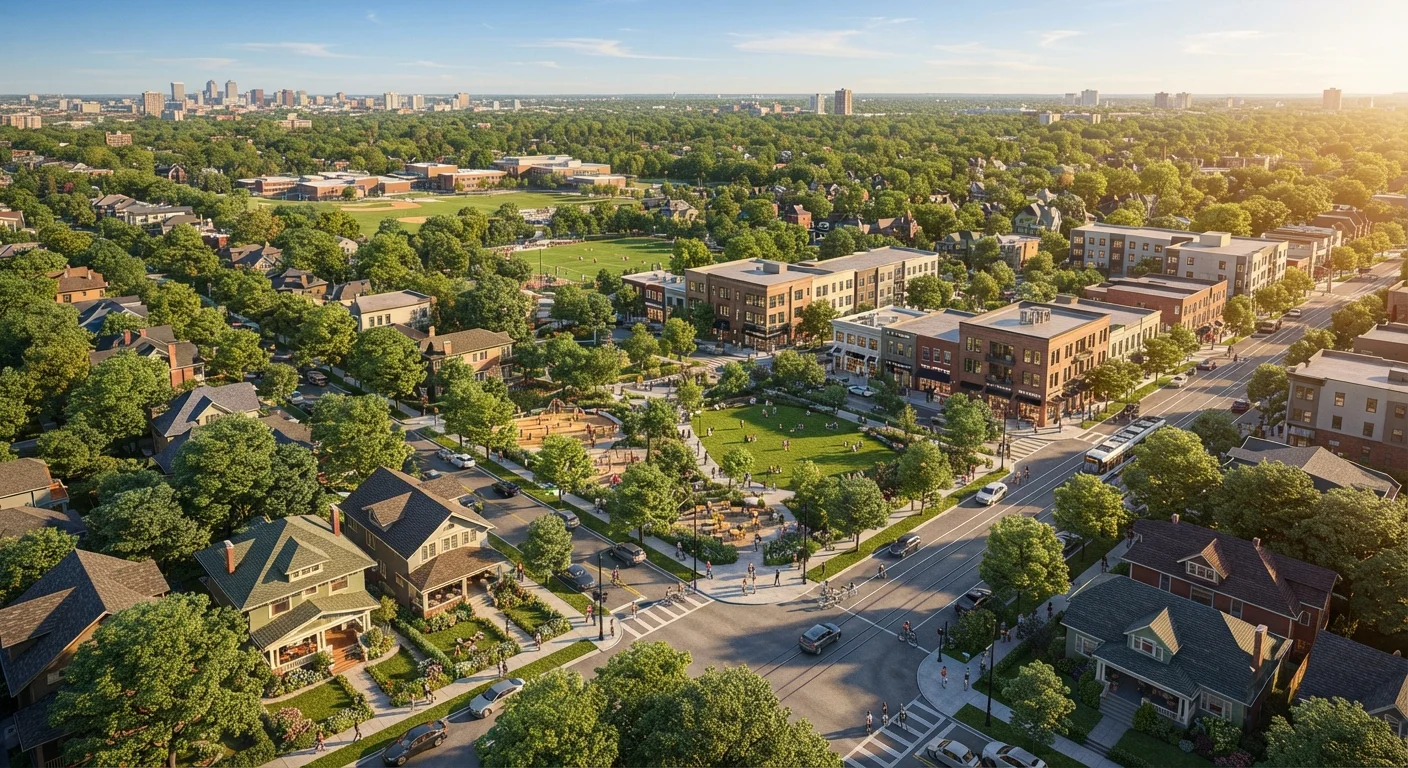
Why 'Good' Is More Than Gut Feeling
Most people form an instant impression of a neighborhood - whether the streets feel welcoming, whether the homes look maintained, whether the area seems lively or quiet. Those impressions are not worthless, but they are incomplete and sometimes misleading. Neighborhood quality is better understood as a set of measurable, researchable characteristics that determine how a place actually functions for the people who live there.
Understanding those factors helps buyers and renters move past surface-level aesthetics and make choices grounded in evidence. It also helps clarify a key truth: a good neighborhood is not an absolute - it is one that matches your specific needs, lifestyle, and stage of life. Neighborhood character adds another layer beyond metrics, capturing the social identity and feel of a place that data alone cannot fully convey.
77%
Buyers citing neighborhood quality as top priority
According to the National Association of Realtors' Profile of Home Buyers and Sellers, the quality of the neighborhood consistently ranks as the most important factor in home purchase decisions.
10-20%
Home value premium in top school districts
Academic research published in urban economics journals consistently finds that homes in higher-rated school districts command meaningful price premiums relative to similar homes in adjacent districts.
2x
Physical activity levels in walkable neighborhoods
Studies from public health and urban planning researchers have found that residents of highly walkable areas are roughly twice as likely to meet recommended daily physical activity targets.
The Core Measurable Factors
Safety
Crime rates remain one of the most heavily weighted factors in neighborhood evaluation - and for good reason. Local police departments and city open-data portals publish incident-level crime data that allows for year-over-year trend analysis. A neighborhood with declining crime rates is often a stronger choice than one with a low absolute count that is trending upward. Be cautious of oversimplified crime scores, which can obscure important distinctions between property crime and violent crime, or fail to account for reporting rates.
School Quality
For households with or planning children, school district boundaries are a dominant consideration - and they meaningfully influence property values even for households without school-age kids. School ratings on public data platforms provide a starting point, but digging into student-to-teacher ratios, academic growth metrics, and extracurricular offerings gives a more complete picture. Our guide on family-oriented neighborhood features beyond school ratings covers the many other factors families should weigh.
Walkability and Transit Access
Walkability scores quantify how easily residents can reach groceries, pharmacies, parks, and transit stops on foot. High walkability correlates with reduced transportation costs, greater physical activity, and stronger social connection. Transit access - frequency of service, proximity to stops - matters particularly for households without a car or those trying to reduce commute costs. Notably, walkable neighborhoods tend to hold value more resiliently across market cycles, according to research from urban planning institutions.
Access to Daily Services and Amenities
Proximity to grocery stores, healthcare facilities, libraries, parks, and restaurants shapes everyday convenience and quality of life. A neighborhood lacking a full-service grocery store within reasonable distance - sometimes called a food desert - imposes real costs on residents' time, health, and spending. Local government services such as park maintenance, street repair, and code enforcement are equally consequential and often overlooked during the home search.
Visit Before You Decide
No data source replaces walking the neighborhood at multiple times of day. Visit on a weekday morning, a weekend afternoon, and an evening to observe foot traffic, noise levels, and how public spaces are used. Talk to residents if possible - they often share details that no online tool captures.
Trajectory and Stability: Where Is the Neighborhood Headed?
A snapshot of current conditions tells only part of the story. A neighborhood's direction - whether it is growing, stabilizing, or declining - shapes what life there will look like five or ten years from now, and what the investment will be worth. Indicators of a positive trajectory include new building permits, rising small-business density, school enrollment growth, and visible infrastructure investment. Signs of stress include long-term vacancies, deferred maintenance on public spaces, and falling enrollment.
Zoning is another forward-looking factor. Understanding what can legally be built near a property you are considering - whether a multi-family building, a commercial development, or an industrial facility - is critical context. Our primer on zoning laws and neighborhood character explains how to check what is planned or permitted near any address.
For a structured approach to assessing a neighborhood across time and conditions, see our guide on evaluating a neighborhood at different times of day - a simple habit that reveals dynamics no data set captures.
Livability Rankings Have Real Limitations
Commercially produced livability indexes aggregate many factors into a single score, but their methodologies vary widely and often reflect metro-level conditions rather than block-level reality. A neighborhood with a mediocre citywide ranking may have exceptional block-by-block conditions - and vice versa. Use rankings as a starting point, not a conclusion.
How to Layer Your Research
No single score, ranking, or data source captures neighborhood quality completely. The most reliable picture comes from layering multiple inputs: public crime and school data, walkability scores, firsthand visits at different times, conversations with current residents, and local news sources. Census data, city planning documents, and community social media groups each reveal dimensions that the others miss.
Our first-timer's guide to neighborhood research tools walks through the main platforms and how to interpret them critically. And because these factors ultimately affect what you pay, our deeper look at how schools, commutes, and neighborhood data shape home values connects the research to your financial decision.
This article is for general informational and educational purposes only and does not constitute financial, legal, or real estate advice. Readers should consult qualified professionals before making property or financial decisions.