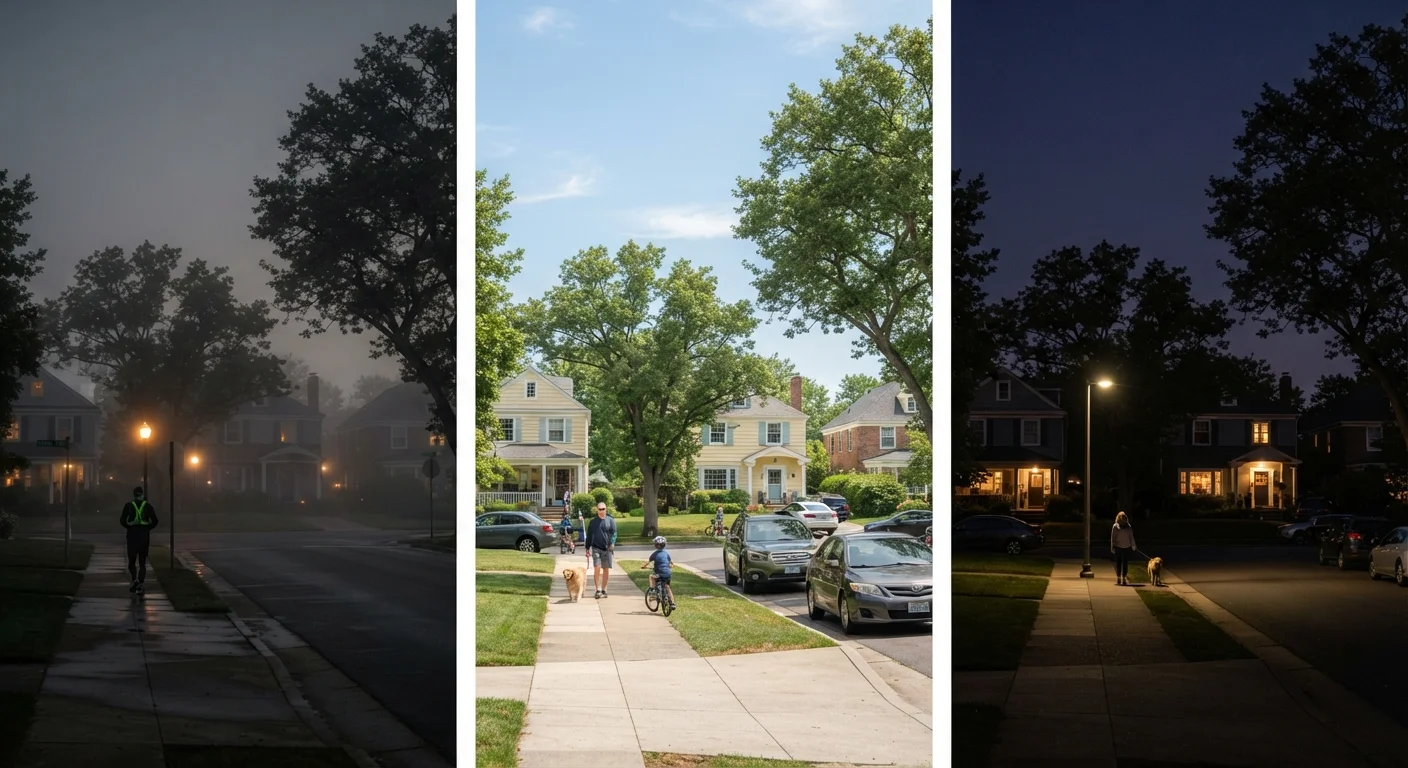
Why Timing Your Visit Actually Matters
Most homebuyers and renters visit a prospective neighborhood once - typically on a weekday afternoon when a showing is convenient. That single snapshot can be deeply misleading. A quiet street at 2pm may transform into a congested cut-through during rush hour. A block that feels safe in daylight may have poor street lighting and little foot traffic by 9pm.
Neighborhood character is not static. It shifts with the rhythms of daily life: school drop-offs, bar closing times, weekend farmers markets, and early-morning delivery trucks all shape what it actually feels like to live somewhere. As the factors that define neighborhood quality article explains, measurable conditions - noise, walkability, safety - matter far more than aesthetics alone. Those conditions change by the hour.
The solution is systematic: plan at least three distinct visits to any neighborhood you're seriously considering, each at a different time of day. The investment of a few extra hours can prevent years of regret.
Best Practices for a Multi-Time Neighborhood Assessment
Approaching each visit with a clear focus prevents observation fatigue and ensures you capture what matters most at each hour.
Visit on a weekday morning between 7 and 9am to observe rush-hour conditions firsthand.
Morning commute patterns - traffic volume, parking competition, transit crowding - directly affect your daily quality of life but are invisible during off-peak visits. Seeing them in person beats any map or data tool.
Return after dark on a weeknight to evaluate lighting, ambient noise, and street activity.
Poor street lighting and late-night noise from nearby businesses are among the most common and impactful surprises new residents report. Evening conditions are virtually impossible to assess from listing photos or daytime walks.
Document observations systematically using a consistent note-taking format for each visit.
Memory is unreliable when evaluating multiple neighborhoods across multiple visits. Structured notes let you compare conditions objectively and avoid letting recency or emotional state bias your final judgment.
Walk, don't just drive, through the neighborhood during at least one visit.
Walking exposes details a car obscures: sidewalk quality, odors from nearby businesses or industrial sites, the actual distance to transit stops, and how comfortable and safe the environment feels at a human pace.
Speak briefly with residents you encounter during different visit windows.
Residents carry firsthand knowledge that no data source captures: recurring issues, recent changes, what the neighborhood is like during seasons you can't observe in a single visit cycle.
What Each Time Window Reveals
Each visit window surfaces different intelligence about a neighborhood's real conditions.
Early morning (6:30-9am): This window reveals commute behavior - how heavy is traffic, where do people park, is transit service reliable at rush hour? It also shows you who lives in the neighborhood: families walking kids to school, dog walkers, early-shift workers. Listen for delivery trucks, garbage collection, or rail noise that may not be present later.
Midday (11am-2pm): A quieter period that exposes baseline conditions - ambient noise, the state of parks and public spaces, how businesses and services actually look when they're open. This is a good time to observe the walkability of the area and check whether the grocery store, pharmacy, or transit stop you're counting on is genuinely accessible on foot. See our neighborhood evaluation checklist for a structured set of midday observations.
Evening (8-10pm): This is the visit most people skip - and the most revealing. Observe street lighting, foot traffic, and noise from nearby restaurants, bars, or entertainment venues. A block near a restaurant corridor may be lively and loud until midnight. Poorly lit streets or empty sidewalks can signal conditions that affect both safety perception and actual light and noise pollution impacts.
Don't Forget the Weekday vs. Weekend Difference
Time of day is only one axis. The day of the week matters nearly as much. A neighborhood near a stadium, a weekend farmers market, or a nightlife district behaves fundamentally differently on Saturday night than on a Tuesday morning. Construction projects that are quiet on weekends may generate significant noise Monday through Friday.
If your daily life runs on a specific schedule - an early commute, a work-from-home routine, or school pickup at 3:30pm - prioritize visiting at those exact times. The commute you experience during a showing is not necessarily the commute you'll experience every day. Our guide to honestly evaluating commutes covers this in detail, including how to test transit reliability during actual peak hours.
Online Research Complements, But Doesn't Replace, In-Person Visits
Crime statistics, walkability scores, and transit maps are useful starting points but are backward-looking aggregates. They can't capture recent changes, seasonal variation, or the subjective feel of a neighborhood at 9pm on a Tuesday. Use data tools to shortlist candidates, then let in-person visits at multiple times of day do the real qualifying work. See signs of neighborhood growth or decline for on-the-ground signals worth watching.
Beyond logistics, living environment genuinely affects wellbeing. Chronic noise exposure, poor lighting, and stressful commutes compound over time in ways that are easy to underestimate during the excitement of a home search. Pairing your on-the-ground visits with neighborhood research tools - crime statistics, permit data, transit maps - gives you the most complete picture before you sign anything.
74%
Buyers who wish they'd researched the neighborhood more
According to a survey by the National Association of Realtors, roughly three-quarters of homebuyers who expressed regret cited neighborhood-related issues as a primary factor.
22 min
Average U.S. one-way commute time
U.S. Census Bureau American Community Survey data indicates the average one-way commute is approximately 27 minutes, with urban commuters often exceeding this - making rush-hour neighborhood visits especially important.