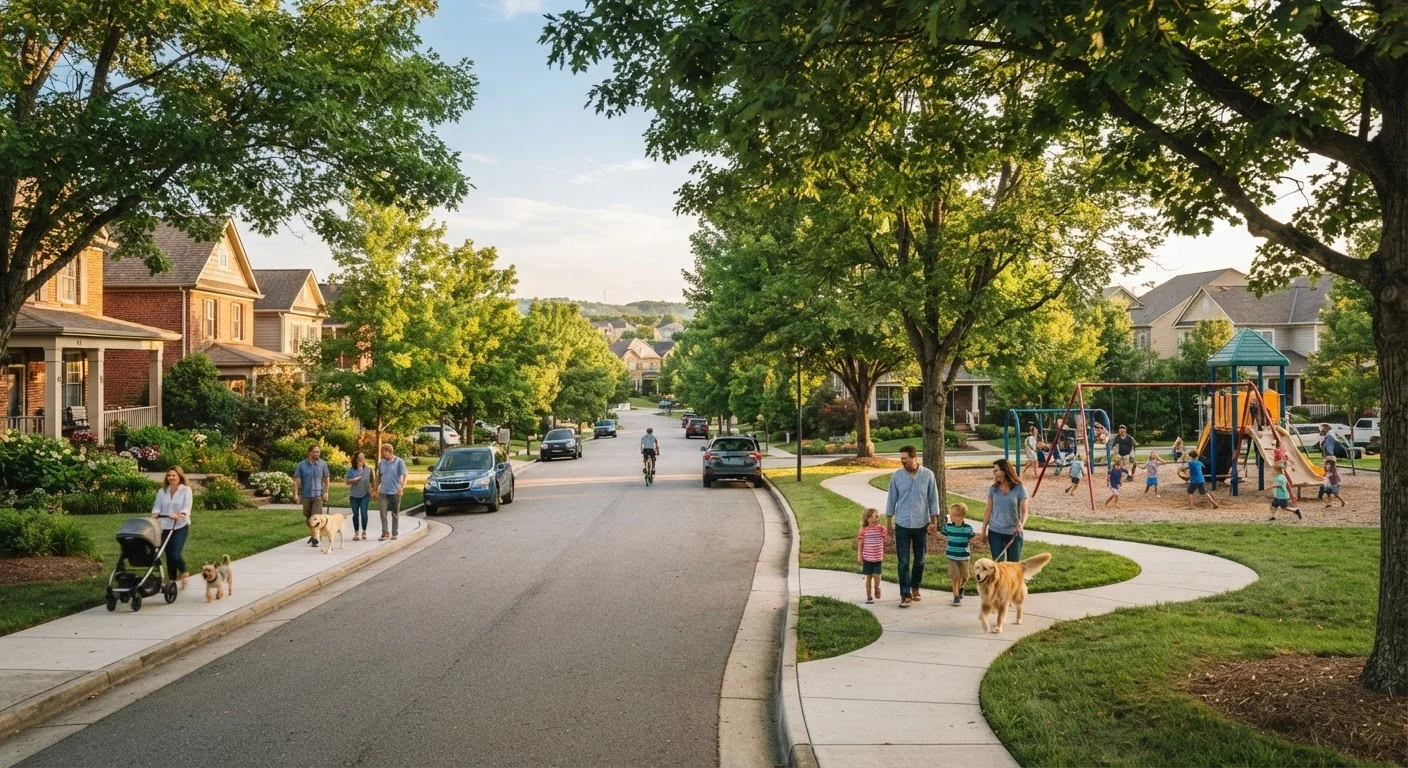
What families actually need from a neighborhood
When families search for a home, school ratings tend to dominate the conversation. They're easy to find, easy to compare, and feel authoritative. But a high-rated school district paired with dangerous street crossings, no sidewalks, and an isolated social environment creates a very different daily reality than the ratings suggest.
The features that shape whether a neighborhood genuinely works for raising children are often quieter and harder to Google - but they're just as consequential. This list covers the infrastructure, services, and community factors worth investigating alongside academic performance data. For a structured way to evaluate any neighborhood holistically, our neighborhood evaluation checklist is a useful companion resource.
School Ratings Still Matter - In Context
This article focuses on factors beyond school ratings, but that doesn't mean ratings are irrelevant. School quality influences property values and community investment for all homeowners, not just those with children. The key is treating ratings as one input among many rather than the sole filter. See our piece on evaluating schools even without children for a nuanced view.
Seven neighborhood features families should evaluate
Visit on a Weekday Afternoon
Weekend visits show a neighborhood at its most quiet or staged. A weekday afternoon visit - especially around school dismissal time - reveals traffic patterns, pedestrian activity, and the real texture of daily life. Bring your checklist and plan to stay for at least an hour across different parts of the area.
Sidewalk coverage and pedestrian infrastructure
A neighborhood's walkability shapes everyday family life in concrete ways. Can your child walk to a friend's house or the nearest park without stepping into traffic? Continuous sidewalks, crosswalks with pedestrian signals, and well-lit paths are infrastructure details that rating sites rarely capture but that parents feel every single day.
Walk the streets at different times - morning drop-off, afternoon, and evening - to assess real-world foot traffic and safety. Note where sidewalks end abruptly, where crossing feels unsafe, or where sight lines are obstructed. These gaps compound over years of raising children in a neighborhood.
Sidewalk gaps and missing crosswalks create daily hazards that no school rating ever reflects.
Traffic volume and street design near homes and schools
High-traffic cut-through streets, absent speed controls, or poorly placed school drop-off zones are genuine safety concerns for families with young children. Look beyond the address itself - examine the surrounding street network. Are there traffic-calming measures like speed bumps, roundabouts, or marked school zones? Does the neighborhood road layout discourage speeding?
Local transportation or planning departments often publish traffic count data. Reviewing this alongside a site visit gives you a fuller picture of daily risk than any aggregate neighborhood score can provide.
Street design and traffic volume near a home affect child safety more than many buyers anticipate.
Public library access and programming
Public libraries are among the most underrated assets in a family neighborhood evaluation. Beyond book lending, most branch libraries offer free or low-cost programs: story hours for toddlers, homework help for school-age children, STEM workshops, and summer reading challenges that help prevent learning loss.
Check the local library system's website for branch locations, hours, and program calendars. A library within walking or easy driving distance - with programming matched to your children's ages - can meaningfully support development and provide safe, enriching after-school options without added expense.
A well-resourced public library branch can rival private enrichment programs at zero cost.
Park quality, playgrounds, and recreational facilities
The presence of green space matters, but so does its condition and programming. A maintained park with age-appropriate playground equipment, sports fields, and shaded seating invites regular family use. A neglected or inaccessible park does not. Look for parks within a quarter-mile to half-mile of the home, and visit them in person rather than relying on map imagery.
Beyond basic parks, check whether the municipality operates recreation centers with youth sports leagues, swim lessons, or structured after-school activities. These programs build peer connections and healthy routines that contribute to children's long-term wellbeing.
Park condition and recreational programming - not just proximity - determine whether families actually use them.
Community events and neighborhood social fabric
A neighborhood with active block associations, seasonal farmers markets, community festivals, or organized holiday events tends to have higher social cohesion - a factor linked in research to both child wellbeing and resident satisfaction. Social fabric is harder to measure than a school API score, but it's tangible when you look for it.
Search for a neighborhood association website or Facebook group. Ask at the local library or community center about upcoming events. Talk to people you encounter during site visits. Current residents will tell you, often candidly, whether neighbors look out for each other or keep entirely to themselves. For a broader evaluation framework, see our neighborhood evaluation checklist.
Neighborhood social cohesion is measurable - look for active associations, events, and engaged residents.
Access to pediatric and family healthcare
Proximity to pediatricians, family medicine practices, urgent care centers, and children's hospitals is a practical concern that often goes unevaluated during home searches. In a dense metro area, options may be abundant; in suburban fringe or rural settings, a 45-minute drive to the nearest pediatric urgent care can matter enormously when a child is sick at 10 p.m.
Use your insurer's provider directory to map in-network options near any home you're seriously considering. This is general informational guidance - consult your health plan for specifics relevant to your coverage.
Healthcare access for children deserves the same due diligence as school district research.
After-school program availability and childcare infrastructure
Even families with children in highly rated schools face a practical gap: what happens between 3 p.m. and 6 p.m.? The availability of licensed childcare centers, after-school programs, and youth organizations (such as community-run clubs, arts programs, or sports leagues) varies widely by neighborhood and directly affects working parents' daily logistics.
Research local YMCA branches, nonprofit after-school programs, and municipal recreation departments before committing to a neighborhood. These resources often fill faster than school enrollment and represent real daily infrastructure for family life. As you weigh neighborhoods, consider how broader quality factors interact with these everyday logistics.
After-school infrastructure is daily logistics for working parents - research it as carefully as schools.
Putting it all together before you commit
No neighborhood will score perfectly across every dimension, and your family's priorities will differ from another's. A toddler household has different infrastructure needs than a family with teenagers. The goal of this kind of research isn't to find perfection - it's to avoid blind spots that years of daily life will expose.
Balance what the data shows with what you observe in person and hear from residents. Consider how these community-level factors interact with the trade-offs between established neighborhoods and newer developments - a topic covered in depth in our piece on established neighborhoods vs. new developments. School ratings are a reasonable starting point, but they are not a substitute for the fuller picture that on-the-ground research provides.
This article is intended as general informational guidance for educational purposes only and does not constitute legal, financial, or professional real estate advice. Consult qualified professionals for decisions specific to your circumstances.