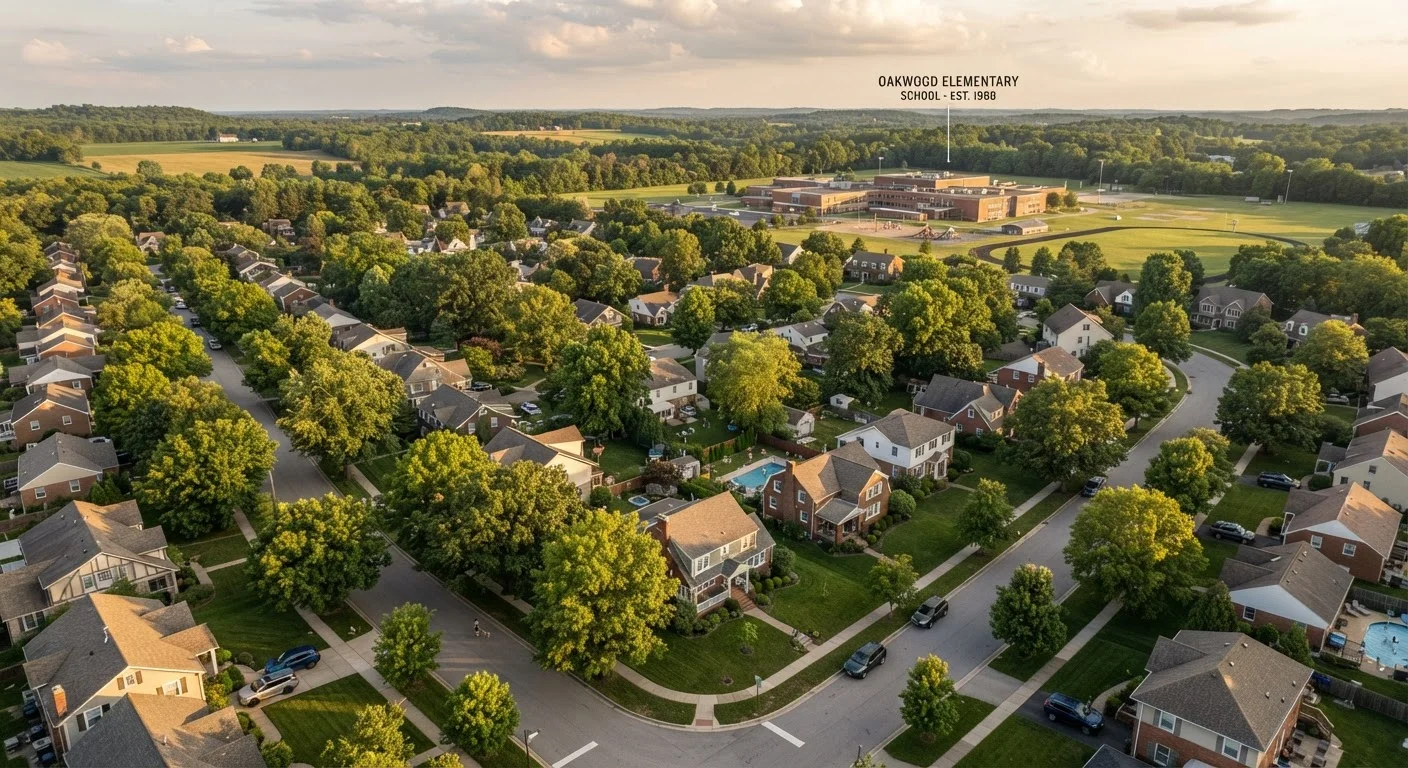
Why School Quality Is a Real Estate Variable, Not Just a Parenting Decision
Most home-buying checklists treat school ratings as relevant only to families with school-age children. That framing is too narrow. School district quality functions as one of the most durable signals of neighborhood investment, municipal fiscal health, and long-term property demand. Understanding it gives any buyer - regardless of household composition - a clearer picture of where a neighborhood is headed.
The connection between school performance and property value is well-documented across housing research. Districts with consistently strong outcomes tend to attract stable buyer demand, which supports home prices over time. Conversely, neighborhoods experiencing school funding cuts or declining enrollment often show parallel softening in property values and community amenities. These patterns play out over years, not months, making school quality a particularly useful long-horizon indicator for any buyer thinking about resale.
Beyond investment considerations, schools also reflect the broader civic priorities of a community. High per-pupil spending, active parent involvement, and well-maintained facilities suggest a local government and resident base that invests in shared infrastructure - a signal that often extends to parks, public transit, libraries, and safety services. See how these factors connect in our overview of what actually makes a neighborhood good.
School Quality Affects Your Resale Value
Homes in higher-rated school districts have historically commanded a price premium and sell faster than comparable homes in lower-rated districts. Even if you never enroll a child, a large share of future buyers will weigh school quality heavily. Ignoring this factor when buying can limit your exit options years down the line.
How to Research and Interpret School Data
Evaluating schools without the context of a parent's direct experience requires leaning on publicly available data - and knowing which data points actually matter.
What you will need
State Department of Education Website
Access official school report cards, test score trends, graduation rates, and budget data for any public school in the state.
National Center for Education Statistics (NCES) School Finder
Look up enrollment figures, student-to-teacher ratios, and demographic breakdowns for individual public schools nationwide.
County Assessor or GIS Mapping Tool
Verify which school district boundary a specific property falls within before relying on assumptions.
Third-Party School Rating Aggregators
Provides a quick comparative overview of nearby schools, useful as a starting point - not a final judgment.
Confirm the Exact School District Boundary for the Property
School district lines do not always follow intuitive geographic borders. A home on one side of a street can fall in a different district - with meaningfully different funding, programs, and property value implications - than the home directly across from it. Use your county assessor's GIS tool or the district's official website to confirm which schools are assigned to the specific parcel you are evaluating. Do not assume based on proximity alone.
For a deeper explanation of why these boundaries matter financially, see how school district boundaries affect homebuyers and renters.
Pull the State's Official School Report Card
Every state publishes annual school report cards through its Department of Education. These documents go beyond simple letter grades and include graduation rates, proficiency trends across multiple years, chronic absenteeism rates, and teacher qualification data. Look specifically for year-over-year improvement - a school moving upward on key metrics signals active institutional investment, which is a stronger long-term indicator than a static snapshot score.
Review the District's Budget and Community Investment
District funding levels reflect how much a local government prioritizes public education - and that prioritization often extends to other municipal services. Check per-pupil spending figures (available through NCES or state reports) and compare them to neighboring districts. A district with stable or growing per-pupil funding typically operates in a community with a healthy tax base, which correlates with well-maintained infrastructure, parks, and public services that affect quality of life for all residents.
[warning_callout]Assess What School Quality Signals About the Broader Neighborhood
Strong public schools are rarely an isolated phenomenon. They tend to coincide with active neighborhood associations, maintained parks, lower vacancy rates, and consistent reinvestment in local infrastructure. As the factors that define neighborhood quality article outlines, school performance is one of the most measurable proxies for overall civic health. If schools are underfunded and declining, ask whether adjacent municipal services are following the same pattern.
Evaluate the Resale Demand Implications
When it is time to sell, your buyer pool will be shaped by the school district your home sits in. Families - who represent a substantial share of the home-buying market - routinely filter searches by district before ever looking at a listing's features. Homes in districts with strong ratings attract more competing buyers, which supports price stability. Review recent sales data for comparable homes both inside and outside the district to quantify any observable premium. This exercise grounds your expectations for future liquidity.
For more on how school data interacts with broader value drivers, see how schools, commutes, and neighborhood data shape home values.
Cross-Reference Multiple Data Sources
No single database gives a complete picture of school quality. Cross-reference state report cards, district budget documents, and local community forums to build a more accurate view. State education department websites publish raw performance data that is often more current and granular than aggregator platforms.
For a broader framework covering schools alongside other community factors, the neighborhood evaluation checklist provides a useful companion structure. And if the neighborhood you are considering caters to families, community features beyond school ratings covers additional dimensions worth researching alongside district performance.
This article is for general informational and educational purposes only and does not constitute financial, legal, or real estate advice. Consult a licensed real estate professional for guidance specific to your situation and local market.