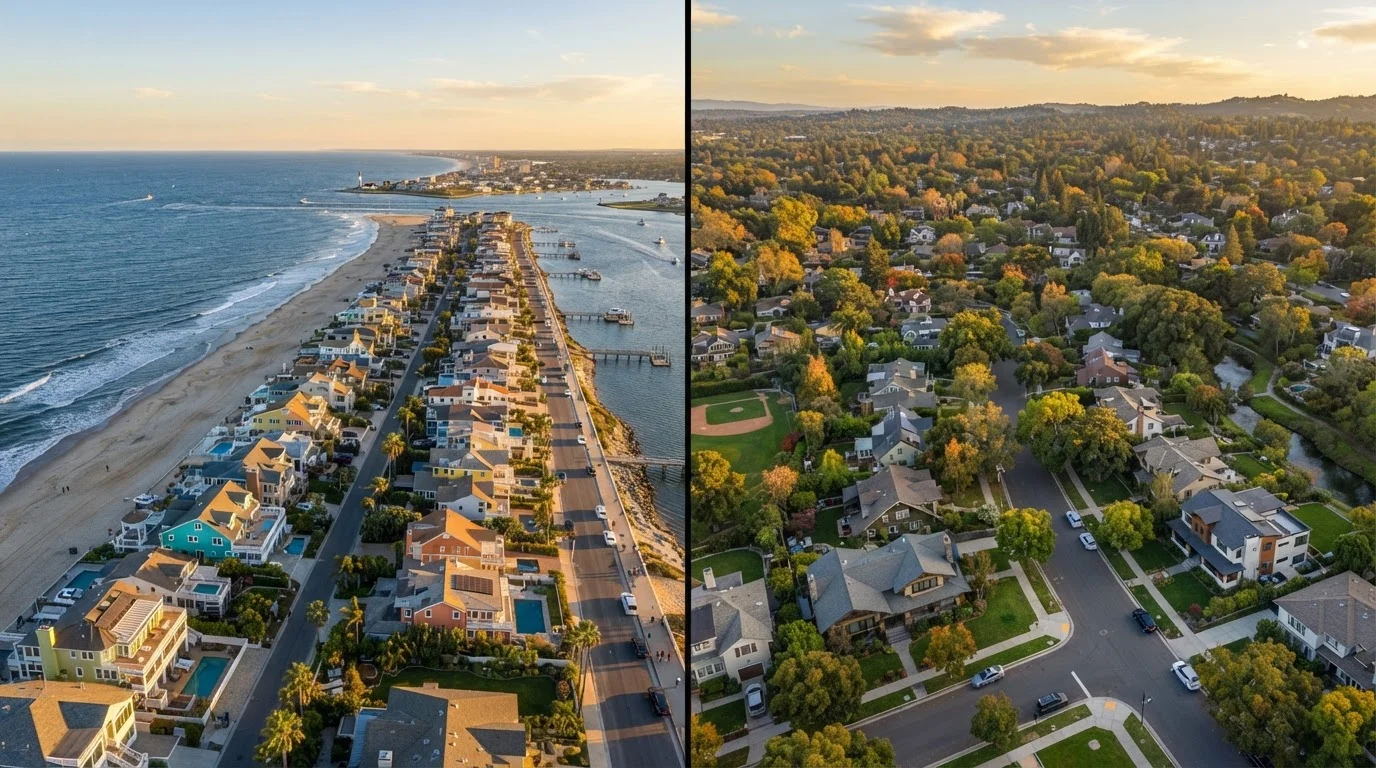
Lifestyle Appeal: What Each Setting Actually Delivers
Coastal neighborhoods command enduring demand because the lifestyle benefits are tangible: proximity to beaches, boating, and water-oriented recreation, along with sea breezes that moderate summer heat in many regions. Walkable waterfronts, seafood culture, and a sense of place tied to natural surroundings contribute to quality of life in ways that are difficult to replicate elsewhere.
Inland communities trade those amenities for different advantages. Quieter residential streets, larger lot sizes at equivalent price points, easier highway access, and more predictable day-to-day routines appeal to households prioritizing family logistics over scenic setting. Many inland suburbs sit within commuting range of major employment centers, offering a practical balance that coastal towns - often at the urban fringe - can struggle to match.
Neither profile is universal. A coastal neighborhood in a mid-sized city may offer robust transit and dense amenities, while a rural inland town may feel isolated. Evaluate the specific community, not just the geography. The urban-suburban-rural trade-off framework is a useful starting lens when narrowing down location type.
Environmental Risk: Understanding What You're Buying Into
This is where coastal living demands the most rigorous homework. Properties near coastlines face a distinct set of hazards: flooding from storm surge and heavy rain, wind damage from tropical and nor'easter systems, erosion that can literally shrink a lot over decades, and - in some regions - saltwater intrusion affecting groundwater and foundations.
Flood zone designation is a starting point, not the full picture. FEMA's National Flood Insurance Program maps identify Special Flood Hazard Areas, but these maps are not always current, and some high-risk parcels fall just outside designated zones. Sea-level rise projections add a long-term dimension that historical maps do not capture. Before purchasing coastal property, reviewing current hazard disclosures and consulting resources like FEMA flood maps is essential - the article flood zones, fire risk, and other environmental hazards covers this process in depth.
Inland neighborhoods are not risk-free. Wildfire exposure has expanded significantly across western and southeastern states. Inland flooding from riverine sources and increasingly severe rainfall events affects communities well away from coasts. Extreme heat is an emerging livability concern in many inland metros. The key difference is that coastal risk tends to cluster in predictable geographic patterns, making it more identifiable during due diligence.
Don't Rely on Flood Maps Alone
FEMA flood zone maps are updated on irregular schedules and may not reflect current risk - particularly in areas affected by subsidence, sea-level rise, or altered drainage. Properties just outside a Special Flood Hazard Area can still experience significant flood damage. Request elevation certificates, review local hazard mitigation plans, and consult with a licensed insurance professional before assuming a coastal property's flood risk is manageable.
Cost Comparison: Purchase Price, Insurance, and Ongoing Expenses
Coastal properties command a premium that reflects both desirability and risk. Median home prices in waterfront communities consistently exceed those of comparable inland markets, often by a substantial margin depending on the metro area. That premium extends beyond the purchase price.
Homeowners insurance is the most significant ongoing cost differential. Coastal properties in hurricane-prone states such as Florida, Texas, Louisiana, and the Carolinas face dramatically higher wind and flood insurance premiums - sometimes running thousands of dollars annually above inland equivalents. In some markets, private insurers have reduced coastal coverage availability, pushing homeowners toward state-backed insurers of last resort. This is general financial information; consulting a licensed insurance professional for policy specifics applicable to any property you are considering is strongly advised.
Flood insurance, required by lenders for properties in designated flood zones, is an additional line item that inland buyers rarely face. Combined with elevated wind coverage, total insurance costs can meaningfully affect a coastal home's affordability calculation even when the purchase price appears manageable.
| Coastal Neighborhoods | Inland Neighborhoods | |
|---|---|---|
| Typical home price premium | Higher - waterfront demand adds significant markup | Lower - more value per square foot in most markets |
| Homeowners insurance cost | Substantially higher; wind and flood coverage required | Generally lower; flood insurance rarely required |
| Primary environmental hazards | Storm surge, flooding, erosion, wind damage | Wildfire, riverine flooding, extreme heat (varies by region) |
| Lifestyle amenities | Beach, water recreation, scenic views | Larger lots, highway access, quieter residential feel |
| Infrastructure resilience | Variable; seawalls and drainage age and vary by municipality | Generally more stable; less exposed to storm disruption |
| Long-term climate risk trajectory | Rising - sea-level rise, intensifying storms | Moderate - expanding wildfire and heat exposure in some regions |
Inland buyers generally face lower insurance costs and property tax bases, freeing capital for other priorities - though local tax rates vary significantly and should be researched at the county level.
Schools, Amenities, and Community Resilience
School quality does not correlate neatly with coastal or inland geography - it correlates with district funding, local governance, and community demographics. Both settings contain high-performing and underperforming districts. Families should research specific district ratings, test performance data, and extracurricular offerings rather than assuming either environment is educationally superior.
Community resilience infrastructure is an underappreciated differentiator in coastal areas. Seawall maintenance, stormwater drainage capacity, evacuation route accessibility, and local emergency management capability vary widely between coastal municipalities. Some well-resourced coastal communities have invested substantially in hardening; others have aging or inadequate systems. Requesting information from local planning and emergency management offices is a reasonable step during due diligence.
Inland communities benefit from generally more stable infrastructure that is less subject to storm disruption, though extreme weather events increasingly challenge this assumption. For households sensitive to noise and light pollution as quality-of-life factors, inland suburban settings often perform favorably compared to busy coastal resort towns.
For a broader comparison of how community character differs across neighborhood types, see our analysis of established neighborhoods versus new developments.
Ask About Post-Storm Recovery History
Before committing to a coastal neighborhood, ask sellers and local residents how the community fared after recent major storms. Recovery timelines, insurance claim experiences, and infrastructure repairs tell you more about livability and resilience than any brochure. Local planning department records and news archives can surface this history efficiently.
This article is for general informational and educational purposes only. It does not constitute financial, insurance, or legal advice. Consult licensed professionals for guidance specific to your circumstances and the properties you are evaluating.