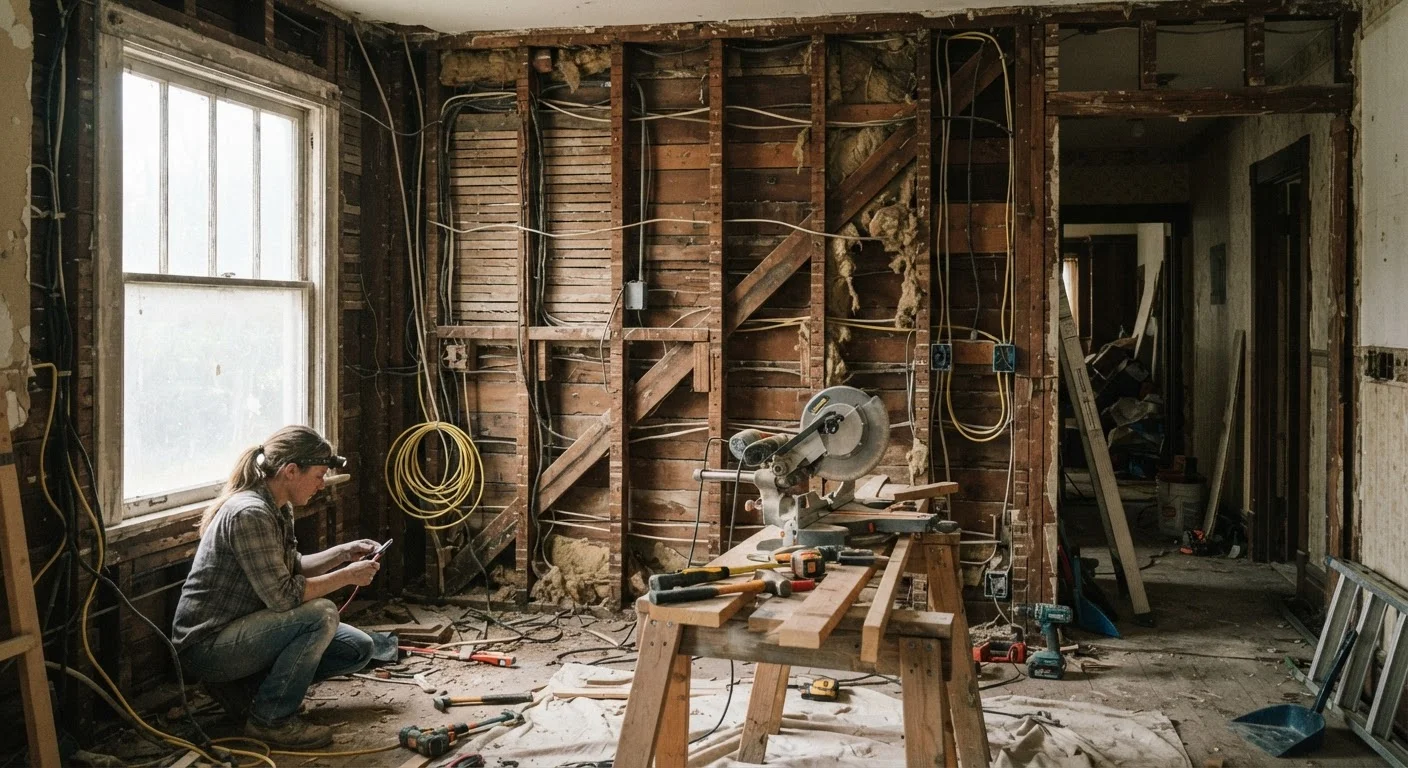
Why Older Homes Demand a Different Renovation Mindset
Renovating a home built before 1970 is a fundamentally different undertaking than updating a newer build. Decades of deferred maintenance, successive owners with varying skill levels, and materials that are now known to be hazardous mean that walls, floors, and ceilings can hide serious problems invisible to the naked eye. Experienced contractors expect surprises in older homes - unprepared homeowners often do not.
The most effective way to protect your project, your budget, and your family's safety is to plan for discovery before work begins. That means understanding what's likely hiding inside your walls, knowing which discoveries require licensed professionals, and structuring your budget and contract to absorb the unexpected. See our breakdown of often-overlooked renovation costs for a fuller picture of what to line-item before work starts.
Assuming the original inspection covered everything inside the walls.
Why it happens: Homebuyers rely on pre-purchase inspections, which are visual and non-invasive by design. Inspectors cannot see through drywall, beneath flooring, or inside closed ceiling cavities.
Failing to test for asbestos and lead paint before any demolition work.
Why it happens: Homeowners often assume these hazards were addressed by previous owners, or they underestimate how widely these materials were used in mid-20th century construction. Asbestos appeared in floor tiles, pipe insulation, textured ceilings, and roofing materials through the late 1970s.
Ignoring outdated electrical systems until the project is already underway.
Why it happens: Knob-and-tube wiring (common through the 1940s) and aluminum branch-circuit wiring (common in the 1960s-70s) are often functional enough that homeowners don't prioritize them - until an electrician opens a wall and flags them as unsafe or uninsurable.
Skipping permits because the work 'seems minor' or to save time and money.
Why it happens: Permits add cost and delay. In older homes, owners sometimes rationalize skipping them - especially for work that previous owners completed without permits - not realizing the compounding problems this creates.
Setting a contingency budget that's too small - or not setting one at all.
Why it happens: Homeowners anchor to the initial contractor estimate and treat it as a ceiling rather than a floor. Most renovation guides suggest a 10-20% contingency, but older homes with high uncertainty often warrant the upper end of that range or beyond.
Treating walls as non-load-bearing without professional verification.
Why it happens: Open-concept renovations are popular, and it's tempting to assume interior walls are purely cosmetic. In older homes, framing patterns don't always follow modern conventions, making load-bearing status harder to judge from visual inspection alone.
The Statistics Behind Older-Home Surprises
The numbers reinforce what contractors already know from experience: older housing stock carries disproportionate risk. According to the U.S. Environmental Protection Agency, homes built before 1978 are likely to contain lead-based paint. The U.S. Census Bureau estimates that a significant share of the nation's occupied housing units were built prior to 1980, meaning millions of renovation projects each year have meaningful hazard exposure.
~40%
U.S. homes built before 1970
According to U.S. Census Bureau data, a substantial share of the occupied housing stock was constructed before modern building codes addressed many hazardous materials and electrical standards.
Pre-1978
Lead paint risk threshold
The U.S. EPA identifies homes built before 1978 as likely to contain lead-based paint, which remains one of the most common renovation hazards discovered in older properties.
15-20%
Recommended contingency for older-home renovations
Industry professionals widely advise homeowners renovating pre-1970s homes to reserve 15-20% above project estimates to absorb mid-project discoveries.
These figures matter when evaluating contractor bids. A quote that seems unusually low on an older home may simply not account for the realistic probability of hazardous material abatement, re-inspection, or structural remediation. Review our article on how low-ball renovation bids can backfire before signing any estimate.
Contract Protections That Matter Most in Older Homes
Even experienced homeowners sometimes treat the renovation contract as a formality. In an older home, it is your primary financial protection when discoveries arise. Key provisions to negotiate before work begins include a clearly defined change-order process, a contingency allowance written into the scope, and explicit language about who is responsible for costs when hidden conditions are found.
Hazardous Material Discoveries Must Pause Work
If a contractor encounters suspect insulation, floor tile, textured ceiling material, or pipe wrap in a home built before 1980, work in that area should stop immediately. Disturbing asbestos-containing materials releases fibers that pose serious long-term health risks. Do not allow demolition to continue until a certified abatement professional has evaluated and, if necessary, remediated the material in compliance with local regulations.
Make sure your contract specifies that work will pause - not proceed at the contractor's discretion - when a potentially hazardous material is uncovered. Work through the terms carefully; our guide to renovation contract terms every homeowner should understand explains what change-order clauses, lien waivers, and payment schedules actually mean in practice.
Finally, once the structural picture becomes clearer, use it to make informed priority decisions. Prioritizing structural over cosmetic repairs is especially critical in older homes where foundations, framing, and systems may need attention before any aesthetic improvements can safely proceed.
This article is for general informational purposes only and does not constitute professional contracting, legal, or financial advice. Always consult licensed contractors, inspectors, and relevant local authorities before beginning renovation work, particularly in older homes where hazardous materials or structural issues may be present.