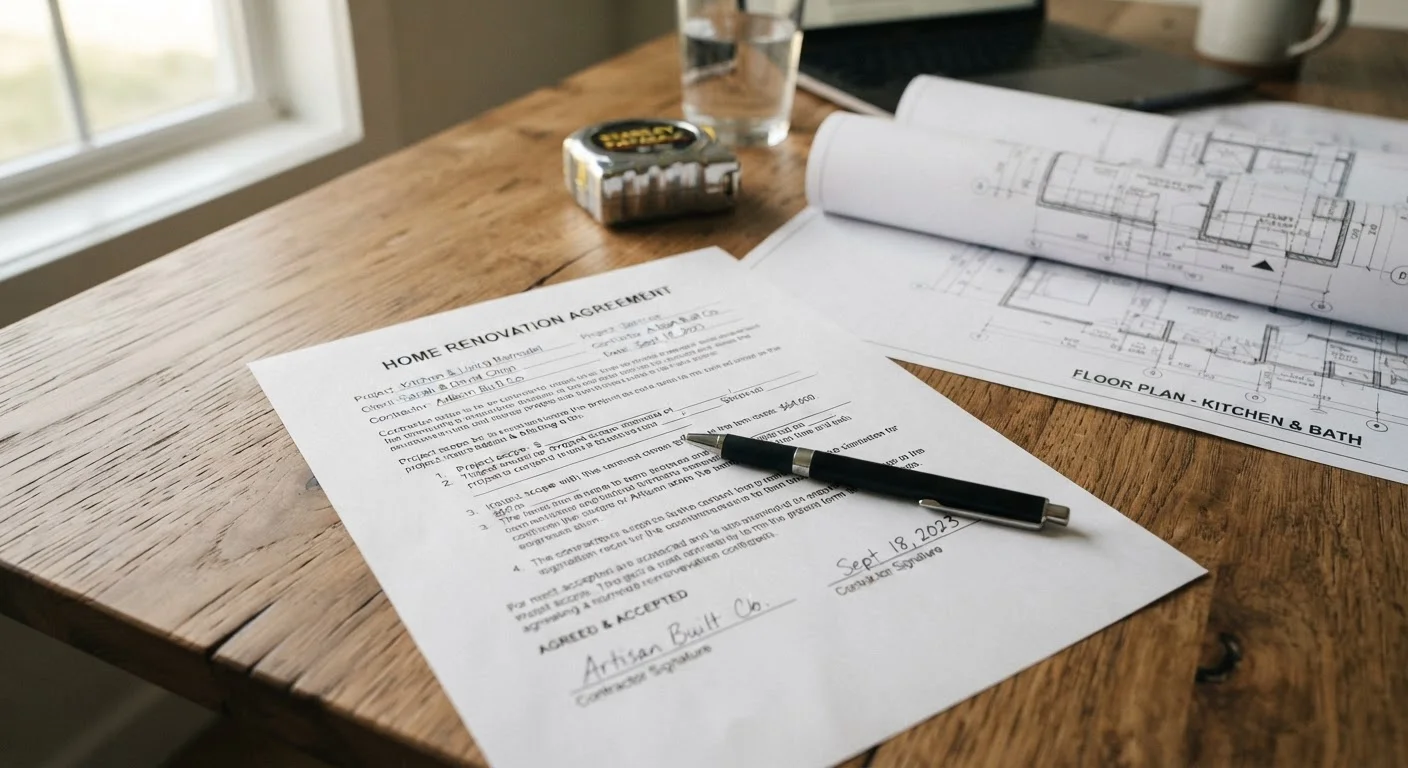
Why the Contract Is the Most Important Document in Any Renovation
Before a single wall comes down or a tile is laid, the renovation contract is already doing critical work. It defines who is responsible for what, how disputes get resolved, and what happens when something goes wrong - and in home improvement projects, something almost always goes wrong.
Many homeowners treat contracts as a formality, skimming past dense clauses to get to the start date. That's a costly habit. A vague or one-sided contract is one of the primary reasons renovations spiral over budget or end in legal conflict. See our guide to low-ball bids for how contract weaknesses often connect to suspiciously cheap estimates.
This reference covers the clauses you'll encounter in nearly every residential renovation contract and what each one actually means for you as the homeowner.
| Recommended upfront deposit | No more than 10-15% of total contract value (General industry practice; varies by state law) |
| Typical workmanship warranty | 1 year (labor); longer for specific systems (Common industry standard; confirm in writing) |
| Permit responsibility | Should be explicitly named in the contract (Required by most jurisdictions; homeowner remains liable) |
| Change orders | Must be written and signed before work proceeds (Verbal change orders are legally unenforceable in most states) |
| Lien waiver timing | Request with each progress payment; final unconditional waiver at project close (Standard practice; rules vary by state) |
Core Contract Clauses Defined
The following terms appear in the vast majority of residential renovation contracts. Knowing what they mean - and what to watch for - puts you in a far stronger position before you sign.
Scope of Work
A detailed written description of every task the contractor agrees to perform, including materials, finishes, and specific products. The more precise the scope, the less room for disputes over what was included.
Change Order
A written, signed amendment to the original contract that documents any addition, deletion, or modification to the agreed scope of work, along with its cost and schedule impact.
Mechanic's Lien
A legal claim that contractors, subcontractors, or suppliers can file against your property if they are not paid for labor or materials they provided. A lien can cloud your title and complicate any future sale or refinance.
Lien Waiver
A document signed by a contractor or supplier confirming they have been paid and waiving their right to file a mechanic's lien against your property for that payment amount.
Allowance
A budget placeholder in the contract for a specific item - such as tile or fixtures - whose exact cost is not yet determined. If your selections exceed the allowance, you pay the difference.
Retainage
A percentage of each progress payment (commonly 5-10%) that the homeowner withholds until the project reaches substantial completion, providing financial incentive for the contractor to finish all work correctly.
Substantial Completion
The point at which the project is sufficiently complete to be used for its intended purpose, even if minor punch-list items remain. This milestone often triggers the final payment obligation.
Indemnification Clause
A provision in which one party agrees to hold the other harmless from certain claims, damages, or losses. In renovation contracts, this typically means the contractor assumes liability for injuries or damage caused by their work.
Beyond definitions, pay close attention to how these clauses are worded. A scope of work that says "update kitchen" offers almost no legal protection; one that specifies cabinet model numbers, tile dimensions, and appliance cutout sizes does. The same level of specificity should apply to your payment schedule and completion milestones. For a line-by-line breakdown of how estimates translate into contract pricing, see reading a renovation estimate.
Payment Schedules, Change Orders, and Lien Waivers
Three contract provisions carry outsized financial risk and deserve special attention.
Payment Schedules
A well-structured payment schedule ties disbursements to completed milestones - not arbitrary calendar dates. Avoid contracts that request more than 10-15% upfront; large advance payments reduce your leverage if work stalls. Final payment should be withheld until all punch-list items are resolved and any required inspections are passed. Learn which projects typically require those inspections in our article on when permits and inspections are required.
Change Orders
No renovation proceeds exactly as planned. A change order is the written mechanism for authorizing and pricing any deviation from the original scope. Verbal agreements to add or remove work are legally precarious. Insist that every change - no matter how minor - be documented with a signed change order before work proceeds. This is especially important in older homes where hidden conditions frequently alter scope; see how older homes surprise contractors for context.
Lien Waivers
A lien waiver is a document in which a contractor or subcontractor waives their right to file a mechanic's lien against your property after receiving payment. Without lien waivers, a subcontractor your contractor failed to pay can place a legal claim against your home - even if you paid the general contractor in full. Request conditional lien waivers with each progress payment and unconditional waivers upon final payment.
State Laws Govern Lien Rights
Mechanic's lien rules - including filing deadlines, required notice language, and waiver validity - vary significantly by state. Some states require preliminary notices from subcontractors before lien rights attach; others do not. Consult a local real estate attorney if you're managing a large or complex project to understand the specific rules in your jurisdiction.
For a fuller picture of costs that renovation budgets often overlook - including permit fees and debris removal - see hidden renovation costs.
Dispute Resolution, Warranties, and What to Do Before Signing
Two additional clauses define your options when things go wrong after the project ends.
Dispute Resolution Clauses
Many contractor contracts include mandatory arbitration clauses, which require disputes to be resolved through a private arbitrator rather than the court system. Arbitration can be faster and cheaper, but it typically limits your ability to appeal decisions and may favor repeat industry participants. Understand what you're agreeing to before signing a contract that removes your right to sue in court.
Warranty Provisions
Warranties in renovation contracts cover two categories: workmanship (the contractor's labor) and materials (often tied to manufacturer warranties). A one-year workmanship warranty is common, though some contractors offer longer terms on specific work. Confirm what is covered in writing, what voids the warranty, and how warranty claims must be submitted. After a major renovation, an inspection can confirm whether the work holds up - see what inspectors check after a major renovation.
Before You Sign
- Have a real estate attorney review contracts for projects exceeding $25,000.
- Confirm the contractor is licensed, bonded, and insured - and request certificates of insurance naming you as an additional insured.
- Verify that the contract specifies which party is responsible for pulling permits.
- Never sign a contract with blank fields - fill or strike every line before executing.
This article provides general educational information about renovation contracts and is not legal or financial advice. Consult a licensed attorney for guidance specific to your situation and jurisdiction.