What R-Value Actually Means
Every insulation product carries an R-value - a number that measures thermal resistance, or how well a material slows heat flow. The higher the R-value, the more effective the insulation. R-values are additive: two layers of R-15 batt together yield roughly R-30.
The right target depends on where you live and which part of the home you're insulating. The U.S. Department of Energy divides the country into climate zones and publishes recommended R-value ranges for attics, walls, floors, and crawl spaces. In colder northern climates, attics typically need R-49 to R-60; in milder southern zones, R-30 to R-38 may suffice. Local building codes set minimums - verify requirements with your municipality before beginning any project.
| Fiberglass batt R-value per inch | R-2.9 to R-3.8 (U.S. Department of Energy insulation guidance) |
| Closed-cell spray foam R-value per inch | R-6.0 to R-7.0 (U.S. Department of Energy insulation guidance) |
| Cellulose loose-fill R-value per inch | R-3.2 to R-3.8 (U.S. Department of Energy insulation guidance) |
| Typical attic R-value target (cold climates) | R-49 to R-60 (DOE Climate Zones 5-8 recommendations) |
| Mineral wool batt R-value per inch | R-3.0 to R-3.3 (Industry product specifications) |
| Rigid foam board range (EPS to polyiso) | R-3.8 to R-6.5 per inch (U.S. Department of Energy insulation guidance) |
R-value alone doesn't tell the whole story. Air sealing dramatically affects real-world performance; even high-R insulation loses effectiveness if air is moving freely around it. See our guide to caulking and weatherstripping for how to address air infiltration before or alongside insulation work.
Common Insulation Materials Compared
Not all insulation is interchangeable. Each material has a distinct R-value per inch, installation method, moisture behavior, and ideal application.
R-Value
A measure of thermal resistance - how well a material resists heat flow. Higher numbers mean better insulating performance. R-values are additive when layers are combined.
Thermal Bridging
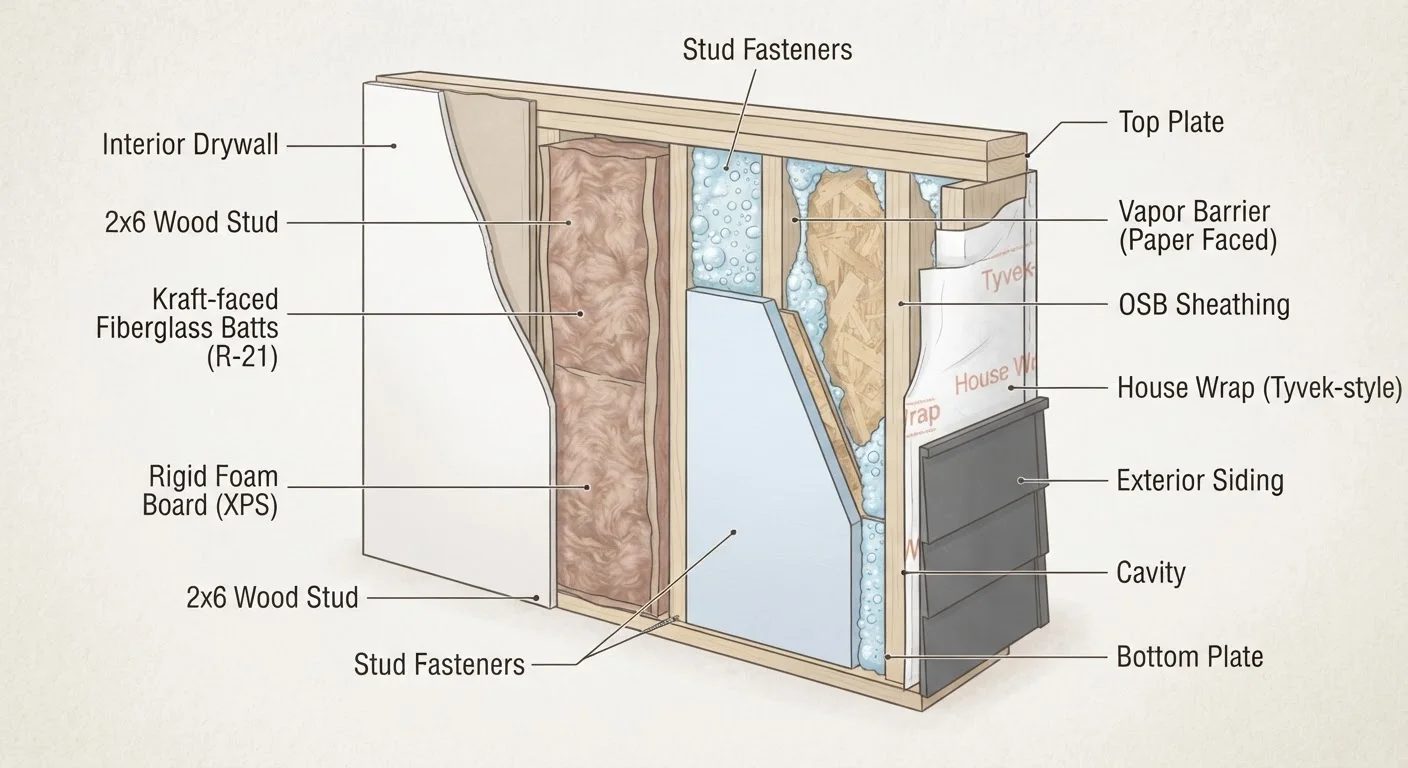
Heat loss that occurs through a more conductive material (like a wood or metal stud) bypassing the insulation layer. Continuous insulation on the exterior face of a wall reduces this effect.
Vapor Barrier / Retarder
A material that limits moisture movement through a building assembly. Closed-cell spray foam acts as a vapor retarder; required facing and placement vary by climate zone and local code.
Dense-Pack
A blown-in installation technique in which cellulose or fiberglass is packed at higher density into enclosed cavities (existing walls, for example) to reduce settling and improve air resistance.
Continuous Insulation
An unbroken insulation layer - typically rigid foam board - applied across the exterior face of wall framing to minimize thermal bridging through studs.
Climate Zone
A geographic designation used by the U.S. Department of Energy to group regions with similar heating and cooling demands, used to set insulation R-value recommendations.
Fiberglass Batts and Rolls
The most familiar insulation type, fiberglass batts fit between standard stud bays and floor joists. R-value runs approximately R-2.9 to R-3.8 per inch. Batts are widely available, relatively inexpensive, and suitable for DIY installation in open wall cavities, attic floors, and floors over unconditioned spaces. They perform best when cut precisely to fill the cavity without compression - compressed fiberglass loses R-value proportionally.
Mineral Wool (Rock Wool / Slag Wool)
Mineral wool batts offer R-3.0 to R-3.3 per inch and are denser than fiberglass, providing better sound attenuation and higher fire resistance. They hold their shape well, are less prone to moisture absorption, and are a common choice for interior walls where noise control matters alongside thermal performance.
Blown-In Loose Fill
Available in fiberglass or cellulose form, loose-fill insulation is blown into place with specialized equipment - either rented at home centers or handled by a contractor. Cellulose (made from recycled paper treated with fire retardant) delivers approximately R-3.2 to R-3.8 per inch and excels at filling irregular attic floors and retrofit wall cavities where batts can't reach. Fiberglass loose fill runs R-2.2 to R-2.7 per inch but is lighter and less prone to settling.
Spray Polyurethane Foam (SPF)
Spray foam comes in two forms. Open-cell foam (about R-3.5 per inch) is softer and vapor-permeable, suited for interior applications like rim joists and interior wall cavities. Closed-cell foam (R-6.0 to R-7.0 per inch) is rigid, highly moisture-resistant, and acts as both insulation and vapor barrier - useful in unvented crawl spaces, rooflines, and areas with high moisture exposure. Professional installation is strongly recommended for spray foam; improper mixing or ventilation poses health and safety risks.
Rigid Foam Board
Foam boards (EPS, XPS, and polyisocyanurate) range from R-3.8 to R-6.5 per inch depending on type. They're used on exterior walls under siding, in basement walls, and under concrete slabs. Because they don't need a cavity to work, they're valuable for continuous insulation - a technique that reduces thermal bridging through studs. Pairing continuous exterior insulation with a new exterior cladding project makes sense; our comparison of exterior siding materials covers compatibility considerations.
Where Each Type Belongs in Your Home
Choosing the right material is partly about R-value and partly about the physical and moisture conditions of each location.
When to Call a Professional
DIY installation of fiberglass batts and rigid foam board is generally accessible to careful homeowners. However, spray polyurethane foam requires licensed applicators due to chemical hazards during installation, and any insulation work near electrical panels, knob-and-tube wiring, or recessed light fixtures should be reviewed by a qualified electrician or contractor first. Always check whether a permit is required in your jurisdiction before beginning.
| Location | Recommended Material(s) | Notes |
|---|---|---|
| Attic floor | Blown-in cellulose or fiberglass; batts | Blown-in covers irregularities; aim for DOE-recommended R-value for your zone |
| Unvented attic / roofline | Closed-cell spray foam | Creates conditioned attic; professional installation required |
| Exterior wall cavities | Fiberglass or mineral wool batts; blown-in for retrofit | Dense-pack blown-in for existing walls without opening drywall |
| Basement walls | Rigid foam board; closed-cell spray foam | Moisture-resistant options critical; avoid unfaced fiberglass against masonry |
| Crawl space walls/floor | Closed-cell spray foam (walls); rigid foam (floor) | Encapsulation and vapor barrier often paired; consult a professional |
| Rim joists | Closed-cell spray foam; rigid foam + caulk | High-impact area for air sealing; frequently overlooked |
| Interior walls (sound) | Mineral wool batts; open-cell spray foam | Focus on sound control rather than thermal R-value |
For homeowners weighing a broader set of energy improvements, this overview of high-impact efficiency upgrades puts insulation in context alongside HVAC, windows, and air sealing.
This article is for general informational purposes only. Building codes, required R-values, and permit requirements vary by location. Consult a licensed insulation contractor or building professional before undertaking significant insulation projects, especially those involving spray foam, electrical work in wall cavities, or structural modifications.