What Each Approach Actually Does
Enrichment and obedience training are frequently lumped together under the broad umbrella of "keeping your dog stimulated," but they operate very differently. Understanding that difference helps owners use each tool in the right context.
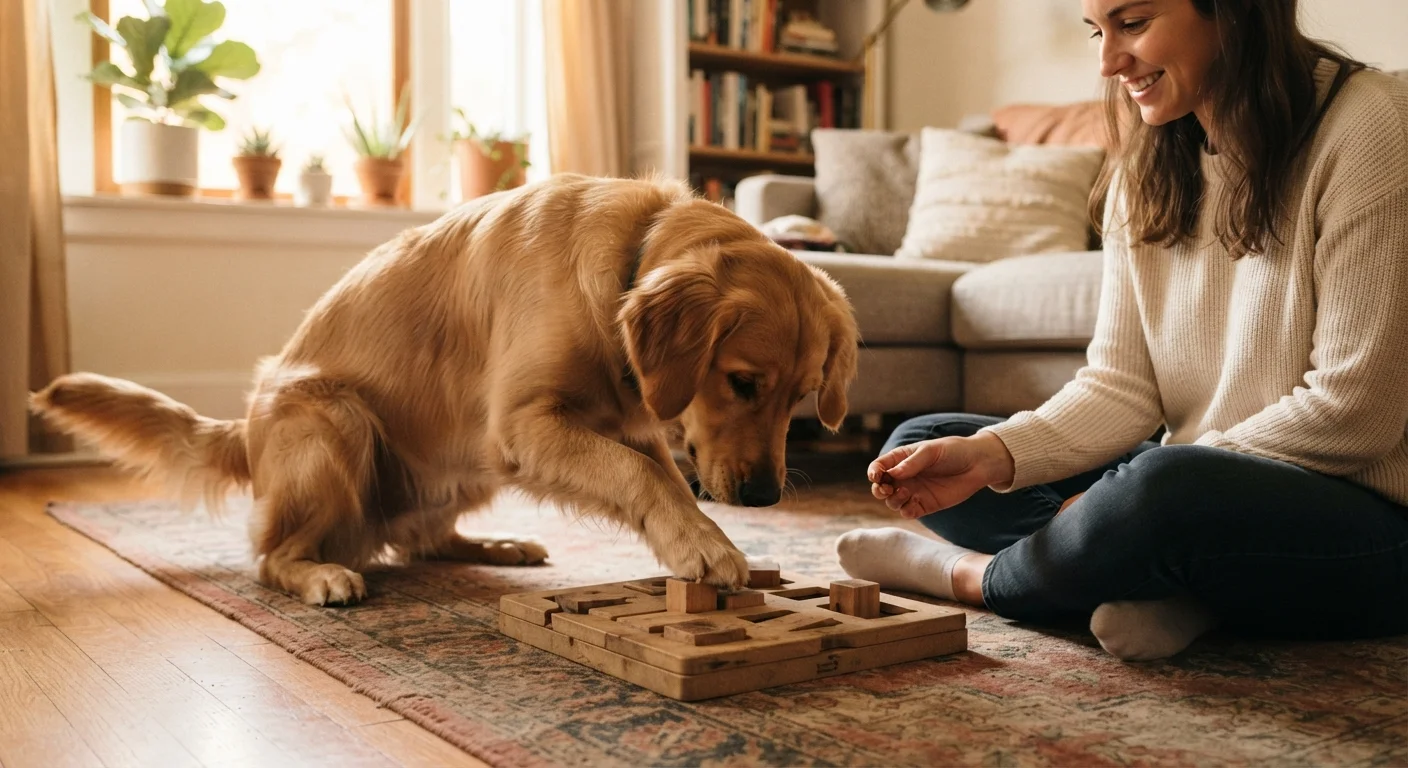
Enrichment refers to activities that engage a dog's natural drives - sniffing, foraging, exploring, chewing, and problem-solving. Its purpose is to satisfy cognitive and sensory needs that a domestic environment often under-delivers on. Enrichment activities like puzzle feeders and sniff walks give dogs an outlet for instinctual behaviors, which in turn reduces stress, boredom, and the destructive behavior those states produce.
Obedience training, by contrast, is structured communication. It teaches a dog to respond reliably to specific cues - sit, stay, come, leave it - and builds impulse control through repetition, clear criteria, and consistent reinforcement. It is inherently handler-directed, meaning the dog is learning what you want, rather than pursuing their own agenda.
Neither is a substitute for the other. Physical and mental health are deeply linked in dogs, and both enrichment and training contribute to that balance - just through different mechanisms.
| Enrichment | Obedience Training | |
|---|---|---|
| Primary goal | Satisfy cognitive and sensory needs | Build reliable responses to cues |
| Structure required | Low to moderate | Moderate to high |
| Session format | Open-ended, self-directed | Structured, handler-directed |
| Addresses boredom | Directly and effectively | Indirectly, through engagement |
| Builds impulse control | Partially, through problem-solving | Directly and consistently |
| Requires prior skills | Minimal | Grows with foundation skills |
| Examples | Puzzle toys, sniff walks, foraging | Sit, stay, recall, loose-leash walking |
How Enrichment Supports Training Outcomes
A dog that is chronically under-stimulated arrives at every training session carrying a backlog of unspent energy and frustration. That internal state competes directly with learning. Enrichment acts as a pressure valve - it addresses the dog's needs on their own terms, so the dog is neurologically calmer and more available to engage when structured work begins.
Use Enrichment as a Training Warm-Up
A five-minute sniff walk or short puzzle session before a training block can take the edge off a high-energy dog, making it easier for them to focus. Think of enrichment as burning off restless energy so the training session can be calmer and more productive. Over time, this sequence can become a reliable pre-training ritual your dog recognizes.
Scent-based enrichment deserves particular attention here. Sniffing is cognitively demanding for dogs in a way that straightforward physical exercise is not.
~10 min
Ideal daily focused training session length
Animal behavior researchers generally recommend multiple short sessions rather than extended drilling to optimize retention and motivation.
5-10x
Mental fatigue from sniffing vs. walking
Canine behavioral science suggests that 20 minutes of active scent work can tire a dog as effectively as far longer periods of physical exercise.
Enrichment also builds confidence. Dogs that regularly problem-solve through foraging games or novel objects develop a "try it" orientation toward new challenges. That mindset transfers directly into training: a dog that is comfortable experimenting is more likely to offer behaviors, recover from mistakes, and persist when a task is difficult.
How Training Reinforces the Value of Enrichment
The relationship runs both ways. Formal training builds the impulse control and attention skills that make enrichment activities more productive. A dog with a reliable "leave it" cue can be trusted with a wider variety of enrichment setups. A dog that has learned to settle on cue can transition calmly between an enrichment session and rest without becoming overstimulated.
Training also deepens the bond between dog and owner in a way that makes enrichment more meaningful. When a dog understands that engaging with you produces good outcomes - a lesson reinforced through positive, reward-based training methods - they are more likely to choose interaction over self-directed behavior, including during enrichment activities that involve the handler.
Short, consistent training sessions spaced throughout the week have a compounding effect: they keep the dog's skills sharp without mental overload, and they establish a rhythm that the dog learns to anticipate positively.
Enrichment Doesn't Replace Basic Training
A well-enriched dog may be calmer and happier, but enrichment alone won't teach a dog to come when called, walk politely on a leash, or stay when asked. Skipping foundational obedience in favor of puzzle toys and sniff walks leaves important safety and communication gaps. Both approaches need to be part of a complete care plan.
Building a Practical Daily Balance
Most dogs benefit from some form of enrichment every day and structured training several times per week. The exact ratio depends on the individual dog's age, breed drives, current skill level, and energy. A young, high-drive sporting dog may need substantially more enrichment time than a laid-back older dog.
A simple framework to consider:
- Morning: Breakfast served through a puzzle feeder or scatter-feeding in the yard (enrichment)
- Midday or afternoon: A sniff-focused walk where the dog sets the pace (enrichment)
- Evening: A 5-10 minute structured training session reinforcing current skills or introducing a new cue (training)
For households managing multiple dogs, keeping enrichment and training sessions separate per dog - at least initially - allows each animal to progress at their own pace. Managing multi-dog training requires additional planning, but the enrichment-plus-training framework applies to each dog individually.
The goal is not perfection in either category but consistent engagement across both. A dog whose cognitive needs are met and who understands how to communicate with its owner is simply easier, safer, and more enjoyable to live with.
This article is for general informational and educational purposes only. Consult a certified professional dog trainer or veterinary behaviorist for guidance tailored to your individual dog's needs.