How Compound Interest Works Against Borrowers
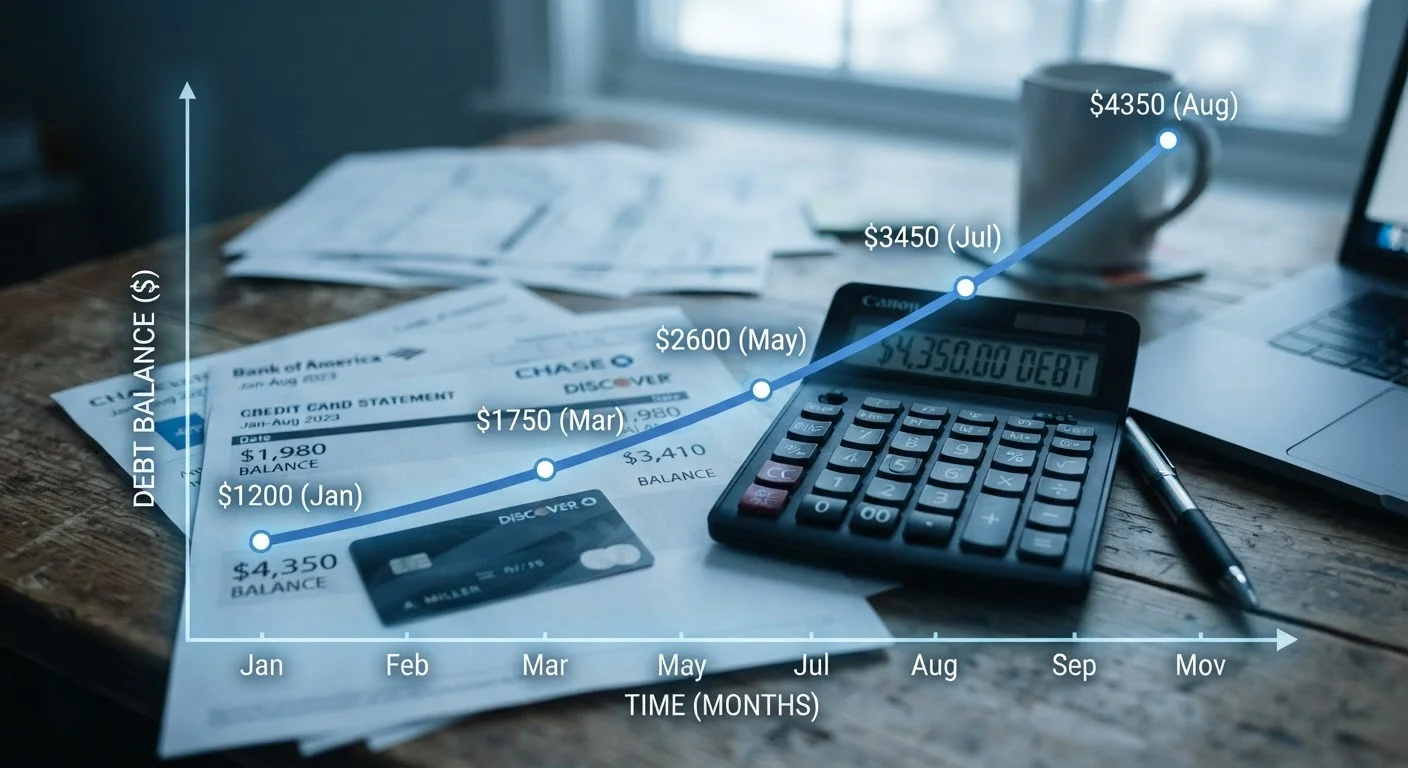
When you borrow money, interest is the cost you pay for using it. With simple interest, that cost is always calculated on your original balance. With compound interest, unpaid interest is folded back into your balance - and then that larger balance earns even more interest. Over time, this compounding cycle causes debt to grow at an accelerating pace, not a steady one.
Consider a $3,000 credit card balance at a 22% APR with no new purchases. If you made no payments, compounding alone would push that balance to roughly $3,660 within a year, and nearly $4,480 by the end of year two - purely from interest stacking on interest. The actual numbers depend on compounding frequency and your card's specific terms, but the direction is always the same: upward, and faster than most people intuitively expect.
This is why carrying a credit card balance month to month is fundamentally different from, say, a fixed car loan. As explained in our article on how amortization schedules work, installment loans follow a set payoff path. Revolving credit card debt has no such guardrail.
22%
Average credit card APR in recent years
According to Federal Reserve data, average credit card interest rates have hovered near historic highs, making compounding effects particularly steep for cardholders carrying balances.
10+ years
Repayment timeline on minimum payments alone
Consumer finance analyses consistently show that paying only the minimum on a mid-sized credit card balance can extend repayment well beyond a decade due to compounding interest.
Daily
How often most credit cards compound interest
Most major U.S. credit card issuers apply a daily periodic rate to your outstanding balance, meaning interest accrues 365 days a year on any unpaid amount.
The Minimum Payment Trap
Credit card minimum payments are not designed to get you out of debt - they are designed to keep you in debt in a financially manageable way for the lender. Minimums typically cover the interest charges for the month plus a thin sliver of principal, often 1-2% of the total balance. Paying only the minimum means your principal shrinks very slowly while interest continues compounding on a nearly unchanged base.
On a $5,000 balance at 20% APR, paying the minimum (estimated at 2% of the balance) could result in over a decade of repayment and more than $4,000 in total interest - meaning you effectively paid for the original purchases twice. If you understand how rate changes affect your debt, you'll also recognize that variable-rate cards compound this problem when rates rise.
One Simple Rule to Reduce Interest Faster
If you can only make one change, commit to paying a fixed dollar amount above the minimum each month rather than a percentage of the balance. As your balance falls, minimum payments shrink - but a fixed extra payment keeps attacking principal consistently, shortening your compounding window significantly.
Why Acting Early Makes a Measurable Difference
Compound interest on debt rewards urgency. Every dollar you pay toward principal today is a dollar that will not compound against you tomorrow. This asymmetry is the core reason financial educators consistently emphasize tackling high-interest debt before almost any other savings goal except an emergency fund.
Contrast this with how compounding works in your favor with savings. The same mechanism that punishes debt also builds wealth in savings accounts - but only when you are on the right side of the equation. Our guide on how interest compounds in savings accounts explains the flip side of this dynamic in detail.
If you are carrying multiple high-rate balances and wondering whether consolidation could help, it is worth understanding the trade-offs first. See our overview of debt consolidation pros and pitfalls for a grounded look at whether that path makes sense for your situation.
This article is for general informational purposes only and does not constitute personalized financial advice. Consult a qualified financial professional for guidance specific to your circumstances.