How the Amortization Math Works
Every fixed-rate installment loan operates on the same underlying math. The lender calculates your fixed monthly payment at origination using your loan amount, interest rate, and term. That payment stays the same every month - but the way it is divided between interest and principal changes with each payment.
Here is the core mechanic: your interest charge for any given month equals your remaining principal balance multiplied by your monthly interest rate. If you borrow $20,000 at 6% annual interest, your first month's interest charge is $20,000 × 0.5% = $100. The rest of your payment reduces the balance. Next month, you calculate interest on a slightly smaller balance, so the interest charge falls - and the principal portion rises by the same amount.
This creates the amortization curve: a gradual shift in payment composition over the life of the loan. For a 30-year mortgage, that shift can feel painfully slow in the early years. For shorter loans like a 5-year auto loan, the curve moves faster. Either way, the structure is identical.
~72%
Share of early mortgage payment going to interest
On a typical 30-year fixed mortgage in the first year, the large majority of each monthly payment covers interest rather than reducing the loan balance.
30 years
Standard US mortgage amortization term
The 30-year fixed-rate mortgage is the most common home loan structure in the United States, according to the Consumer Financial Protection Bureau.
For a deeper look at how interest compounds against you when balances stay high, see our article on what compound interest actually does to your debt over time.
Reading Your Amortization Schedule
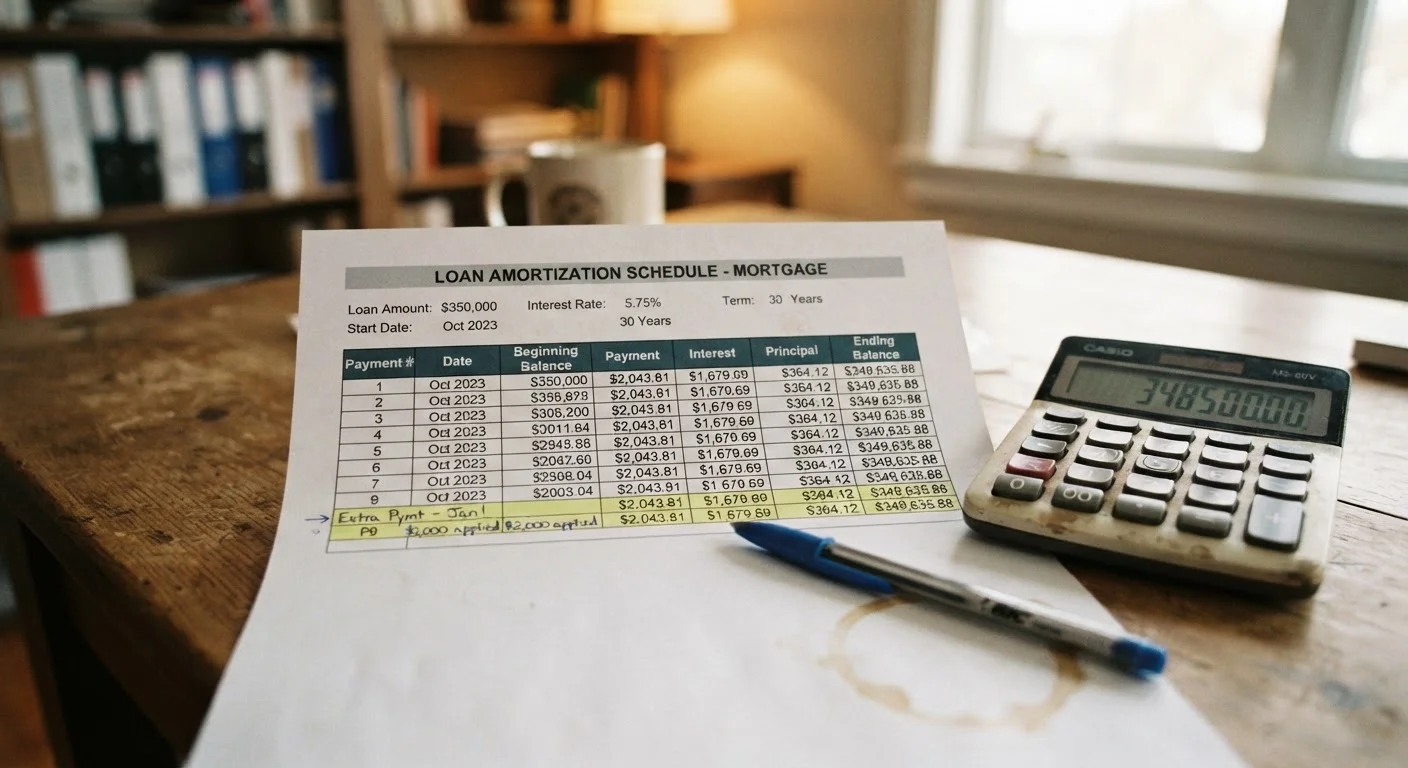
An amortization schedule is a row-by-row breakdown of every payment in your loan. Each row shows the payment number, the total payment amount, how much goes to interest, how much goes to principal, and the remaining balance. Reviewing this table is one of the most clarifying things a borrower can do.
For example, on a $300,000 30-year mortgage at 7% interest, your monthly payment would be roughly $1,996. In payment one, approximately $1,750 goes to interest and only about $246 reduces the principal. By payment 180 (year 15), those proportions have shifted considerably - but the majority of the total interest paid over the life of the loan was charged in the first half of the term.
Check Your Amortization Schedule Early
Request or generate your loan's amortization schedule as soon as you borrow. Many lenders provide this at closing, and free online calculators can produce one instantly. Seeing exactly how your payments are split - and how extra payments shift that balance - makes the strategy for paying down debt much more concrete and motivating.
Understanding the schedule also helps you evaluate refinancing decisions. Because a new loan restarts the amortization clock, refinancing into a new 30-year term - even at a lower rate - may mean paying more total interest if you are already well into your current loan. See how these dynamics play out specifically in home loans: how mortgage amortization works and why the first years feel so slow.
Why This Matters for Your Debt Payoff Strategy
Understanding amortization has practical consequences for how you approach debt. Because interest is charged on your remaining balance, any extra payment applied directly to principal produces a compounding benefit: it lowers the balance on which future interest is calculated, accelerating your payoff timeline and reducing total borrowing costs.
Even modest additional principal payments made early in a loan's life - when the balance is highest - have an outsized effect compared to the same payments made later. This is why financial educators consistently emphasize that the earlier you act on extra payments, the greater the savings.
The same logic applies across loan types. Whether you carry a car note, a personal loan, or a student loan, the amortization structure is working the same way. See how this plays out with vehicle financing in our guide on how financing a car actually works.
For a broader reference on key terms that come up when managing debt, consult our personal finance terms guide.
This article is for general informational and educational purposes only and does not constitute personalized financial or legal advice. Consult a qualified financial professional before making decisions about your specific situation.