What the Debt Snowball Method Actually Is
The debt snowball method is a debt elimination strategy popularized by personal finance educators in which you pay off balances in order from smallest to largest, regardless of the interest rate attached to each. While this differs from the mathematically optimal avalanche approach - see our comparison of both strategies for a side-by-side breakdown - the snowball prioritizes behavioral momentum over pure interest savings.
The core logic is straightforward: eliminating a small account entirely gives you a tangible win early in the process, which research in behavioral economics suggests helps people stay committed to long-term goals. The payment you were making on that closed account then rolls over - like a snowball gaining mass - onto the next debt in line, increasing the speed of payoff with each account you clear.
Before you start, you need a complete, accurate picture of what you owe. Use a self-audit checklist to compile every balance, minimum payment, and interest rate in one place.
What you will need
Step-by-Step: Running the Debt Snowball
The walkthrough below assumes you have already gathered your debt information. Work through each step in order - skipping ahead typically leads to missed details that slow your progress.
List Every Debt from Smallest to Largest Balance
Write out every outstanding debt - credit cards, medical bills, personal loans, student loans, auto loans - and sort them by current balance, lowest to highest. Set the interest rate aside for now; order is determined by balance alone. This list becomes your official payoff queue.
Example order might look like: store card ($340) → medical bill ($780) → personal loan ($2,200) → auto loan ($8,500) → student loan ($14,000).
Identify Your Minimum Payments for Every Account
Pull the minimum payment due for each debt from your most recent statement or lender portal. These amounts are non-negotiable - you must pay every minimum on every account every month, regardless of which debt is your current target. Falling behind on non-target debts damages your credit and can trigger penalty rates.
Calculate Your Available Extra Payment
Subtract all minimum payments (and all other essential monthly expenses) from your take-home income. The remainder - even if it is only $25 or $50 - is your snowball payment. This is the extra amount you throw entirely at your smallest-balance debt each month, on top of its minimum payment.
If the math leaves you with nothing extra, look for one or two variable expenses to trim temporarily: subscription services, dining out, or discretionary spending categories are common candidates.
Attack the Smallest Debt With Every Extra Dollar
Each month, pay the minimum on every debt except your target. On your target (the smallest balance), pay the minimum plus your full snowball amount. Repeat this every month without exception until that balance reaches zero.
Track the declining balance after each payment - watching the number shrink month by month reinforces the habit and surfaces any billing errors quickly.
Roll the Freed Payment Into the Next Debt
Once the smallest debt is paid off, do not absorb that payment back into your spending. Instead, add the full amount you were paying on the closed account - minimum plus extra - to the minimum payment of the next debt on your list. This is the "snowball" effect in action: each eliminated debt increases the monthly firepower applied to the next one.
If your store card minimum was $35 and your snowball was $75, you are now directing $110 per month extra at the next account, in addition to its own minimum payment.
Repeat and Review Monthly
Continue the cycle - target the next smallest balance, apply the growing snowball, eliminate the account, roll the payment forward. Each month, do a brief budget review to confirm your snowball amount is accurate and to apply any unexpected extra income. Adjust if your expenses or income have changed, but protect the snowball payment first before adding discretionary spending back.
Keep a Visual Tracker
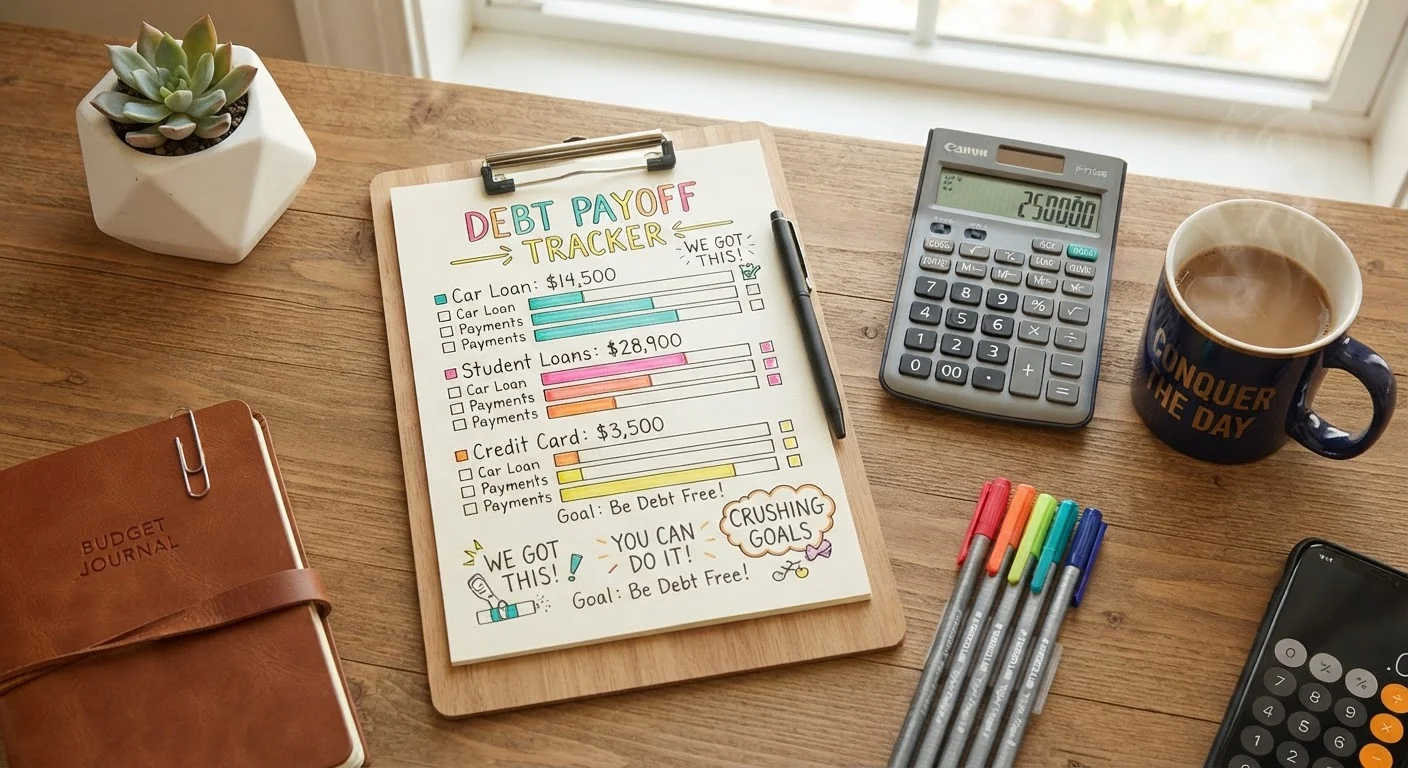
A simple paper chart or spreadsheet showing each debt's starting balance and current balance provides a powerful motivational feedback loop. Seeing balances drop - and accounts disappear entirely - makes the abstract process concrete. Many people find that visible progress is what keeps the plan running through harder months.
This article is for general informational and educational purposes only. It does not constitute personalized financial or legal advice. For guidance specific to your situation, consult a licensed financial professional.
Common Pitfalls and How to Avoid Them
Even a well-structured snowball plan can stall. The most frequent mistakes include continuing to accumulate new debt while paying down old balances - this directly offsets every dollar of progress. If minimum-only credit card payments pulled you into debt, using those same cards during the payoff period recreates the same trap.
Another common error is setting an "extra payment" amount so large that the budget collapses within weeks. Sustainable beats aggressive: a modest but consistent extra payment outlasts an ambitious one that gets abandoned. If your income is uneven, consider a foundational budgeting approach to smooth the variability before committing to a fixed snowball amount.
Finally, some people discover mid-process that their interest burden is so high that consolidation might genuinely reduce costs. Our debt consolidation explainer outlines when that trade-off makes sense and when it does not. And if you are wondering whether to pause debt payoff to build savings simultaneously, see this breakdown of balancing both goals.
Avoid Adding New Debt During Payoff
Continuing to charge new balances while running the snowball can cancel out months of progress. Try to pause discretionary credit card use for the duration of your plan. If an emergency arises and you must use credit, reassess your snowball amount immediately rather than ignoring the new balance.