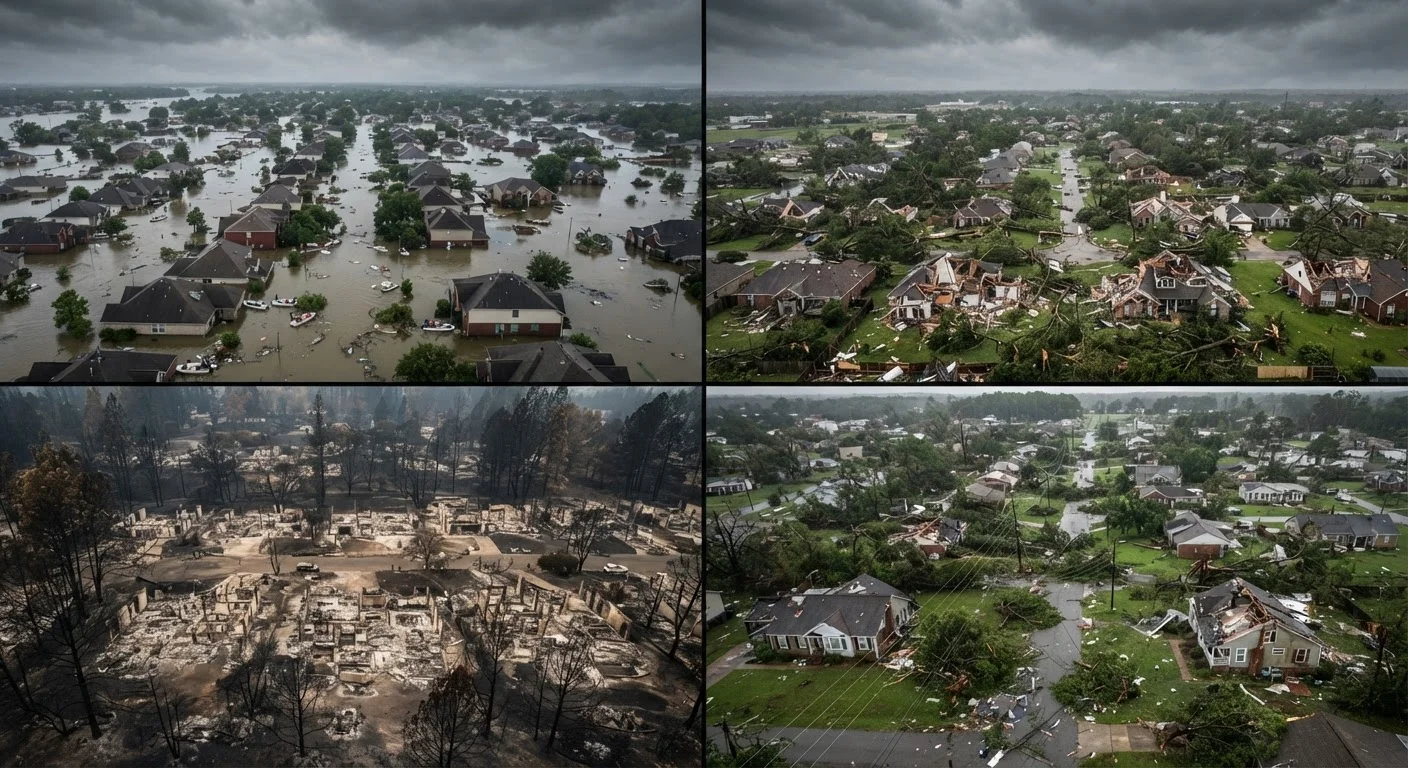
How Insurers Categorize Natural Disasters
Not all natural disasters are treated equally by insurance companies. Whether a covered loss stems from a hurricane, a wildfire, an earthquake, or a flood depends heavily on how your policy defines a covered peril - the specific cause of loss the insurer agrees to pay for. Understanding this framework is the first step to knowing where your protection ends.
Standard homeowners insurance policies (typically HO-3 forms) are written as open perils or named perils contracts. Learn how named and open perils coverage differs and what that means for your claims. Under most standard policies, some weather events are automatically covered - while others are explicitly excluded regardless of policy type.
| Flood Coverage Included in Standard Home Policy | No - requires a separate policy (FEMA / National Flood Insurance Program) |
| Earthquake Coverage Included in Standard Home Policy | No - requires a separate policy or endorsement (Insurance Information Institute) |
| Wildfire Damage Coverage | Generally yes - fire is a standard covered peril (Insurance Information Institute) |
| Wind and Hurricane Damage | Often yes, but coastal areas may have separate wind deductibles (Insurance Information Institute) |
| Auto Natural Disaster Damage | Covered under comprehensive auto coverage only (Insurance Information Institute) |
| Primary Flood Insurance Source | FEMA's National Flood Insurance Program (NFIP) or private insurers (FEMA) |
What Standard Home Insurance Typically Covers
A standard homeowners policy generally covers the following natural disaster-related losses, though exact terms vary by insurer and state:
- Wind and hail damage - including damage from tornadoes and most tropical storms, unless you live in a high-risk coastal area where a separate wind or hurricane deductible may apply
- Lightning strikes - including resulting fire damage to the structure or personal property
- Wildfire and brush fire - fire is a named peril in virtually all standard policies; this includes wildfires spreading from external sources
- Volcanic action - limited coverage for lava flow, ash, and blast is included in most HO-3 policies
- Weight of ice, snow, or sleet - structural damage from winter weather accumulation is generally covered
Even within covered perils, your policy has deductibles, coverage limits, and exclusions that affect your payout. Always read your declarations page and full policy document, not just a summary. For help decoding policy language, see the Policy Terms Explained hub.
Covered Peril
A specific cause of loss - such as fire, wind, or lightning - that an insurance policy agrees to pay for. Events not listed as covered perils (or not excluded under an open perils policy) will not trigger a claim payout.
Named Perils Policy
A policy that only covers losses caused by events explicitly listed in the policy document. If a cause of loss is not named, it is not covered.
Open Perils Policy
A policy that covers all causes of loss except those explicitly excluded. This typically provides broader protection than a named perils policy.
Flood Insurance
A separate insurance policy that covers damage caused by flooding - surface water overflow, storm surge, or heavy rain accumulation. It is not part of a standard homeowners policy.
Comprehensive Coverage
An optional auto insurance coverage that pays for vehicle damage caused by events other than collisions, including natural disasters, theft, and falling objects.
Percentage Deductible
A deductible calculated as a percentage of the insured property's value rather than a flat dollar amount. Common in earthquake and hurricane policies, it can result in a very large out-of-pocket cost before insurance pays.
What Requires a Separate Policy
Two natural disasters are excluded from nearly every standard homeowners policy and require dedicated standalone coverage:
Flood Insurance
Water damage from flooding - defined as an overflow of inland or tidal waters, or rapid accumulation of surface runoff - is not covered under standard home insurance. Flood coverage is primarily available through the National Flood Insurance Program (NFIP), administered by FEMA, or through select private insurers. This is a separate policy with its own premium and deductible. Understand the boundary between flood insurance and homeowners insurance before assuming your current coverage is sufficient.
Earthquake Insurance
Ground movement - including earthquakes, tremors, and earth shifting - is excluded from standard policies. Earthquake insurance is sold as a standalone policy or endorsement. In some states, such as California, a dedicated insurer (the California Earthquake Authority) offers these policies. Deductibles are often percentage-based rather than flat dollar amounts, which can make them substantial. See a detailed breakdown of why flood and earthquake coverage requires separate policies.
Hurricane Damage: Coverage Can Be Split
A single hurricane can cause both wind damage (typically covered by homeowners insurance) and flood damage (not covered). This means two separate claims - one under your homeowners policy and one under a flood policy - may be necessary after a storm. Coastal states often apply a separate hurricane or named-storm deductible, which is usually percentage-based and higher than a standard deductible. Check your policy declarations page for these details before hurricane season.
Natural Disasters and Other Insurance Types
Home insurance isn't the only policy affected by natural disasters. Here's how other coverage types respond:
- Auto Insurance
- Damage to your vehicle from a flood, hail, wildfire, or falling debris is covered under the comprehensive portion of an auto policy - not collision. If you carry only liability coverage, natural disaster damage to your own vehicle is not covered.
- Renters Insurance
- Like homeowners policies, renters insurance typically covers personal property damaged by fire, wind, and lightning - but excludes flood and earthquake damage to belongings. Separate riders or policies are needed for those perils.
- Life Insurance
- Life insurance pays a death benefit regardless of cause of death, including a natural disaster, as long as the policy is active and no applicable exclusions apply (such as a policy lapse).
- Travel Insurance
- If a natural disaster disrupts your trip, travel insurance may cover trip cancellation or interruption - but coverage depends on whether the event qualifies as a named peril under that policy. Explore what travel insurance coverage categories actually protect.
This article provides general insurance information for educational purposes only. Coverage terms, exclusions, and availability vary by insurer, policy, and state. Read your policy documents carefully and consult a licensed insurance professional for guidance specific to your situation.