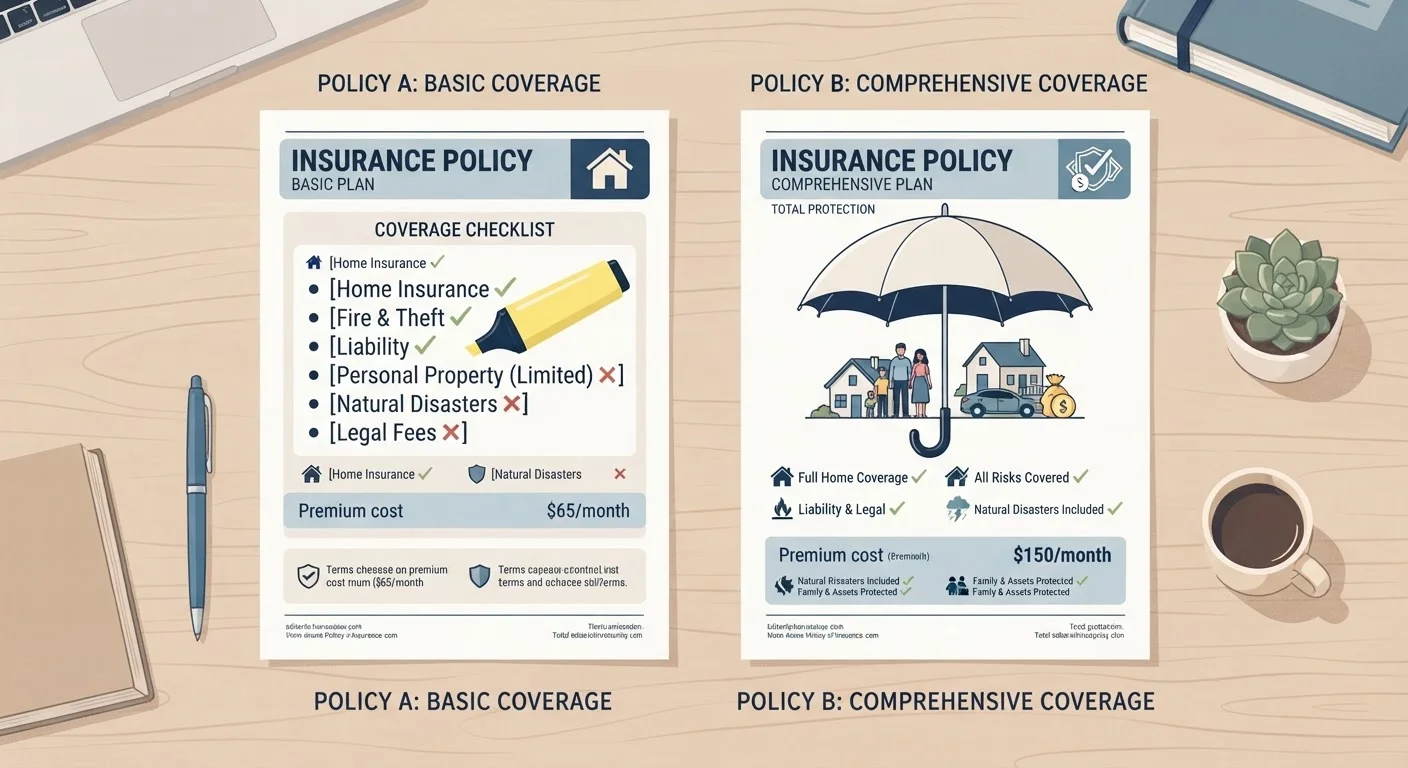
What These Terms Actually Mean
When you buy property insurance - whether for a home, renters policy, or commercial building - your policy uses one of two fundamental frameworks to define what events it will and won't pay for. These frameworks are called named perils and open perils (sometimes called "all-risk" coverage).
A peril is simply a cause of loss or damage: fire, theft, a burst pipe, a fallen tree. The difference between named and open perils coverage comes down to how your policy decides which perils trigger a covered claim.
Under a named perils policy, the document lists specific events - fire, lightning, windstorm, hail, theft, vandalism, and others - and coverage applies only when one of those listed events causes your loss. If the cause isn't on the list, the claim is denied, regardless of how significant the damage is.
Under an open perils policy, the logic is reversed: coverage applies to any cause of loss unless the policy specifically excludes it. Rather than listing what's covered, the policy lists what's not. This distinction has major practical implications, especially at claim time. See also our guide on policy exclusions and what they mean for your coverage.
Side-by-Side: How the Two Approaches Compare
The table below captures the core structural differences between named perils and open perils coverage across the factors that matter most to everyday policyholders.
| Criterion | Named Perils | Open Perils |
|---|---|---|
| Coverage trigger | Loss must match a listed peril | Loss covered unless excluded |
| Burden of proof | Policyholder proves listed peril caused loss | Insurer proves an exclusion applies |
| Typical premium | Lower | Higher |
| Breadth of protection | Narrower - defined list only | Broader - all causes except exclusions |
| Claim dispute risk | Higher - unlisted causes denied | Lower - insurer must cite exclusion |
| Common policy forms | HO-1, HO-2, some renters policies | HO-3 (dwelling), HO-5 |
| Best suited for | Lower-value property, budget-focused buyers | High-value property, broad protection seekers |
One detail that catches many policyholders off guard: the burden of proof. Under a named perils policy, you generally bear the responsibility of demonstrating that a listed peril caused the loss. Under an open perils policy, the burden typically shifts - the insurer must show that an exclusion applies in order to deny the claim. This difference can meaningfully affect how claim disputes play out.
Where Each Type Commonly Appears
Named perils coverage is common in standard renters insurance policies and in the personal property portions of some homeowners policies - particularly older HO-1 and HO-2 policy forms. Open perils coverage is the hallmark of the widely used HO-3 homeowners policy form, which covers the dwelling structure on an open perils basis while sometimes covering personal belongings on a named perils basis.
HO-5 policies - often available for higher-value homes - extend open perils coverage to both the structure and personal property, providing the broadest residential protection. Understanding which form your policy uses is not academic; it determines whether a mysterious water stain, an accidental discharge, or an unusual weather event will generate a covered claim or a denial.
The HO-3 Split: A Common Source of Confusion
Many standard homeowners policies use a hybrid approach. The HO-3 form - one of the most widely sold in the U.S. - covers the dwelling structure on an open perils basis but covers personal belongings on a named perils basis. This means a mysterious crack in your wall may be treated differently than a mysterious disappearance of a laptop. Always check which form applies to each category of property in your policy, not just to the policy as a whole.
For a closer look at how these distinctions apply specifically to home insurance forms, see open perils vs. named perils in home insurance. And because certain catastrophic events - floods, earthquakes, and some hurricane damage - are excluded even from open perils policies, understanding what requires a separate policy is equally important. Our overview of insurance coverage for natural disasters maps this terrain clearly.
Making the Right Choice for Your Situation
Neither coverage type is universally superior - the right fit depends on what you're insuring, your risk tolerance, and your budget. Named perils coverage may be entirely adequate when your primary exposures match the listed events and the property's value doesn't justify a higher premium. Open perils coverage is generally worth the added cost when you're protecting a high-value home or assets where unexpected causes of loss could generate large, uninsured losses.
A practical starting point: request a copy of your current policy's declarations page and look for phrases like "covered causes of loss" or "special form" (a common industry label for open perils) versus "broad form" or "basic form" (associated with named perils). Then review the exclusions carefully - because even open perils policies contain meaningful carve-outs that can limit recovery significantly. Our guide on coverage limits and why the amount matters is also worth reading alongside this decision, since broad coverage at an inadequate limit still leaves you exposed.
For help evaluating which coverage structure fits your needs, consult a licensed insurance agent or broker who can review your specific circumstances. This article is for general educational purposes and does not constitute personalized insurance advice. Policy terms, coverage, and exclusions vary by insurer, policy form, and state.
This article is for informational purposes only and is not a substitute for advice from a licensed insurance professional. Coverage terms, exclusions, and availability vary by insurer and by state. Always read your policy documents carefully and consult a licensed agent with questions about your specific coverage.