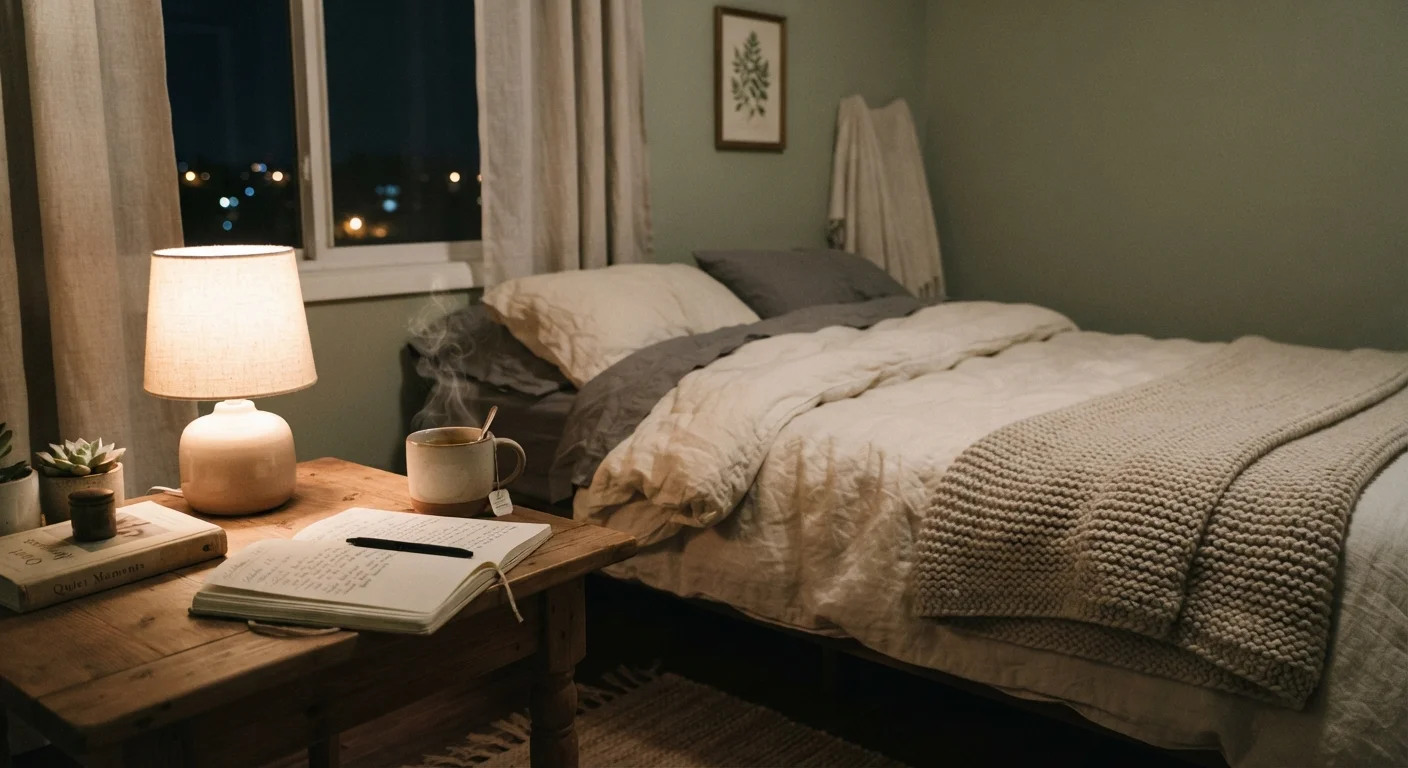
Why Your Brain Needs a Signal to Sleep
Sleep doesn't simply arrive when you lie down - it requires a physiological shift that your brain has to prepare for. Throughout the day, a chemical called adenosine builds up, creating sleep pressure, while your circadian rhythm coordinates the timing of melatonin release. When your evenings are filled with bright light, stimulating content, and mental activity, you're effectively telling your nervous system to stay on high alert - even when you're exhausted.
A wind-down routine works by creating a reliable sequence of low-stimulation cues that help your brain recognize the transition from active wakefulness to sleep readiness. Predictable daily structure has a documented calming effect on the nervous system, and this applies directly to your pre-sleep period. The goal isn't a rigid ritual - it's a flexible sequence your body learns to recognize.
What you will need
How to Build Your Wind-Down Routine
The steps below are designed to be modular - choose the elements that fit your life and layer them in gradually. You don't need all six to see results; starting with two or three and building from there is a realistic approach for most people.
Dim or warm-toned lamp
Reduces blue light exposure in the evening, supporting your body's natural melatonin production.
Journal or notebook
Used for brain-dump or gratitude writing to clear mental clutter before sleep.
Herbal tea (non-caffeinated)
Provides a soothing sensory ritual that signals the wind-down period has begun.
White noise machine or earplugs
Masks disruptive environmental sounds that can delay sleep onset.
Set a consistent wind-down start time
Choose a time 45-60 minutes before your target bedtime and treat it as a daily boundary. Set a phone alarm labeled "wind-down" if needed. The brain learns to anticipate sleep through repetition - regularity in timing is one of the strongest behavioral signals you can send your nervous system, according to general sleep health guidance from organizations such as the American Academy of Sleep Medicine.
Dim your lights and put away screens
Switch off overhead lighting and use a warm-toned or low-intensity lamp instead. Power down or place your phone, tablet, and laptop out of reach. Light - particularly short-wavelength (blue) light emitted by screens - suppresses melatonin, the hormone that helps regulate your sleep-wake cycle. Even social media browsing that feels relaxing keeps your brain in a reactive, alert state.
Do a brief mental offload
Spend five to ten minutes writing down tomorrow's tasks, unresolved worries, or whatever is occupying your mind. Research published in the Journal of Experimental Psychology found that writing a specific to-do list before bed helped participants fall asleep faster than journaling about completed tasks. The act of externalizing thoughts reduces the mental rehearsal loop that keeps many people awake.
Incorporate gentle physical relaxation
Choose one low-intensity body-focused practice: slow diaphragmatic breathing, gentle stretching, or progressive muscle relaxation (systematically tensing and releasing muscle groups from feet to face). These approaches activate the parasympathetic nervous system - often described as the "rest and digest" response - and can measurably lower heart rate and cortisol levels when practiced consistently.
Add one calming sensory anchor
Build in a single pleasant sensory experience that you associate only with wind-down: a cup of non-caffeinated herbal tea, a brief skincare routine (see evening skincare basics for ideas on simple habits to layer in), or reading a few pages of a physical book. The specific activity matters less than its consistency - over time, your brain will begin treating that cue as a sleep trigger.
Keep your sleep environment cool and dark
Before getting into bed, confirm your room conditions: most sleep researchers point to a slightly cool room temperature (roughly 65-68°F / 18-20°C) as conducive to sleep onset. Use blackout curtains, an eye mask, or white noise if your environment warrants it. These aren't luxuries - they are direct inputs to how quickly and deeply your body can transition into sleep.
Start Small and Stay Consistent
Research on habit formation consistently shows that consistency matters more than complexity. If you can commit to only one element - dimming the lights and stepping away from screens - do that every night for two weeks before adding another step. A simple routine you maintain is far more effective than an elaborate one you abandon.
If you're interested in how the quality of your sleep architecture connects to these habits, understanding sleep cycles is a useful next step. For a broader look at which common sleep hygiene practices genuinely hold up to scrutiny, see sleep hygiene habits worth keeping.
When a Routine Isn't Enough
A structured wind-down routine is a meaningful tool, but it isn't a treatment for all sleep difficulties. If you consistently struggle to fall or stay asleep despite sustained habit changes - or if you experience symptoms like loud snoring, gasping, or significant daytime impairment - those patterns may point to something beyond lifestyle factors. Recognizing when sleep problems warrant medical attention is an important part of looking after your overall health.
Don't Dismiss Persistent Sleep Problems
Behavioral changes like a wind-down routine support healthy sleep but are not treatments for sleep disorders such as insomnia disorder, sleep apnea, or restless leg syndrome. If your sleep difficulties are chronic, significantly affect your daytime functioning, or feel outside your control, speak with a healthcare provider rather than attempting to manage the situation entirely on your own.
This article is for general informational purposes only and is not a substitute for professional medical advice, diagnosis, or treatment. If you have concerns about your sleep or health, please consult a qualified healthcare provider.