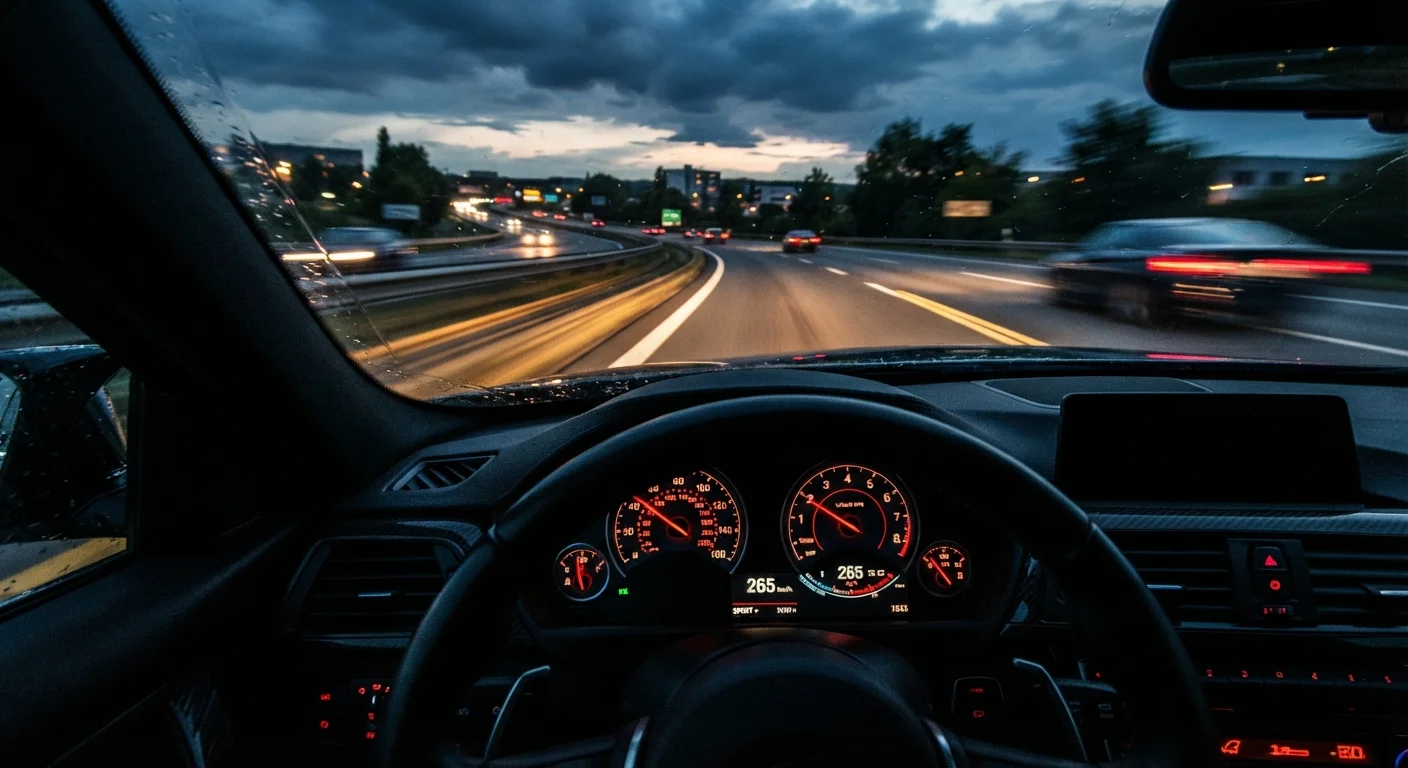
The Physics Behind the Problem
Speed transforms a manageable situation into a life-or-death calculation in less time than it takes to blink. The relationship between speed and stopping distance is not linear - it's exponential on the braking side, which is what makes high-speed driving so unforgiving.
Breaking down total stopping distance helps clarify the danger. It has two distinct phases:
- Perception-reaction distance: The ground your car covers from the moment a hazard appears to the moment your foot contacts the brake pedal.
- Braking distance: The additional ground covered while the vehicle decelerates to a stop.
At 30 mph, a typical driver needs roughly 75 feet to stop entirely. At 60 mph - just double the speed - that figure rises to over 240 feet. The braking component alone grows by a factor of four because kinetic energy, which brakes must dissipate, scales with the square of velocity. See our explainer on stopping and following distance for a full breakdown of the underlying calculations.
~154 ft
Distance traveled at 70 mph during a 1.5-second reaction
Calculated from standard physics: 70 mph equals approximately 102.7 feet per second, multiplied by 1.5 seconds of reaction time.
4x
Increase in braking distance when speed doubles
Because kinetic energy scales with the square of velocity, doubling speed from 30 to 60 mph quadruples the distance needed for the brakes to bring a vehicle to a stop.
1.5-2.5 s
Typical driver perception-reaction time range
Research on driver behavior consistently places average perception-reaction time in this range under normal conditions, with impairment and distraction extending it further.
What Your Body Is Actually Doing in That 1.5 Seconds
Human reaction time is not instantaneous. Between seeing a hazard and braking, your nervous system runs through a sequence: visual input travels to the brain, the brain interprets it as a threat, a decision is made, and a motor command is sent to your foot. That chain typically takes between 1.5 and 2.5 seconds under normal conditions.
At 65 mph, 1.5 seconds of reaction time means roughly 143 feet of road disappears beneath your tires before you even begin to slow down. At 75 mph, that same 1.5 seconds consumes approximately 165 feet. The hazard - a car braking hard ahead, a deer crossing, a child running into the street - is getting closer the entire time your body is still processing it.
Factors that stretch reaction time beyond that baseline include:
- Fatigue: Even moderate sleep deprivation slows cognitive processing measurably. Driver fatigue can impair reaction time as severely as legal alcohol limits.
- Distraction: Glancing at a phone for two seconds at 55 mph means traveling the length of a basketball court without looking at the road.
- Age: Reaction time typically lengthens with age due to changes in vision and neural processing speed. Older drivers benefit from consciously adjusting following distance to compensate.
- Alcohol and medications: Both impair the speed and accuracy of hazard recognition and motor response.
Increase Following Distance Before You Need It
Don't wait for conditions to deteriorate before adding space between you and the vehicle ahead. On highways, consider using the four-second rule rather than three - count from when the car ahead passes a fixed point to when you do. In rain, low light, or heavy traffic, extend that gap further. Space is the one resource that reliably compensates for reaction-time limitations.
Practical Implications for Everyday Driving
Understanding this physics-biology interaction has direct, actionable meaning for how you drive on public roads. A few key principles follow from the evidence:
Speed limits aren't arbitrary
Posted limits are set with stopping distance and reaction time factored into road design. Traveling above those limits doesn't just increase a fine - it shrinks the margin your vehicle and reflexes have to handle the unexpected. Speed limit laws vary by state, but the underlying physics apply everywhere.
Following distance is your primary buffer
Space between your vehicle and the one ahead is effectively a physical translation of reaction time. The commonly cited three-second rule - keeping at least three seconds of following distance - is designed to give an average driver enough room to perceive a hazard and brake. At highway speeds or in adverse conditions, extending that gap is prudent. Even small reductions in speed create meaningful reductions in required stopping distance.
High-risk behaviors compound the problem
Speeding while distracted or fatigued stacks reaction-time penalties. If your baseline 1.5-second reaction stretches to 2.5 seconds because you're tired, and you're traveling at 75 mph, you've added more than 73 extra feet of ground covered before braking begins. Everyday driving habits that seem minor individually can combine into serious risk at speed.
The core takeaway is simple: speed compresses every margin you have. The gap between a close call and a collision is often measured in feet - feet that your reaction time consumes before you can act.