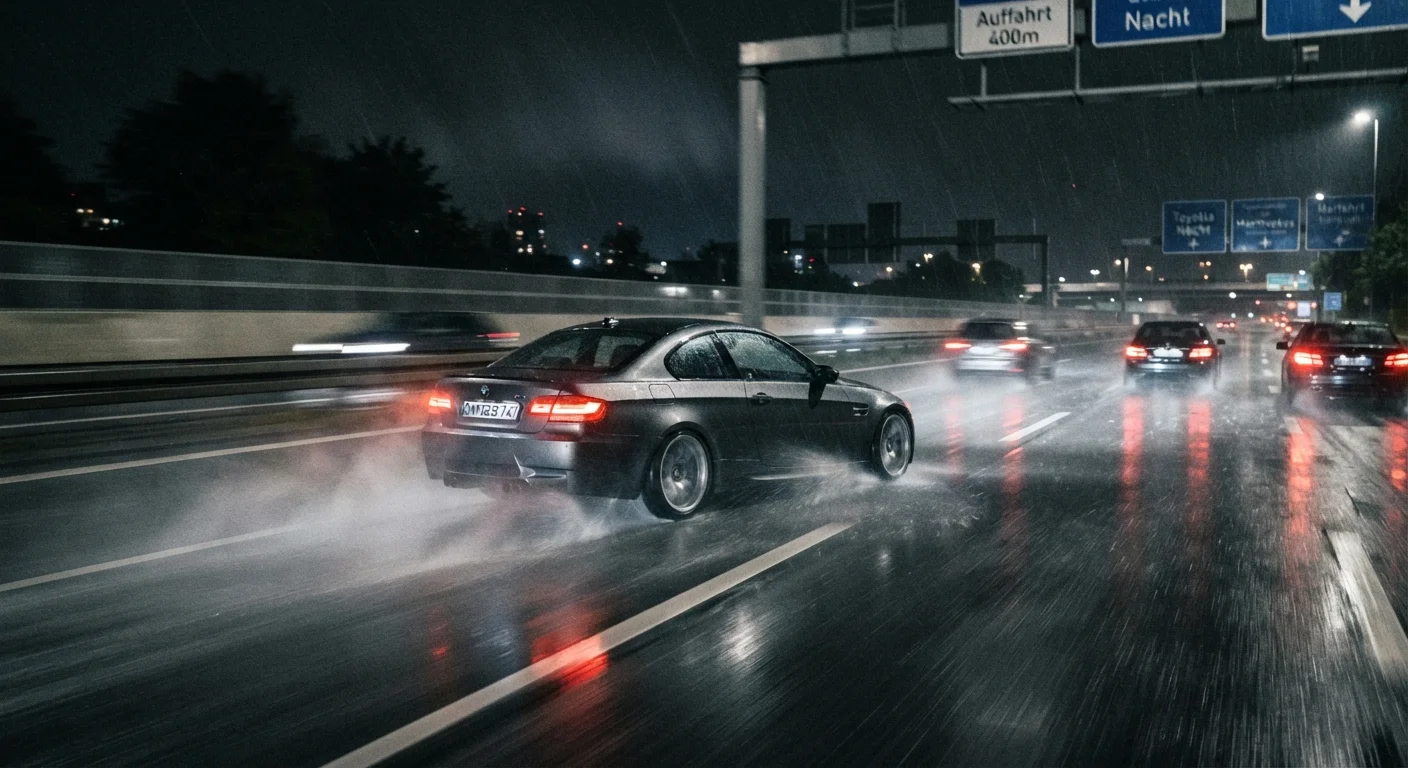
What Separates a Skid from a Spin-Out
These two terms are often used interchangeably, but they describe meaningfully different vehicle dynamics - and mixing them up leads to the wrong corrective response at exactly the wrong moment.
A skid is a condition in which one or more tires lose contact with the road surface in a functional sense - they stop rolling cleanly and instead slide. Skids generally fall into two categories:
- Understeer: The front wheels lose grip, causing the vehicle to push straight or wide rather than following the intended turn. Common in front-wheel-drive vehicles.
- Oversteer: The rear wheels lose grip, causing the rear of the vehicle to swing outward. More common in rear-wheel-drive vehicles and powerful all-wheel-drive setups.
A spin-out, by contrast, is what happens when oversteer is not corrected quickly enough - or when the vehicle experiences a sudden, complete loss of traction that causes it to rotate significantly on its axis. The vehicle is no longer traveling in any intended direction; it is simply rotating. Understanding the physics of a vehicle skid on ice can help clarify how skids escalate into spin-outs when not caught early.
| Criterion | Skidding | Spinning Out |
|---|---|---|
| Definition | One or more tires lose rolling traction | Vehicle rotates significantly off intended path |
| Severity | Partial loss of control | Full rotational loss of control |
| Most common trigger | Excessive speed in a turn, wet or icy road | Uncorrected oversteer or sudden traction loss |
| Primary driver correction | Steer into slide or ease off throttle | Counter-steer, look at exit point, delay braking |
| Role of braking | Avoid hard braking; gradual reduction is safer | Do not brake until rotation stops |
| Electronic stability control impact | ESC actively helps reduce understeer/oversteer | ESC may intervene but cannot always prevent spin |
| Recovery window | Wider - catches early if inputs are correct | Narrow - requires fast, calm response |
How to Respond to a Skid
The key to skid recovery is matching your correction to the type of skid - not simply reacting with instinct, which is often wrong.
Responding to Understeer
When the front wheels are sliding wide, your instinct may be to steer harder. Resist it. Additional steering input adds more demand to tires that already can't deliver. Instead:
- Ease off the throttle smoothly - do not brake suddenly.
- Straighten the steering wheel slightly to reduce the angle the front tires are asked to grip.
- Once you feel front traction returning, gradually re-apply your intended steering direction.
Responding to Oversteer
When the rear slides outward, the classic instruction is to "steer into the skid" - meaning, turn the wheel in the direction the rear is moving. If the rear is swinging left, steer left.
- Apply small, smooth counter-steering corrections - overcorrection creates a pendulum effect.
- Ease off the throttle but avoid hard braking, which can lock the rear and worsen the slide.
- As the vehicle straightens, gently unwind your counter-steer to avoid triggering a second skid in the opposite direction.
Tire condition is a major factor in how quickly grip returns. Tire compound and tread pattern significantly affect how a vehicle behaves during traction loss events - something worth reviewing before winter arrives.
~17%
Crashes on wet pavement annually in the U.S.
According to Federal Highway Administration data, approximately 17% of all vehicle crashes occur on wet road surfaces each year.
25%
Crashes linked to adverse weather and road conditions
The FHWA estimates roughly one in four crashes involves weather-related road conditions, including rain, ice, and snow.
~40%
Reduction in spin-out risk with ESC-equipped vehicles
Research from NHTSA found electronic stability control significantly reduces the risk of fatal single-vehicle rollovers and loss-of-control crashes.
How to Respond to a Spin-Out
A spin-out is a more advanced loss of control, and the response changes accordingly. By the time a vehicle is rotating more than roughly 45 degrees off its intended path, the priority shifts from traction recovery to rotation arrest.
The key steps in a spin-out:
- Look where you want to go. This sounds simple but is neurologically important - your hands tend to follow your eyes. Fix your gaze on your intended exit point, not on the hazard you're trying to avoid.
- Apply smooth counter-steering. Turn the wheel in the direction the nose of the vehicle needs to go to re-align with your intended path. Avoid jerky or excessive inputs.
- Hold off on braking. Braking during active rotation typically locks wheels and extends the spin. Wait until the vehicle is approaching a straight orientation before applying the brakes.
- Use gentle throttle if appropriate. In rear-wheel-drive vehicles, a small throttle application can help pull the front of the car around - but this is a nuanced technique that requires experience.
Once the spin-out is arrested, assess your surroundings immediately and signal or steer to safety. Hydroplaning can trigger a spin-out on wet roads in a similar fashion - the same principles of calm, smooth inputs apply. Always have your brakes properly maintained; worn brakes can make recovery harder. Signs your brakes need attention before a skid situation arises is worth knowing.
Electronic Stability Control: Helpful, Not Infallible
Most vehicles sold in the U.S. since 2012 are required to include Electronic Stability Control (ESC), which can automatically apply individual wheel brakes and reduce engine torque to help counter skids. However, ESC has physical limits - it cannot overcome excessive speed, severely degraded tires, or extreme road conditions on its own. Understanding manual recovery techniques remains valuable even in ESC-equipped vehicles. Consult your owner's manual to understand how your specific system functions.