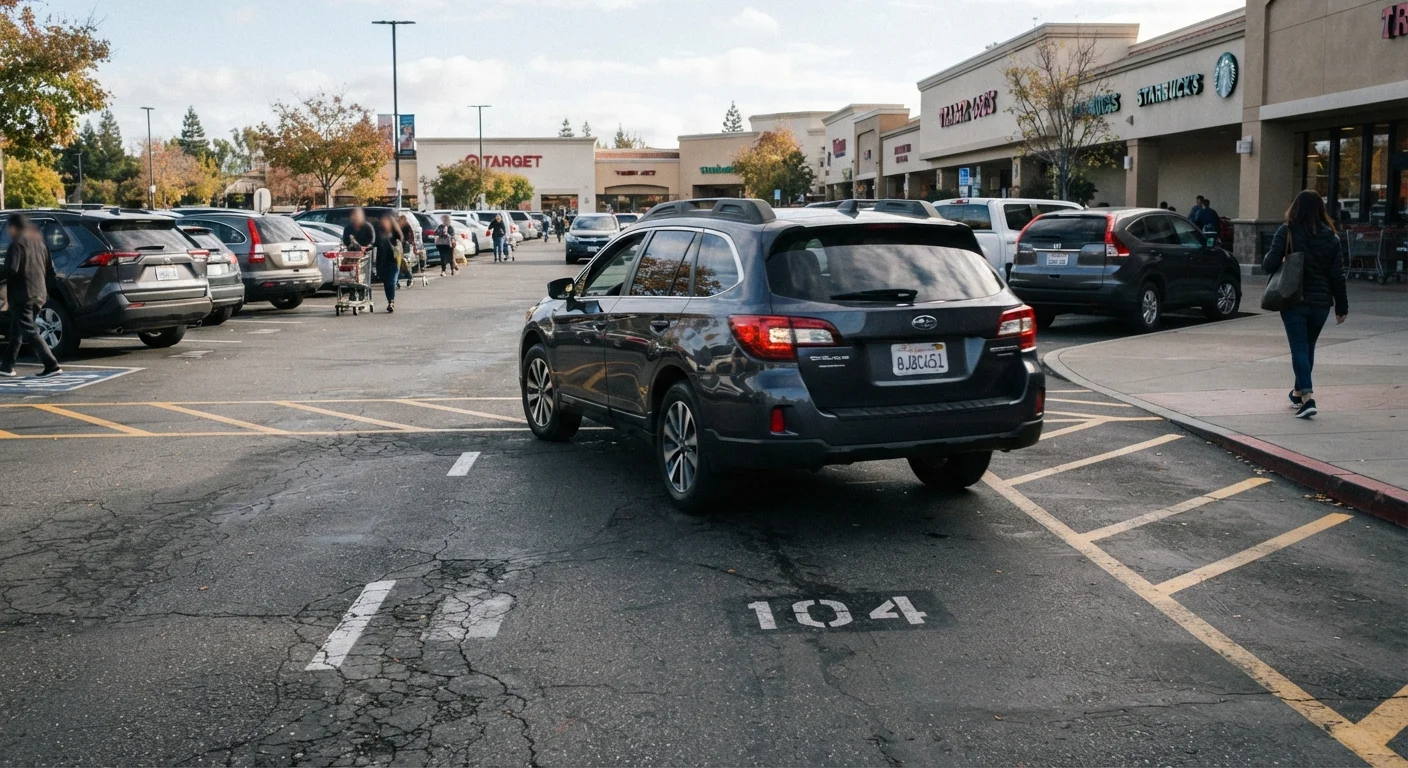
Why Reversing Is Riskier Than It Looks
Reversing feels routine - a short, slow movement we perform dozens of times a week. But that familiarity is precisely what makes it dangerous. Because backing speeds are low and distances are short, drivers tend to under-invest in attention and technique. The result is a category of crash that is remarkably common yet almost entirely preventable.
Research from the National Highway Traffic Safety Administration (NHTSA) has consistently found that backing collisions cause thousands of injuries and fatalities annually in the United States, with a significant share involving pedestrians - particularly young children and older adults - who enter the blind zone behind a vehicle without the driver knowing. Parking lots concentrate many of these hazards in one space, but driveways, residential streets, and loading areas carry similar dangers.
Understanding exactly where technique breaks down is the first step toward backing up safely every time.
~500
Annual U.S. backover fatalities
NHTSA research has estimated that backing crashes kill approximately 500 people and injure tens of thousands more in the United States each year.
31%
Backover victims who are children under 5
NHTSA data has indicated that young children are disproportionately represented among backover fatalities due to their small stature and low visibility in vehicle blind zones.
~70 ft
Typical blind zone length behind a full-size SUV
Consumer vehicle testing has found that the rearward blind zone for larger SUVs and trucks can extend up to approximately 70 feet before the camera or mirrors capture movement.
The Most Common Reverse Maneuver Mistakes
The errors below account for the vast majority of backing incidents. Each is predictable, and each is correctable.
Relying solely on the rearview camera without physically checking mirrors or turning to look.
Why it happens: Backup cameras have become so ubiquitous that many drivers treat the screen as a complete picture of what's behind the vehicle, forgetting its inherent field-of-view limitations.
Backing out of a parking space without pausing at the edge to check for cross-traffic.
Why it happens: Drivers focus on clearing the adjacent parked vehicles and assume the travel lane behind them is clear, when in fact that lane may have pedestrians or moving cars approaching from outside the camera's view.
Reversing at too high a speed to stop quickly if a hazard enters the path.
Why it happens: Low-speed maneuvers feel inherently safe, so drivers apply the same light braking pressure they would use when cruising, not accounting for how fast a child or cyclist can enter a blind zone.
Failing to account for the vehicle's rear overhang and swing arc during a reversing turn.
Why it happens: Most drivers learn the turning radius of the front of their vehicle but underestimate how far the rear corners swing outward during a tight reverse turn.
Skipping a walk-around inspection before reversing in unfamiliar or obstructed environments.
Why it happens: Drivers in familiar locations - their own driveway, their regular parking spot - develop routine assumptions and stop physically checking the space behind the vehicle before reversing.
Pulling forward into a space and then reversing out into a busy traffic lane rather than backing in first.
Why it happens: Pulling straight into a parking space is faster and feels more natural, so most drivers default to it despite the fact that reversing out into traffic is statistically the higher-risk move.
These same attentional failures show up in other low-speed environments. Our guide on driving habits that quietly increase crash risk covers how routine complacency compounds across the full driving cycle.
Technology Helps - But Has Real Limits
Rearview cameras are now federally mandated on all new passenger vehicles sold in the United States, and parking sensors and rear cross-traffic alerts are increasingly standard. These tools genuinely reduce backing crashes - NHTSA data suggest rearview cameras are associated with meaningful reductions in backover incidents. But drivers who treat camera screens as a substitute for physical checks often create new blind spots in the process.
Backup Cameras Don't Cover Every Angle
Standard rearview cameras typically display a 130-160 degree field of view, which can miss objects directly beneath the bumper or far to the side. Sensors may fail to alert drivers to slow-moving or stationary objects in certain conditions. Always supplement camera feeds with mirror checks and a direct over-the-shoulder look before committing to any reverse movement.
Camera lenses have a fixed field of view that may not capture objects close to the bumper or at extreme angles. Sensors can be defeated by rain, dirt, or extreme temperatures. A child moving quickly can enter the frame after you've already committed to the maneuver. The correct approach is to use technology as a supplement to - not a replacement for - mirror checks and a deliberate over-the-shoulder look before and during any reverse movement.
This layered approach to spatial awareness mirrors what safe drivers apply at higher speeds. For context on how gap estimation and space management work in other situations, see our piece on what the two-second rule gets wrong about safe following distance.
Building Better Reverse Habits
Improving your backing technique doesn't require special equipment or professional training. It requires deliberate repetition of a handful of habits until they become automatic.
- Walk around the vehicle before getting in when you know you'll need to reverse in a constrained space - driveways, tight parking spots, or backing out of a garage.
- Adjust mirrors before moving. Your side mirrors should show a thin sliver of your vehicle's rear quarter panels and maximize the view of the surrounding lane.
- Keep both hands on the wheel and turn your torso to look over your right shoulder for the primary rearward view, supplementing with mirror scans continuously.
- Move at a walking pace or slower. If your foot isn't on the brake, you're likely moving too fast to react to a sudden hazard.
- Back into spaces whenever practical. Pulling forward out of a space is dramatically safer than reversing into moving traffic.
These same principles of deliberate spatial management apply whenever you're navigating complex traffic environments. Our coverage of roundabouts vs. traditional intersections illustrates how structured movement patterns reduce conflict points - a concept equally relevant to reverse maneuvers.
Back In Whenever the Environment Allows
Backing into a parking space or driveway - rather than pulling forward in and reversing out - is one of the single most effective changes a driver can make to reduce backing collision risk. Your exit becomes a forward move into a space you can fully see. Fleet safety programs and driver-training organizations consistently recommend this practice for exactly that reason.