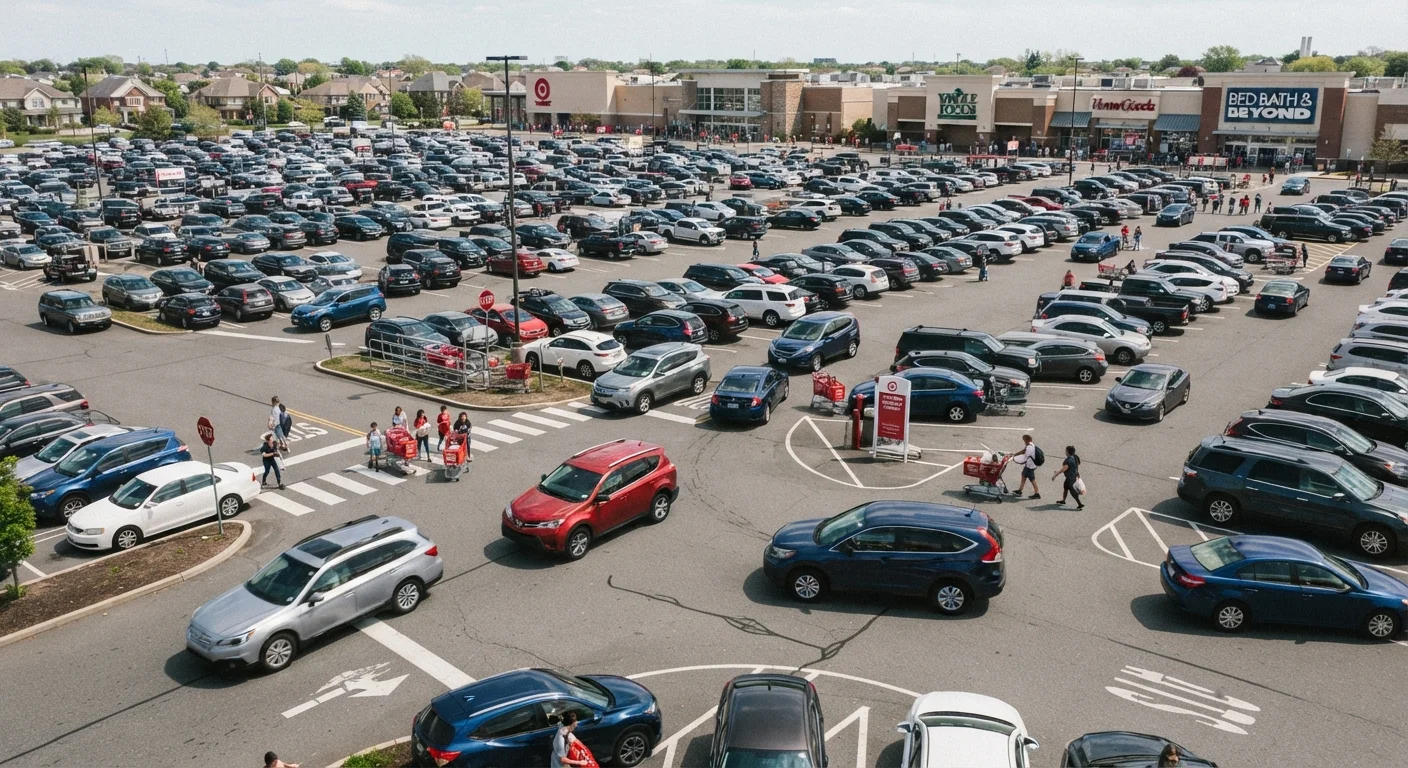
Why Parking Lots Breed Collisions
It seems counterintuitive: a space where cars travel at 5-15 mph produces more fender-benders, pedestrian near-misses, and property damage events than many high-speed roads. Yet parking lots are genuinely hazardous environments, and the reasons are structural.
Parking facilities concentrate vehicles moving in multiple, often unpredictable directions within a confined space. Lanes are narrow, sightlines are blocked by parked vehicles and SUVs, and the rules of the road - yielding, right-of-way, lane discipline - are loosely defined or ambiguously marked. Pedestrians of every age share the same pavement as moving cars, frequently stepping between vehicles without looking.
Driver psychology compounds the physical layout. Many motorists mentally "arrive" the moment they pull into a lot and relax their vigilance before they've actually parked. That false sense of being done driving leads to phone checking, reduced mirror use, and faster-than-appropriate speeds.
~20%
Of all vehicle accidents occur in parking lots
Industry estimates consistently place roughly one in five vehicle collisions in parking lot and garage environments, according to data cited by the National Safety Council.
50,000+
Injuries in U.S. parking lots annually
The National Safety Council has reported that parking lot and garage incidents injure more than 50,000 people in the United States each year.
Understanding these dynamics is the first step toward navigating them safely. The mistakes below represent the most common failure points - and each one is correctable.
Common Mistakes That Lead to Parking Lot Accidents
Driving too fast for the space.
Why it happens: Drivers unconsciously apply road-speed habits to parking lots, treating internal lanes like low-volume streets rather than shared pedestrian spaces.
Backing out of a stall without a full check of the travel lane.
Why it happens: Drivers rely primarily on mirrors or a single glance, missing pedestrians and cyclists in blind spots that open as the vehicle swings out.
Using a phone or in-vehicle screen while navigating the lot.
Why it happens: Many drivers view parking lots as low-stakes zones where it's acceptable to check directions, texts, or apps before fully stopping.
Failing to yield to through-traffic in main parking lanes.
Why it happens: The right-of-way hierarchy in parking lots is not always intuitive: vehicles in main travel lanes generally have priority over those leaving stalls, but this rule is poorly understood.
Parking or idling in fire lanes and designated no-stop zones.
Why it happens: Drivers stopping briefly for drop-offs or pickups treat fire lanes as a convenience when adjacent spaces are full, blocking sightlines and creating hazards for other drivers.
Cutting across empty parking rows rather than using marked travel lanes.
Why it happens: When a lot is partially empty, diagonal shortcuts seem harmless and save a few seconds.
For a deeper look at one of the most accident-prone maneuvers in any lot, see our guide to reversing safely, which covers the specific techniques that break down most often during reverse maneuvers.
Protecting Pedestrians in Parking Environments
Pedestrians face heightened risk the moment they step out of a vehicle. Children are especially vulnerable - they move unpredictably, are difficult to see over hoods and cargo doors, and may dart between parked cars without warning. Elderly pedestrians may move slowly across travel lanes and can be caught off guard by vehicles turning through unmarked areas.
Children Are Hardest to See
A child can disappear entirely from a driver's view within a few feet of the vehicle's rear bumper. Before reversing, physically walk around the rear of your vehicle if children are present nearby. Backup cameras help but do not eliminate blind zones close to the bumper - always verify visually.
Drivers should treat every parking lot pedestrian crossing as they would a marked crosswalk, even when no painted lines exist. Slowing to a near-stop at the ends of parking rows before entering a travel lane gives both the driver and any approaching pedestrian time to react. This principle applies equally when cyclists use lot access roads - the same shared-space rules that apply on public streets carry over. Our article on sharing the road with cyclists and pedestrians explains those dynamics in full.
One practical habit: after parking and before opening your door, scan both mirrors and glance over your shoulder for anyone passing on foot or by bike. A door strike is a collision regardless of where it happens.
Low Speed Does Not Mean Low Consequence
A collision at 10 mph can still cause whiplash injuries, costly vehicle damage, and insurance rate increases. Leaving the scene of a parking lot collision - even a minor one - without exchanging information can constitute a hit-and-run under many state laws. Always stop, document the incident, and notify your insurer promptly.