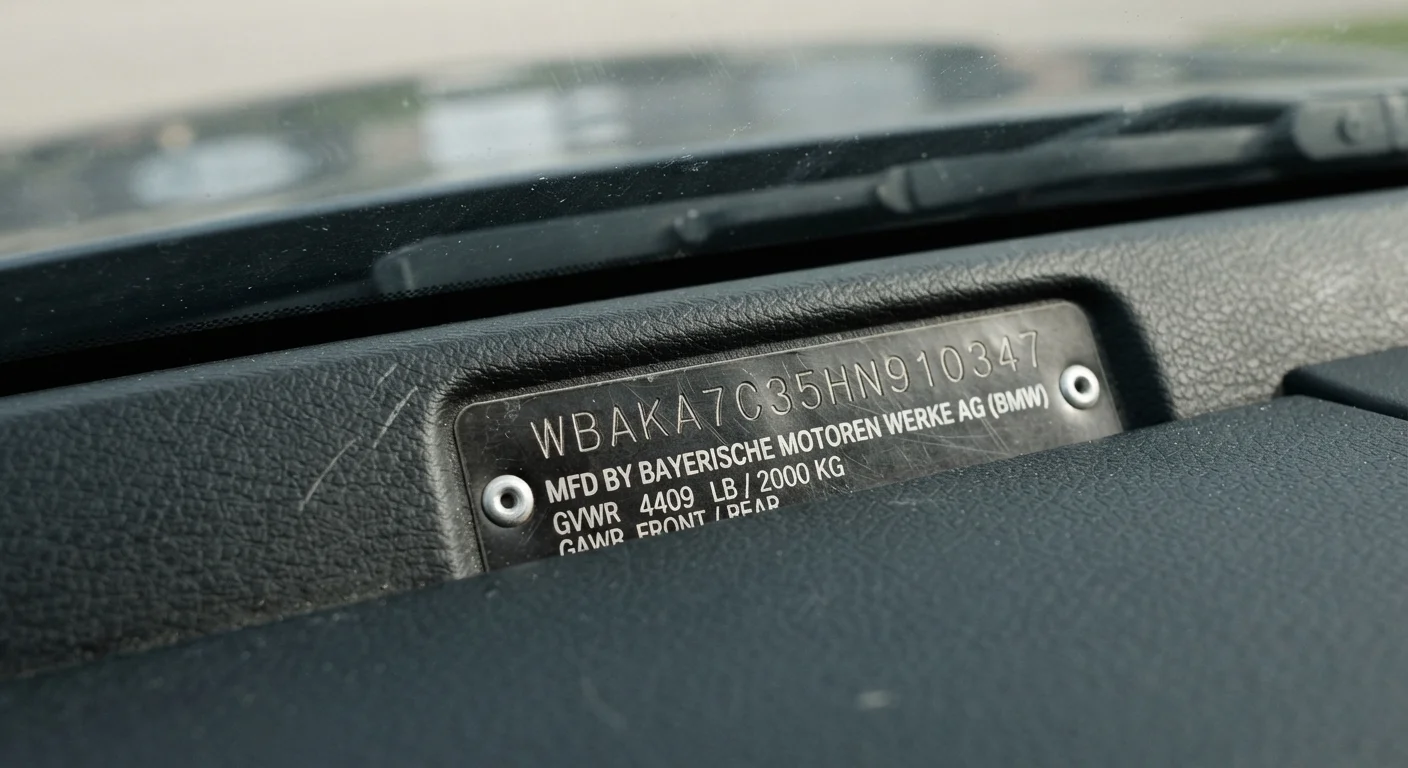
What a VIN Is and Where to Find It
A Vehicle Identification Number (VIN) is a unique 17-character code assigned to every motor vehicle manufactured for sale in the United States since 1981. Think of it as a vehicle's fingerprint - no two vehicles in operation share the same VIN. The National Highway Traffic Safety Administration (NHTSA) standardizes the format, ensuring that every character carries a defined meaning regardless of make or origin.
You can find a vehicle's VIN in several places:
- Dashboard (driver's side): Visible through the windshield at the base of the windshield frame - the most accessible location.
- Driver's door jamb: On a sticker or metal plate when you open the front door.
- Vehicle title and registration documents: Printed on all official paperwork.
- Insurance cards and policy documents.
- Engine block and firewall: Stamped directly onto the vehicle structure for theft-deterrence purposes.
When researching any used vehicle, confirming that the VIN matches across these locations is a basic but important consistency check. Mismatches can signal tampering or title fraud. See our guide to title transfers for how VINs appear in official ownership paperwork.
| VIN Length | 17 characters (NHTSA standard, mandatory since 1981) |
| Characters Used | Letters A-Z (excluding I, O, Q) and digits 0-9 (ISO 3779 / FMVSS 115) |
| Model Year Position | Character 10 |
| Country of Assembly | Encoded in Character 1 |
| Recall Lookup | Free via NHTSA's official VIN tool (nhtsa.gov) |
| Governing Standard | ISO 3779 / U.S. FMVSS 115 |
How to Decode Each Section of a VIN
The 17 characters are divided into three functional groups, each encoding distinct information about the vehicle's origin and specifications.
VIN
Vehicle Identification Number - a standardized 17-character alphanumeric code uniquely identifying every motor vehicle. Each character position carries specific information about origin, specifications, or sequence.
World Manufacturer Identifier (WMI)
The first three characters of a VIN, which identify the country of final assembly and the manufacturer. Assigned and maintained by the Society of Automotive Engineers (SAE).
Check Digit
The ninth character of a VIN, calculated mathematically from the other 16 characters. It allows automated systems to detect transcription errors or forged VINs.
Title Brand
A permanent notation on a vehicle's title indicating significant history such as salvage, flood damage, or odometer rollback. Title brands are tied to the VIN and follow the vehicle through ownership changes.
Vehicle Indicator Section (VIS)
Characters 10 through 17 of the VIN, encoding the model year, assembly plant, and the vehicle's unique sequential production number within that plant.
Characters 1-3: World Manufacturer Identifier (WMI)
The first character identifies the country of final assembly. For example, codes beginning with 1, 4, or 5 indicate the United States; 2 indicates Canada; 3 indicates Mexico; J indicates Japan; W indicates Germany. The second and third characters together identify the specific manufacturer and vehicle type.
Characters 4-8: Vehicle Descriptor Section (VDS)
These five characters describe the vehicle's attributes - body style, engine type, restraint systems, and model. The exact meaning of each position varies by manufacturer, which is why a VIN decoder tool (available through NHTSA's free public database) is more reliable than manual interpretation for this section.
Character 9: Check Digit
This single character is calculated using a mathematical formula applied to the other 16 characters. Its purpose is error-detection: a valid VIN will always produce a predictable check digit. Online VIN validators can confirm this instantly.
Characters 10-17: Vehicle Indicator Section (VIS)
Character 10 encodes the model year using a letter or number (for example, K = 2019, L = 2020, M = 2021). Character 11 identifies the manufacturing plant. Characters 12-17 form the unique sequential production number assigned to each individual vehicle on the assembly line.
Once you have a VIN decoded, pairing it with a history report is the logical next step - our guide to reading vehicle history reports explains what each section of those reports actually means.
How to Use a VIN When Researching a Vehicle
The VIN is the key that unlocks a vehicle's documented history. Federal law requires manufacturers to maintain records tied to each VIN, and several public and commercial databases aggregate this information.
- NHTSA recalls: Enter a VIN at NHTSA's official recall lookup tool to see whether any open safety recalls affect that specific vehicle - and whether they have been completed.
- Vehicle history reports: Services that compile accident records, odometer readings, title brands (such as salvage or flood), and ownership history all use the VIN as the primary index. Learn what each flag means in our vehicle history report explainer.
- Insurance and financing: Lenders and insurers use the VIN to verify the vehicle's exact specifications before approving a loan or issuing a policy.
- Warranty verification: Manufacturers track warranty coverage, service campaigns, and technical service bulletins by VIN.
High mileage combined with a clean VIN history paints a very different picture than low mileage with a salvage title - our article on what mileage really tells you explores how to weigh these factors together. For a broader view of vehicle ownership documentation, see the Complete Guide to Vehicle Ownership.
This article is for general informational and educational purposes only. Always verify vehicle information through official sources and consult qualified professionals when making purchasing or legal decisions involving a vehicle.