How Each Channel Works
Buying a vehicle at auction and buying from a dealership are fundamentally different transactions - not just in price, but in process, protection, and pace.
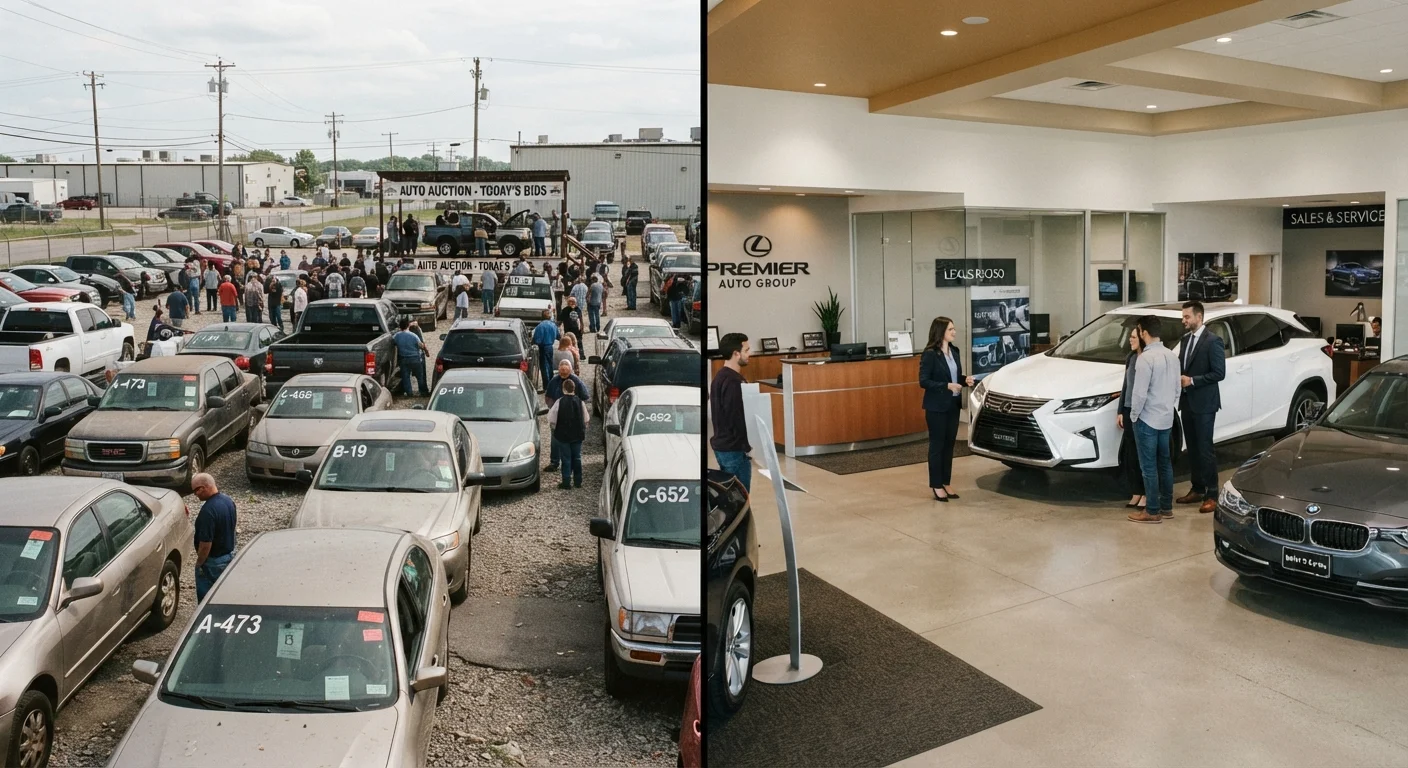
At an auction, vehicles are sold to the highest bidder, often within minutes. Public auctions - open to everyday consumers - may include off-lease fleet returns, government surplus vehicles, repossessions, or trade-ins that dealers chose not to retail. Most auctions operate on a strict as-is basis: you bid, you win, you own it, regardless of what you discover afterward.
At a dealership, the buying process is slower and more structured. Dealers acquire, inspect, and recondition vehicles before putting them on the lot. You can negotiate, arrange a pre-purchase inspection, review a vehicle history report, and in many cases take advantage of a limited return window. See how these dynamics compare further in our guide to private seller versus dealership trade-offs.
Price and Value Differences
Auctions are often associated with lower prices, and that reputation has some basis in reality. Vehicles at public auctions frequently sell below retail book value - particularly those that are older, higher-mileage, or of uncertain condition. However, a low hammer price doesn't automatically translate into a good deal.
Auction buyers typically pay additional fees - buyer's premiums, administrative charges, and title transfer costs - that can add hundreds of dollars to the final price. Without the ability to negotiate or test-drive before bidding, it's easy to overpay for a vehicle with undisclosed problems.
| Auction | Dealership | |
|---|---|---|
| Typical Price | Often below retail value | Retail market value, negotiable |
| Buyer Protections | Minimal - usually as-is | State laws, lemon law may apply |
| Inspection Opportunity | Limited preview only | Pre-purchase inspection typically allowed |
| Financing Options | Must arrange independently | On-site financing available |
| Title Clarity | Not always guaranteed | Generally verified before sale |
| Return Policy | Almost never available | Limited return windows sometimes offered |
Dealerships mark up vehicles to cover reconditioning, overhead, and profit margin. That markup often reflects real value: a vehicle that's been inspected, detailed, and certified carries less immediate risk. If negotiation is your preference, our editorial team covers strategies for negotiating a fair price in a separate guide.
Buyer Protections and Risk
This is where the two channels diverge most sharply. Dealerships - particularly licensed franchised dealers - are subject to state consumer protection laws, FTC regulations, and lemon law provisions that vary by state. Many offer certified pre-owned programs with limited warranties, and some provide short return windows. If a dealer misrepresents a vehicle, you generally have legal recourse.
Auctions offer almost none of these protections. Most are explicitly as-is, meaning the sale is final once the gavel falls. Title issues, mechanical defects, and odometer discrepancies all become your problem. Some auctions do provide basic vehicle history reports, but a report is not a substitute for a physical inspection.
As-Is Means Exactly That
At most auctions, there is no implied warranty of merchantability and no legal obligation for the seller to disclose defects. If a transmission fails the day after purchase, that cost is yours. Buyers should treat auction vehicles as requiring a full mechanical inspection budget on top of the purchase price, and should never bid on a vehicle they cannot afford to repair.
Certain auction vehicles carry salvage or rebuilt titles - designations that significantly affect insurability, resale value, and roadworthiness. If you're considering this segment, our guide on flood-damaged and salvage title vehicles explains what those designations mean in practice.
Financing and Paperwork
At a dealership, financing is typically available on-site. Dealers work with multiple lenders and can structure a loan during the same visit. This convenience has trade-offs - dealer-arranged financing can sometimes carry higher interest rates than loans arranged directly through a bank or credit union. For a closer look at how those paths compare, see our piece on financing through a dealer versus your own lender.
Auctions are typically cash or pre-arranged financing affairs. Most require payment in full within 24 to 72 hours of the winning bid, with wire transfer or certified funds as the norm. If you haven't secured financing before bidding, you could lose the vehicle - and your deposit.
Paperwork at a dealership is handled by finance office staff and generally covers title transfer, registration, and any applicable warranties in one sitting. At auction, buyers are responsible for understanding what documents they'll receive and whether a clean title can be transferred - this is not always guaranteed, particularly with repossession inventory.
Secure Financing Before You Bid
If you plan to buy at auction, arrange your financing with a bank or credit union before attending. Most auctions require full payment within a short window, and arriving without a pre-approved loan or sufficient funds can forfeit your deposit. Knowing your ceiling in advance also helps prevent overbidding in the heat of competition.