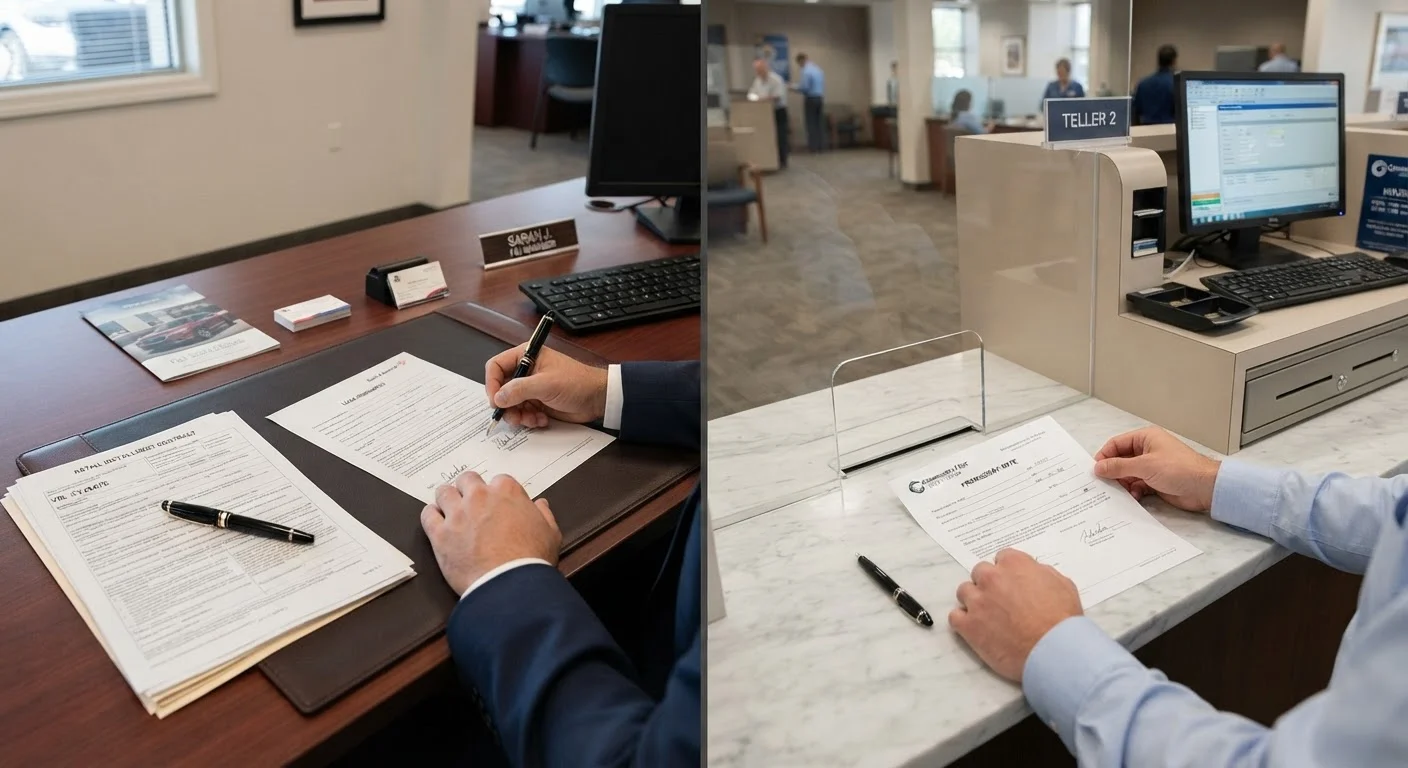
How Each Financing Route Is Structured
When you finance a vehicle through a dealer, you are not borrowing directly from the dealership. Instead, the dealer submits your application to one or more lenders - banks, captive finance arms of automakers, or finance companies - and presents you with terms. The dealer may receive a fee for placing that loan, and in many cases is permitted to mark up the interest rate above what the lender's system actually approved. That spread becomes additional revenue for the dealership.
Direct lending - through your own bank or a credit union - works differently. You apply before visiting a dealership, receive a conditional pre-approval with a stated annual percentage rate (APR), and use that as a ceiling when comparing whatever the finance office offers. Credit unions and commercial banks are structured differently, and those structural differences often show up in the rates and fees they extend. To understand the underlying mechanics of any loan - principal, interest, and how terms shape total cost - see how auto financing actually works.
| Criterion | Dealer-Arranged Financing | Bank or Credit Union Financing |
|---|---|---|
| Rate transparency | Buy rate may be marked up without disclosure | Rate stated upfront in pre-approval |
| Promotional rates | Manufacturer 0%-low APR offers available | Not eligible for captive lender promos |
| Application timing | Applied at point of sale | Applied before visiting a dealership |
| Lender access | Multiple lenders via dealer network | Single institution per application |
| Negotiating leverage | Price and financing often bundled together | Separates price negotiation from financing |
| Typical fees | Potential dealer markup; varies by lender | Origination fees may apply; often lower overall |
| Convenience | One-stop process at dealership | Requires advance planning and application |
The Rate Markup Question
One of the most consequential differences between the two routes is the potential for dealer rate markup. A lender may approve a buyer at 6.5% APR, but the dealer presents an offer at 8.0% APR. The buyer, unaware of the buy rate, accepts. The additional interest paid over a five-year loan on a $30,000 vehicle in this example would amount to hundreds or even over a thousand dollars transferred to the dealership - not the lender.
Consumer financial regulators have scrutinized this practice, and some lenders cap or eliminate dealer markup. But policies vary, and buyers generally have no way to know the lender's buy rate during the transaction. Having a pre-approved rate from your own institution creates a hard comparison point. The finance office must then beat your rate, match it, or lose the financing to your bank. This is why financial educators consistently describe pre-approval as a negotiating tool, not just a convenience.
~1-2%
Typical dealer interest rate markup range
Consumer advocacy research suggests dealer markup on auto loans commonly ranges from one to two percentage points above the lender's buy rate, though policies vary.
72 months
Average new-car loan term in recent years
Experian's State of the Automotive Finance Market reports have shown average new vehicle loan terms extending to approximately 72 months, making rate differences more costly over time.
Be aware that the finance office visit is also where add-on products are commonly presented. Understanding what those products are before you sit down helps you evaluate them clearly rather than under time pressure.
When Dealer Financing Has a Genuine Advantage
Dealer financing is not inherently disadvantageous. Manufacturer-subsidized financing - often called captive lender rates - can be the lowest available option in the market for a given vehicle. When an automaker's finance arm offers 1.9% or 0% APR for qualified buyers, no bank or credit union is likely to match that, because the automaker is effectively subsidizing the cost to move inventory. The key phrase is qualified buyers: these promotions typically require strong credit scores and are limited to specific models or trim levels.
Dealers also work with a broader network of lenders than most consumers access independently, which can benefit buyers with limited credit history or recent credit events. If a single bank declines or quotes a very high rate, a dealer's finance office may surface an approval from a lender the buyer hadn't considered. The trade-off is less transparency into which lenders were approached and on what terms. For buyers who are also evaluating whether to purchase at all, comparing leasing and buying adds important context before committing to any loan.
Risks Worth Understanding Before You Sign
A specific risk associated with dealer financing is spot delivery - also called yo-yo financing - where a buyer drives away before financing is technically finalized, only to be called back and told the terms have changed. This practice is legal in many states and is worth understanding before you take delivery. Spot delivery and yo-yo financing explains the mechanics and what to watch for.
Regardless of which route you choose, the loan contract itself deserves careful review. The fine print in auto loan agreements covers clauses such as prepayment penalties, GAP waiver terms, and rate lock provisions that affect your flexibility over the life of the loan. Borrowers who focus only on the monthly payment - rather than the APR and loan term - often discover they have paid substantially more than they realized.
Applying for Pre-Approval and Credit Inquiries
When you apply for a pre-approval at a bank or credit union, the lender performs a hard credit inquiry, which can temporarily affect your credit score. However, credit scoring models generally treat multiple auto loan inquiries made within a short window (often 14-45 days, depending on the scoring model) as a single inquiry for rate-shopping purposes. Checking your own credit report beforehand - a soft inquiry - does not affect your score.
This article is for general informational and educational purposes only. It is not personalized financial or legal advice. Loan terms, eligibility, and rates vary by lender, credit profile, and state. Consult a licensed financial professional before making decisions about your specific situation.