How eSIM Works Under the Hood
Traditional SIM cards are removable plastic chips that store your carrier credentials - essentially proof that your device belongs on a particular network. Swapping carriers meant swapping cards. An eSIM works the same way logically, but the chip is permanently soldered to your phone's motherboard.
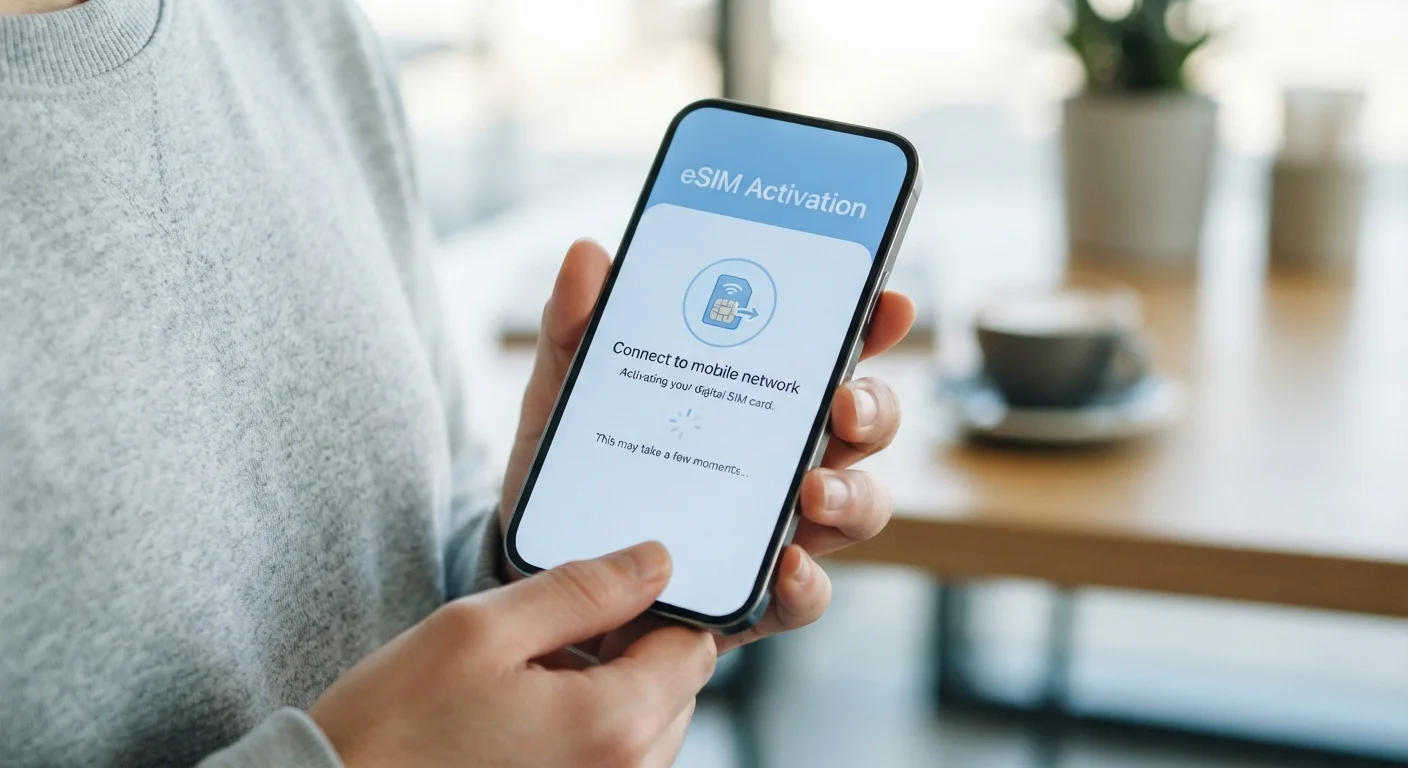
What changes is how that chip gets its carrier information. Instead of physically inserting a new card, your device downloads a carrier profile - a small encrypted file containing all the credentials your phone needs to connect to that network. This happens over a secure internet connection, usually triggered by scanning a QR code provided by the carrier or tapping through a carrier's app.
One significant advantage: an eSIM can store multiple carrier profiles simultaneously. You choose which one is active at any given time, and switching between them takes seconds from the settings menu. This capability is what makes eSIM particularly powerful for international travelers and anyone who regularly evaluates competing plans.
eSIM Does Not Mean Carrier-Free
A common misconception is that eSIM lets you use any carrier freely at any time. In practice, your device still needs to be carrier-unlocked to accept profiles from competing networks. The embedded chip changes how credentials are delivered - not the underlying business relationship between you, the device manufacturer, and the carrier.
Which Devices Support eSIM?
eSIM support has expanded rapidly across device categories. On the smartphone side, Apple introduced eSIM capability with the iPhone XS in 2018, and starting with the iPhone 14 sold in the United States, Apple removed the physical SIM tray entirely. Google's Pixel line and many Samsung Galaxy flagships have offered eSIM support for several generations as well.
Beyond phones, eSIM is standard on cellular-capable smartwatches, many iPads, select laptops with built-in LTE or 5G, and even some dedicated travel hotspots. If you're curious how next-generation connectivity fits into the broader picture, our explainer on what 5G means for everyday users covers how network upgrades intersect with modern hardware.
~300
Carriers offering eSIM worldwide
According to GSMA intelligence reporting, over 300 operators globally had launched commercial eSIM services for consumer devices as of recent years.
2018
Year eSIM debuted in mainstream smartphones
Apple's iPhone XS and XS Max, released in 2018, were among the first flagship consumer smartphones to include eSIM alongside a physical SIM tray.
Switching Carriers with eSIM: What Actually Changes
The practical impact of eSIM on carrier switching is significant. Previously, changing carriers involved ordering a new SIM card, waiting for delivery, and sometimes visiting a store to complete activation. With eSIM, the entire process can happen in under ten minutes from your couch.
That said, carrier-locking still applies. A locked eSIM device will only accept profiles from the carrier it's locked to. Unlocking rules - which vary by carrier and contract terms - haven't changed just because the SIM is embedded. Our article on locked vs. unlocked phones explains how to determine your device's lock status and what it means for your options.
For travelers, eSIM removes one of the biggest friction points of international trips: hunting down a local SIM card on arrival. Many carriers and dedicated travel services now offer short-term international eSIM profiles you activate before you even board your flight. This pairs naturally with features like Wi-Fi calling and VoIP, which can further reduce roaming costs when you're abroad.
Before Traveling Internationally with eSIM
Confirm that your device supports multiple simultaneous eSIM profiles and that your home carrier won't deactivate your plan when you add a foreign profile. Some carriers treat adding a second profile as a trigger for account review. Activating a travel eSIM plan before departure - rather than on arrival - also avoids connectivity gaps when you need navigation or communication most.
Limitations Worth Knowing Before You Switch
eSIM is not without trade-offs. If your device has a hardware failure severe enough to require motherboard replacement, recovering your eSIM profiles may require contacting your carrier directly - there's no card to pop out and slide into a backup phone. For this reason, it's worth understanding the repair-vs-replace calculus on modern devices; our guide on when to replace rather than repair your smartphone covers the key signals.
Additionally, not every carrier or plan tier supports eSIM, particularly among smaller regional operators and some international carriers. And while the technology is broadly mature, the activation experience isn't perfectly standardized - some carriers still require a phone call to complete an eSIM transfer, which partially undercuts the convenience advantage.
Overall, eSIM represents a meaningful evolution in how consumers interact with mobile networks - reducing physical friction, enabling faster plan comparisons, and making multi-network use genuinely practical for the first time.