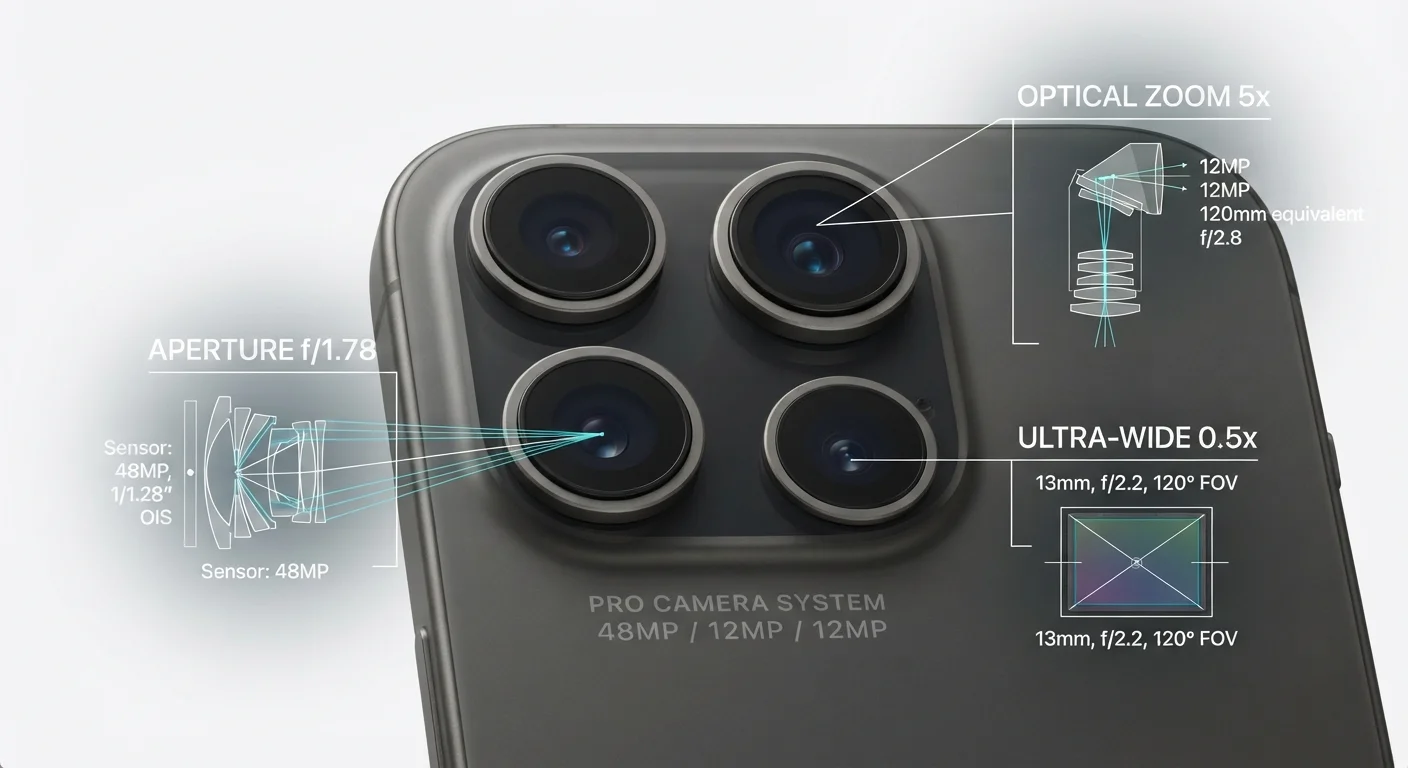
Megapixels: Resolution vs. Quality
Megapixels are the most marketed camera figure, and the most misunderstood. A megapixel (MP) equals one million pixels, and the number tells you the resolution of the captured image - how many data points the sensor records. A 50 MP photo has more detail to work with when cropping or printing large, but megapixels alone say nothing about exposure, color accuracy, or sharpness.
In practice, a 12 MP sensor with excellent optics and a large sensor area often outperforms a 108 MP sensor with a physically tiny chip in challenging lighting. Many high-megapixel phones also use pixel binning - merging adjacent pixels - to produce cleaner default shots at a lower effective resolution. Check the glossary below for a full breakdown of key terms.
Megapixel (MP)
One megapixel equals one million individual pixels captured in a photo. Higher megapixel counts allow for larger prints and more cropping flexibility, but do not independently determine image quality.
Aperture (f-number)
Aperture describes how wide the camera lens opens to admit light, expressed as an f-number (e.g., f/1.8). A lower f-number means a wider opening, letting in more light - beneficial in dim conditions.
Sensor Size
The physical dimensions of the image sensor behind the lens. Larger sensors capture more light per pixel, which generally produces cleaner images, especially in low-light environments.
Optical Zoom
Zoom achieved by physically moving lens elements, preserving image sharpness at longer distances. Distinct from digital zoom, which simply crops and enlarges the existing image, reducing quality.
OIS (Optical Image Stabilization)
A hardware mechanism that physically compensates for hand movement while shooting, reducing blur in photos and shake in videos - particularly useful in low light or at longer zoom ranges.
Pixel Binning
A process where multiple small pixels are combined into one larger effective pixel, improving light capture and reducing noise. Often used in high-megapixel sensors shooting in default mode.
Aperture (f-number)
Aperture describes how wide the camera lens opens to admit light, expressed as an f-number (e.g., f/1.8). A lower f-number means a wider opening, letting in more light - beneficial in dim conditions.
Night Mode
A computational photography feature that takes multiple exposures and merges them to produce brighter, lower-noise images in dark environments. Results depend heavily on software quality, not just sensor hardware.
For a broader look at how specs translate to real-world use across devices, see our smartphone specs glossary.
Aperture, Sensor Size, and Low-Light Performance
Aperture and sensor size are the two variables that most directly determine how a camera handles low light. Aperture is expressed as an f-number: f/1.6 opens wider than f/2.4, admitting roughly twice as much light. A wider aperture also creates a shallower depth of field - the blurred-background effect popular in portrait shots.
Sensor size is expressed in fractional-inch notation, which is counterintuitive: a 1/1.28" sensor is larger than a 1/2.55" sensor. Larger sensors produce larger individual pixels (or more pixels at the same size), which translates to better dynamic range and less noise in dimly lit scenes.
| Typical main sensor range | 12 MP to 200 MP (Common across flagship and mid-range smartphones as of recent product generations) |
| Wide aperture range | f/1.4 - f/2.0 (Found on primary wide-angle lenses in most modern smartphones) |
| Optical zoom range | 2x - 10x (periscope lenses) (Periscope telephoto designs extend optical zoom beyond traditional limits) |
| Standard video resolution | 4K at 30 or 60 fps (Widely available on mid-range and above smartphones) |
| Sensor size notation | Expressed as fractions (e.g., 1/1.28") (Larger denominator = smaller sensor; counterintuitive but standard industry notation) |
Optical Image Stabilization (OIS) works alongside these specs, compensating for hand movement to sharpen handheld shots in dim environments and reduce camera shake in video. It is a hardware feature distinct from electronic image stabilization, which processes the video signal after capture.
200 MP
Highest main sensor resolution in consumer smartphones
Some Android flagship devices have shipped with 200-megapixel main sensors, though pixel binning is used in most shooting conditions.
10x
Optical zoom via periscope telephoto lens
Periscope-style telephoto lenses in select flagship phones achieve up to 10x optical zoom without significant image degradation.
f/1.4
Widest aperture found on smartphone main cameras
A handful of flagship devices have featured f/1.4 variable aperture lenses, delivering strong low-light performance.
Zoom: Optical vs. Digital, and What Periscope Changes
Zoom specifications on smartphones require careful reading. Optical zoom uses physical lens movement to magnify a scene without any loss of pixel data. Digital zoom simply crops the image and enlarges it - the result looks softer because no additional detail is actually captured.
Many phones list a high maximum zoom figure that combines both types. A phone advertising "30x Space Zoom" might offer 3x optical zoom and use software processing for the remaining 10x or more. Checking the optical zoom figure gives a more accurate picture of telephoto capability.
Periscope telephoto lenses represent a meaningful hardware advancement. By routing light through a horizontal prism inside the phone body, they allow longer focal lengths than a traditional vertical stack permits - enabling 5x to 10x optical zoom in a device slim enough to pocket.
More Specs Don't Always Mean Better Photos
Camera hardware is only part of the equation. Computational photography - the software algorithms that process raw sensor data - plays an equally significant role in final image quality. Two phones with identical megapixel counts can produce noticeably different results depending on their image signal processors and software tuning. Real-world sample photos, not spec sheets, are the most reliable quality indicator.
Once you understand these specs, you can put them to use - our guide on smartphone photography techniques explains how to apply camera controls in everyday shooting situations.
Video Specs and Multiple Lenses Explained
For video, the key specifications are resolution (commonly 1080p, 4K), frame rate (fps), and stabilization. Higher frame rates - 60 fps versus 30 fps - produce smoother motion and allow slow-motion editing. Shooting at 4K captures four times the pixel data of 1080p, though file sizes grow accordingly and some phones apply heavier compression or lose stabilization features at maximum resolution.
Modern smartphones frequently carry three or four camera lenses: an ultra-wide for expansive scenes, a main wide-angle for everyday shots, a telephoto for distant subjects, and sometimes a macro lens for extreme close-ups. Each lens is a separate physical camera with its own sensor, aperture, and focal length. Understanding which lens the phone uses by default - and when it switches between them during zoom - helps set realistic expectations for performance across shooting scenarios.
If you find that decoding display specs follows similar logic, our article on TV resolution numbers explained applies the same kind of clarity to screen terminology.
This article is for informational and educational purposes only. Specifications and features vary widely across devices and manufacturers; always verify current details with the manufacturer or retailer before making a purchase decision.