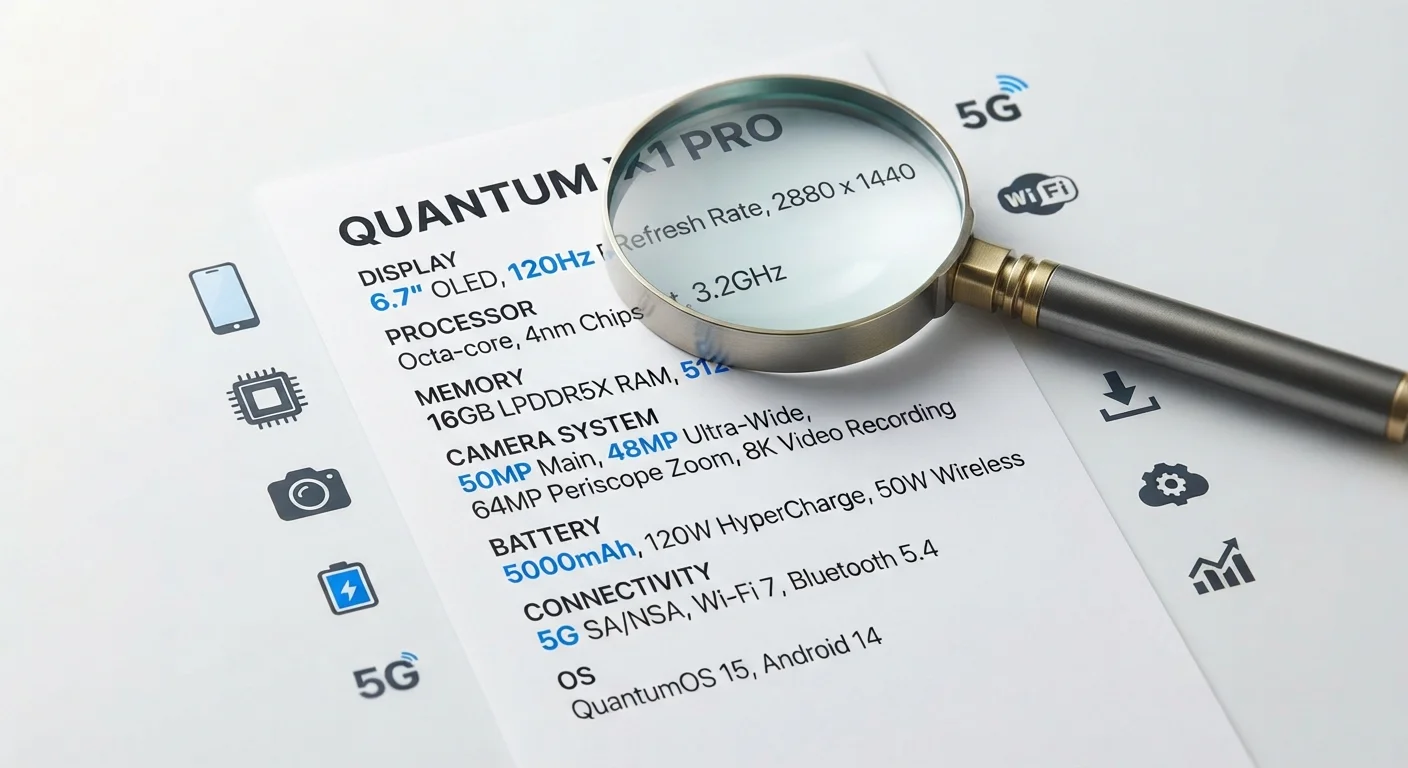
Why Spec Sheets Feel So Confusing
When you're comparing smartphones, the specification sheet can read like a foreign language. Terms like SoC, UFS 3.1, and f/1.8 aperture are precise in meaning - but manufacturers rarely explain them. The result is that shoppers either tune out entirely or fixate on a single number like megapixels or gigabytes, missing the fuller picture.
This glossary is designed as a quick reference. Scan it before you read any spec sheet, and the numbers will start to tell a coherent story. For a deeper look at how similar specs apply to laptops, see our guide to reading a computer spec sheet.
| Common SoC manufacturers | Qualcomm (Snapdragon), Apple (A-series), MediaTek (Dimensity), Samsung (Exynos) |
| Minimum recommended RAM for smooth everyday use | 6 GB or more for most modern Android phones |
| IP68 water resistance depth (typical) | Up to 1.5 meters for 30 minutes (varies by manufacturer) |
| Standard display refresh rates | 60Hz (basic), 90Hz (smooth), 120Hz (premium) |
| Typical flagship battery capacity range | 4,500 - 5,000 mAh |
| NFC use cases | Contactless payments, transit cards, device pairing, smart tags |
Core Terms Defined
The glossary below covers the terms you'll encounter most often across any smartphone listing - from entry-level devices to flagships.
SoC (System on a Chip)
An integrated circuit that combines the processor (CPU), graphics unit (GPU), modem, and other components onto a single chip. The SoC largely determines a phone's performance and power efficiency.
RAM (Random Access Memory)
Short-term memory the phone uses to keep active apps running smoothly. More RAM generally means more apps can stay open in the background without reloading.
nits
A unit of screen brightness. Higher nit counts (e.g., 1,000+ nits) make displays easier to read outdoors in direct sunlight.
IP Rating
A standardized measure (Ingress Protection) of a device's resistance to dust and water. For example, IP68 means the phone is dust-tight and can be submerged in water up to a specified depth.
NFC (Near Field Communication)
A short-range wireless technology that allows a phone to communicate with nearby devices or payment terminals, enabling features like contactless payments and quick device pairing.
Refresh Rate (Hz)
How many times per second the display updates its image. A 120Hz screen appears noticeably smoother than a 60Hz screen, particularly during scrolling and gaming.
mAh (Milliamp-hour)
The unit used to measure battery capacity. A higher mAh number generally indicates a larger battery, though real-world battery life also depends on software efficiency and screen brightness.
Aperture (f-number)
A measure of how wide a camera lens opens to admit light. A lower f-number (e.g., f/1.6) means a wider aperture, which is better for low-light photography.
5G / LTE
Mobile network generation standards. LTE (4G) is widely available; 5G is the newer standard offering faster speeds where network infrastructure supports it.
UFS / eMMC Storage
Internal storage standards. UFS (Universal Flash Storage) is faster than eMMC, leading to quicker app launches and file transfers in mid-range to flagship phones.
HDR (High Dynamic Range)
A display technology that expands the range between the brightest whites and darkest blacks on screen. HDR-capable displays show more detail in highlights and shadows when viewing compatible content.
OIS (Optical Image Stabilization)
A hardware mechanism in the camera that physically compensates for hand movement, reducing blur in photos and video without relying solely on software processing.
Specs Don't Tell the Whole Story
A higher number isn't always better in context. For example, more megapixels in a camera sensor doesn't automatically mean better photos - sensor size, aperture, and processing algorithms all play important roles. Use specs as a starting framework, then look for independent, hands-on evaluations to see how those numbers translate into real-world performance.
Understanding the processor is especially important. The SoC (System on a Chip) is the engine of the phone - it influences everything from gaming performance to camera processing speed and battery efficiency. Our related article on how computer processors are described adds useful context if you want to go deeper on chip architecture.
Storage is another area where terminology matters. RAM and internal storage are completely different things - RAM keeps apps responsive, while internal storage holds your files and apps permanently. For a thorough breakdown, see our guide on smartphone storage explained.
On the camera side, the aperture (f-number) and OIS pairing is worth understanding together - a wide aperture captures more light, and optical stabilization ensures that light is captured sharply even when your hand isn't perfectly steady.
Network specs like 5G and NFC relate to connectivity rather than performance. Whether 5G matters to you depends on local network availability. Our 5G explainer for everyday users walks through the real-world impact.
Finally, the IP rating is a genuinely useful durability indicator. It tells you how well the phone tolerates everyday exposure to dust and water - relevant for outdoor users or anyone prone to kitchen-counter spills. Note that IP ratings are tested under controlled conditions; manufacturer-specific depth and duration limits vary.
If you're weighing whether your current phone's specs still hold up - or whether it's time to move on - our article on signs it's time to replace your smartphone offers a practical framework.