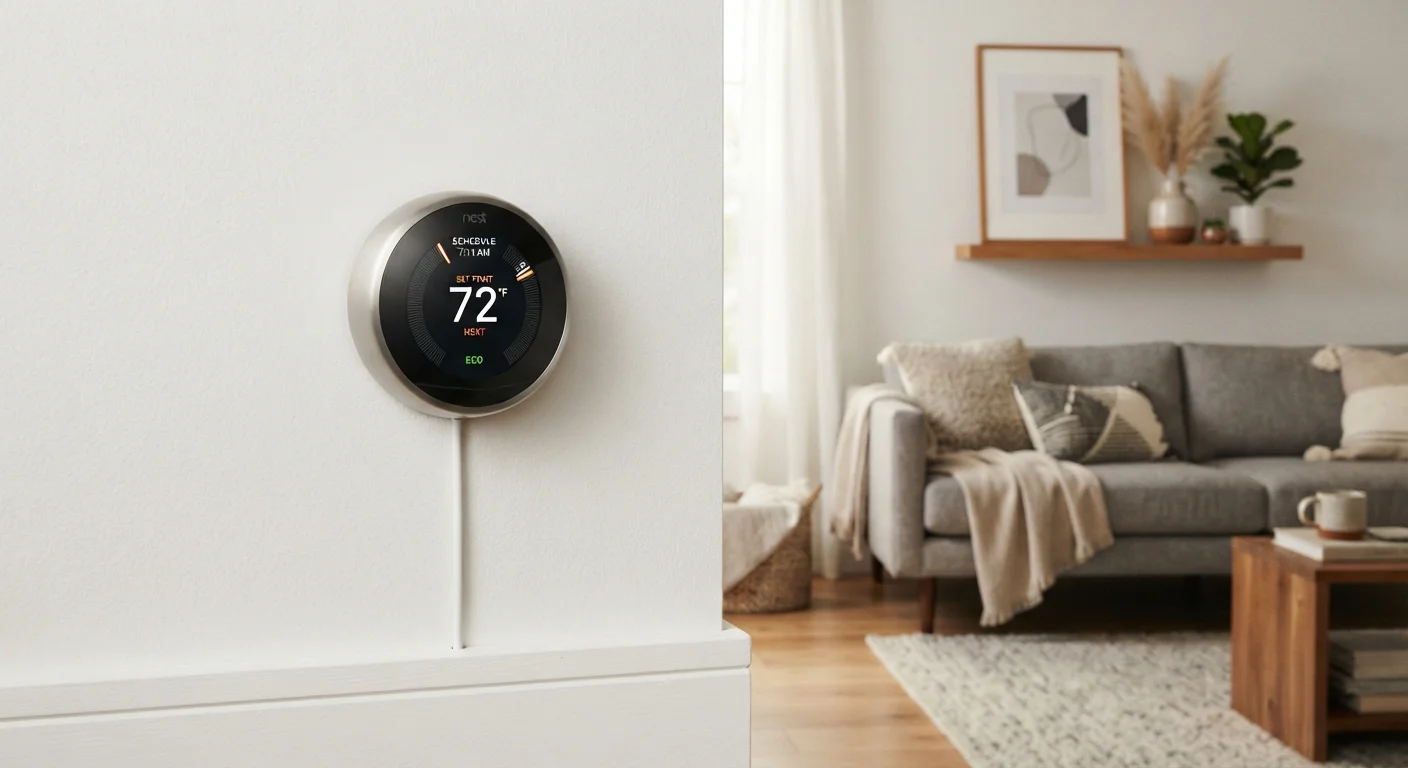
How Smart Thermostats Learn Your Habits
The defining feature of a learning smart thermostat is its ability to observe and adapt. During an initial training period - typically one to two weeks - the device records every time you manually change the temperature and cross-references that with occupancy data from built-in motion sensors. Over time, it builds a schedule that reflects when people are actually home and active.
Beyond motion detection, many models use geofencing: they monitor your smartphone's GPS location and begin adjusting temperatures as you leave or approach home. This removes the lag between when you actually depart and when the system reacts. Some devices go further, integrating with local weather forecasts to anticipate demand before temperatures shift.
It's worth understanding that this "learning" is pattern matching, not artificial intelligence in a sophisticated sense. If your schedule changes significantly - a new job, remote work, seasonal travel - the thermostat may take days to recalibrate. For households with highly variable routines, a manually programmed schedule sometimes performs more reliably than the auto-learning mode. Common misconceptions about this learning process can lead to disappointment when real-world behavior doesn't match marketing claims.
1-2 weeks
Typical learning period for schedule adaptation
Most manufacturers state that learning thermostats need one to two weeks of normal household use before generating a reliable automated schedule.
~8%
Estimated heating savings under typical conditions
The U.S. Department of Energy notes that setback strategies - which smart thermostats automate - can reduce heating costs by roughly 1% per degree of setback per 8 hours.
50M+
Smart thermostats installed in U.S. homes
Industry estimates suggest tens of millions of smart thermostats are now in use across American households, reflecting significant growth in adoption over the past decade.
What a Smart Thermostat Actually Controls
A smart thermostat interfaces with your home's central HVAC system - it does not directly control the furnace, air handler, or heat pump itself. It sends low-voltage electrical signals through control wires to tell your system when to run and in what mode (heat, cool, fan-only). The quality and responsiveness of that underlying system determine how effective the thermostat can be.
Standard installations control one temperature zone, meaning the thermostat measures air at its single location and runs the whole-home system based on that reading. If your home has multiple floors or rooms with very different thermal characteristics, the thermostat's sensor location matters enormously. A unit placed near a sunny window or a drafty hallway may read temperatures unrepresentative of where you actually spend time.
Some systems support multiple zones with separate dampers and additional thermostats, but this requires compatible HVAC equipment and professional setup. For context on how your heating and cooling system is structured, understanding HVAC system basics is a useful starting point before evaluating any thermostat upgrade.
Placement Affects Performance Significantly
Install your thermostat on an interior wall, away from direct sunlight, drafts, doorways, and heat-generating appliances. A poorly placed sensor will cause the system to cycle incorrectly - heating or cooling past the point of comfort. If your current thermostat location has always felt "off," a smart upgrade won't fix a placement problem.
The Real Limits of Smart Thermostat Technology
Smart thermostats are frequently marketed with energy savings estimates, but those figures are based on specific usage assumptions that may not apply to your home. Savings are most likely when a household previously had no schedule set at all - running heating or cooling continuously regardless of occupancy. If you already use a manual programmable schedule, the incremental gain from a smart model may be modest.
Compatibility is a hard technical limit. Homes with high-voltage heating systems (common with electric baseboard heaters), steam boilers, or certain multi-stage heat pumps may not support standard smart thermostat wiring. The absence of a C-wire in older homes can also complicate installation. Understanding what "smart" truly means in an appliance context helps separate genuine automation from features that simply add an app.
Finally, smart thermostats depend on a reliable home Wi-Fi connection and an active account with the manufacturer's cloud service. If either is unavailable - due to an outage, a discontinued product line, or a changed service agreement - some features may stop functioning. This is a meaningful consideration for long-term planning, and it mirrors broader concerns about fragmented smart home setups that create more hassle than convenience.
Cloud Dependency Is a Long-Term Consideration
Many smart thermostat features - remote access, scheduling sync, energy reports - rely on the manufacturer's cloud servers. If a company discontinues a product line or shuts down its service, some functionality may be lost even though the hardware still works. When evaluating a smart thermostat, it's reasonable to check whether basic local control (setting temperature directly on the device) remains possible without an internet connection.