What an HVAC System Actually Does
HVAC stands for heating, ventilation, and air conditioning. The term describes the integrated system that controls temperature, humidity, and air quality inside your home. While many people think of heating and cooling as separate appliances, they typically share critical infrastructure - ductwork, a thermostat, and a blower fan - making them genuinely one system.
Ventilation is the piece most homeowners overlook. It governs how stale indoor air is exchanged with fresh outdoor air, and how pollutants, moisture, and odors are managed. Poor ventilation can affect indoor air quality even when your heating and cooling operate perfectly.
If you're a first-time buyer still learning what you're taking on, our guide on what to know before you start looking covers foundational homeownership concepts worth reviewing alongside this one.
Refrigerant
A chemical fluid that absorbs and releases heat as it cycles between liquid and gas states, enabling your air conditioner or heat pump to cool indoor air.
Evaporator coil
The indoor coil where refrigerant absorbs heat from your home's air, causing the air to cool before it's distributed through your ductwork.
Condenser unit
The outdoor component of a central AC or heat pump system that releases heat absorbed from inside the home to the outdoor air.
SEER rating
Seasonal Energy Efficiency Ratio - a measure of an air conditioner's cooling efficiency over a typical season. Higher numbers indicate greater energy efficiency.
Heat pump
A system that moves heat rather than generating it - cooling in summer by moving heat outside, and heating in winter by extracting warmth from outdoor air.
Condensate drain
A drain line that removes moisture extracted from indoor air during the cooling process; blockages can cause water damage or trigger a system shutoff.
The Core Components and How They Connect
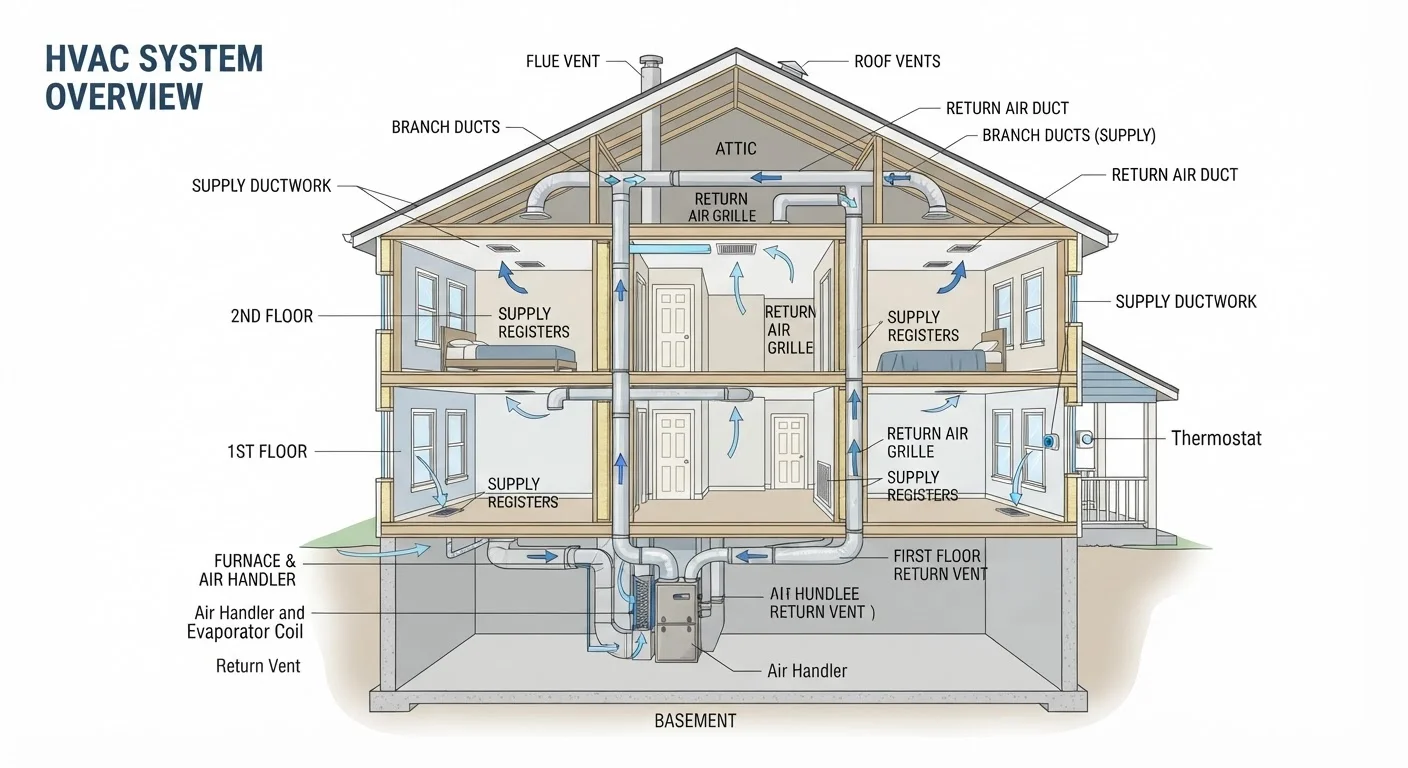
A typical central HVAC system includes these primary components:
- Furnace or air handler: Generates or moves conditioned air through the home via a blower fan and ductwork.
- Air conditioner or heat pump: Removes heat from indoor air (cooling) or extracts heat from outdoor air (heating). The outdoor condenser unit and indoor evaporator coil work together using refrigerant.
- Ductwork: The network of metal or flexible channels that delivers conditioned air to each room and returns it to be reconditioned.
- Thermostat: The control interface that signals the system when to heat or cool and to what setpoint.
- Air filter: Positioned at the return air intake, it traps dust, pollen, and debris before air circulates through the system.
Heat pumps deserve a special note: they serve as both heater and air conditioner, making them efficient in moderate climates but less effective in extreme cold without a supplemental heat source.
Routine Maintenance You Can Handle Yourself
Most HVAC failures are preceded by neglected maintenance. These are the tasks well within a homeowner's ability:
- Replace air filters regularly. A clogged filter forces the blower to work harder, reduces airflow, and allows dust to accumulate on coils - degrading both efficiency and air quality.
- Keep outdoor condenser units clear. Remove leaves, grass clippings, and debris from around the unit. Maintain at least two feet of clearance on all sides.
- Clean supply and return vents. Vacuum grilles periodically and ensure furniture isn't blocking airflow.
- Check and clear the condensate drain line. Air conditioners produce condensation; the drain line can become clogged with algae, causing water damage or system shutoff.
Set a Filter Change Reminder
Write the installation date on the filter's cardboard frame with a marker when you install it. Set a recurring calendar reminder for your replacement interval. This one habit prevents the majority of avoidable efficiency losses and equipment strain.
For a broader seasonal view of what to maintain and when, our annual home maintenance checklist pairs well with the HVAC tasks above.
When to Call a Licensed HVAC Professional
Knowing where DIY ends matters as much as knowing what you can do. The following always require a licensed technician:
- Refrigerant issues: Adding or recovering refrigerant requires EPA Section 608 certification. Low refrigerant signals a leak, not a simple top-off.
- Electrical components: Capacitors, contactors, and wiring carry significant voltage risk. Incorrect handling can cause injury or further damage.
- Duct sealing and insulation: Improper duct work can create pressure imbalances, reduce efficiency, and - in gas systems - create combustion air concerns.
- Annual system tune-up: A professional inspection covers coil cleaning, refrigerant charge verification, safety controls testing, and combustion analysis for gas furnaces.
This parallels the decision-making around vehicle repairs - some things are genuinely owner-appropriate, others carry real risk without the right tools and training. Our piece on DIY versus professional car maintenance explores that same boundary in a different context.
Gas Furnaces Require Extra Caution
If you suspect a gas leak, carbon monoxide issue, or cracked heat exchanger, leave the home immediately and contact your gas utility and emergency services. Do not attempt to inspect or repair gas components yourself. Carbon monoxide is colorless and odorless - install detectors on every floor and test them regularly.
Smart Thermostats and Modern Upgrades
One of the most accessible upgrades for most homeowners is a smart thermostat. These devices learn usage patterns, allow remote control via smartphone, and can generate energy usage reports that help identify inefficiencies. Many are compatible with standard systems and can be installed by a moderately comfortable DIYer - though verify compatibility with your system type before purchasing.
For those exploring broader home automation, smart thermostats are often a natural entry point. Our first-timer's orientation to smart home technology provides a useful frame for understanding where HVAC control fits into a connected home.
Other upgrades worth discussing with a professional include variable-speed blowers (which run more quietly and maintain steadier temperatures), whole-home humidifiers and dehumidifiers, and zoning systems that allow different areas of the house to be conditioned independently.
This article is for general informational and educational purposes only. It does not constitute professional HVAC, contractor, or financial advice. Consult a licensed HVAC technician for diagnosis, repair, and installation decisions specific to your system and local code requirements.