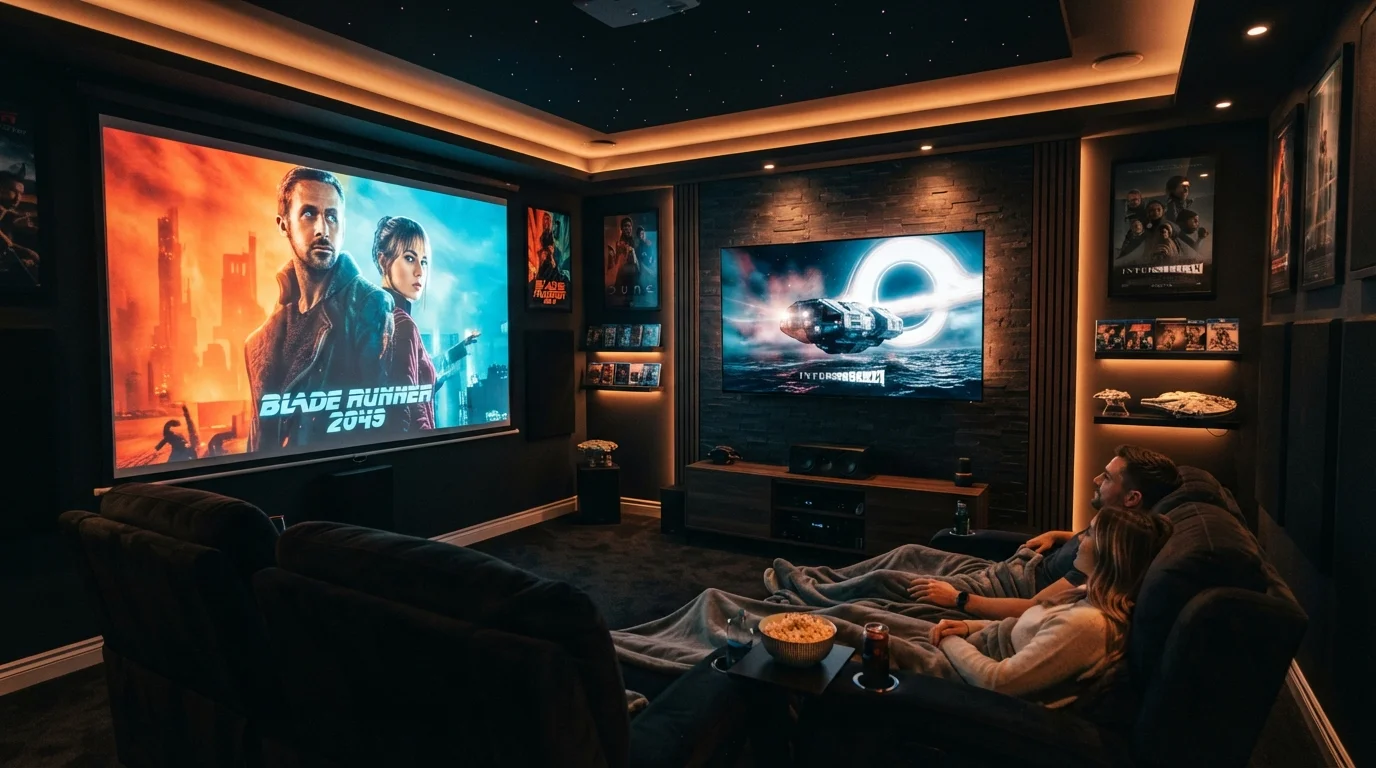
The Core Difference: How Each Technology Creates a Big Picture
Projectors work by throwing light from a lamp or laser light source onto a reflective surface - typically a dedicated projection screen or a flat white wall. The image size is determined by the distance between the projector and that surface, known as throw distance. Move the projector farther back, and the image grows. This flexibility is the technology's defining advantage.
Large-screen TVs, by contrast, are self-contained displays. The panel itself emits or controls light directly, producing the image on a fixed-size screen. Panel technologies vary - LED-backlit LCD, OLED, and QLED panels each handle brightness, contrast, and color differently - and if you want to understand those distinctions in detail, our comparison of OLED, QLED, and LED panels breaks them down clearly.
The practical implication is straightforward: projectors excel at scale, while TVs excel at consistent, controlled output. Neither is universally superior - the right choice depends on your environment and habits.
Room Conditions: The Factor That Matters Most
Ambient light is the single most important variable in this decision. Projectors rely on a dark or near-dark room to deliver satisfying contrast and color. Even moderate daylight - from windows or overhead fixtures - can wash out a projected image, making it look pale and flat. While high-lumen and ultra-short-throw projectors have improved in bright-room performance, they still trail TVs significantly in well-lit spaces.
Large-screen TVs are designed to perform across a range of lighting conditions. High-brightness panels can reach thousands of nits of peak output, cutting through ambient light and maintaining vivid HDR (High Dynamic Range) images even in sunny rooms. For everyday living rooms that do double duty as dining areas, playrooms, or workspaces, this resilience is a practical advantage that's easy to underestimate.
Room Lighting and Audio Go Hand in Hand
Room lighting decisions that affect your projector or TV experience can also influence how sound behaves in the space. Hard surfaces reflect both light and audio in ways that affect picture glare and echo. If you're designing or renovating the room, it's worth considering acoustic treatment alongside display placement. Our guide to matching audio systems to your room covers how room shape and surfaces factor into speaker choices.
Room lighting also affects audio planning. Whatever display you choose, the acoustic character of your space will shape how sound performs. Our guide to matching audio systems to your room is a useful companion read here.
Installation, Space, and Ongoing Maintenance
Setting up a projector involves more planning than simply choosing a screen size. You'll need to account for throw distance (the ratio of image width to projector distance from the screen), ceiling mounting or shelf placement, cable routing, and screen surface. Many standard projectors require eight to twelve feet of distance to produce a 100-inch image, which rules them out for smaller rooms. Ultra-short-throw projectors sit just inches from the screen but typically carry a higher price and are sensitive to placement precision.
Maintenance is another consideration. Lamp-based projectors require bulb replacements - typically every 3,000 to 5,000 hours of use - which adds long-term cost. Laser projectors avoid this but sit at a higher initial price. Large-screen TVs, by contrast, are largely maintenance-free for most users: no bulbs, no calibration drift from distance changes, and no screen surface to keep clean and flat.
| Criterion | Home Projector | Large-Screen TV |
|---|---|---|
| Maximum image size | 100-150+ inches typical | Up to ~98 inches (mainstream) |
| Performance in bright rooms | Poor to moderate | Good to excellent |
| Installation complexity | High - throw distance, mounting, screen | Low - wall mount or stand |
| Ongoing maintenance | Lamp replacement (lamp models) | Minimal for most users |
| Input lag for gaming | Typically higher (20-50ms+) | Often under 10ms (game mode) |
| HDR peak brightness | Limited by lamp output | Strong on high-end panels |
| Built-in smart platform | Rarely included | Standard on most models |
For households weighing multiple display decisions simultaneously - such as a home office monitor setup alongside a living room screen - our piece on multi-monitor considerations covers related planning principles.
Picture Quality, Gaming, and Everyday Use
Modern large-screen TVs hold a clear edge in peak brightness, motion handling, and input lag - the delay between a controller input and what appears on screen. For gaming, many current TVs offer input lag under 10 milliseconds in dedicated game modes, and support technologies like VRR (Variable Refresh Rate) that smooth out frame-rate fluctuations. Projectors, while improving, generally lag behind here, both literally and figuratively.
For film-focused home theater use, a well-calibrated projector in a dark room can rival or exceed a TV's sense of scale and immersion. The sheer size of a 100-inch or 120-inch projected image creates a qualitatively different experience from even a large 85-inch TV. However, a projector's HDR performance - its ability to display very bright highlights against deep blacks - is constrained by the light output limits of most consumer models.
100"-120"
Typical projector image range in home use
Consumer projectors commonly produce images in this range at standard throw distances, a size that flat-panel TVs rarely reach in mainstream retail.
~3,000-5,000 hrs
Typical lamp life for lamp-based projectors
Most manufacturers rate lamp-based projector bulbs in this range before significant brightness loss, after which replacement is recommended.
<10ms
Input lag in TV game mode (many current models)
Many modern large-screen TVs advertise input lag under 10 milliseconds in their dedicated game modes, a meaningful advantage for interactive content.
If you're also deciding how your content gets delivered to the screen, it's worth reading about streaming sticks versus built-in smart TV platforms, since projectors often need an external streaming device while TVs have platforms built in.