Why Smart Home Compatibility Has Been Such a Mess
For years, buying a smart home device meant committing to an ecosystem. A thermostat built for one platform might not work with another brand's hub. A smart lock certified for one voice assistant might ignore commands from a different one. The result was a fragmented landscape where interoperability was the exception rather than the rule.
This friction wasn't accidental - it was often a competitive strategy. Companies had incentives to keep users inside their own walled gardens. But it also discouraged adoption and left consumers frustrated when devices they assumed would work together simply didn't.
To understand the broader challenge of connecting devices across different platforms, see our explanation of smart home ecosystems. For a closer look at the wireless protocols involved, Zigbee, Z-Wave, and Thread explained is a useful companion.
Matter Is a Standard, Not a Brand
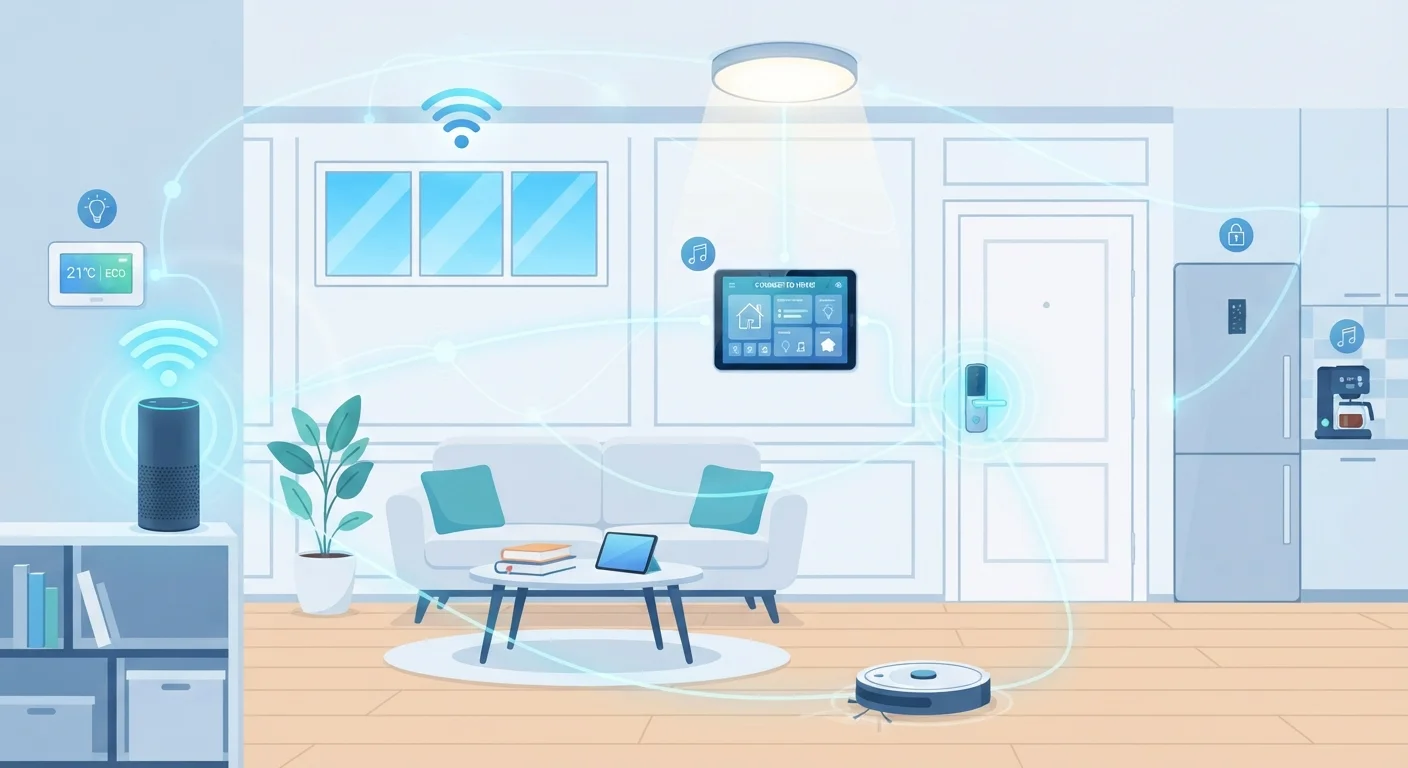
Matter doesn't replace the apps or assistants you already use - it works underneath them. Your smart home setup still runs through whichever ecosystem you prefer; Matter simply ensures that more devices can participate in it, regardless of who made them. Think of it less like a new product and more like a shared language that devices now speak.
What Matter Actually Does
Matter is a certification and communication standard, not a physical product. When a device carries the Matter badge, it means it has been tested and verified to follow a common set of rules for discovery, setup, and control. Any Matter-certified controller - a smart speaker, phone app, or hub - should be able to communicate with any Matter-certified device.
Practically speaking, this means a Matter-certified light bulb can be set up through Apple Home, controlled through Google Home, and automated through Amazon Alexa - all at the same time. This multi-platform control is called multi-admin, and it's one of the most significant shifts the standard introduces.
Matter also prioritizes local processing. Because devices communicate directly over your home network rather than routing commands through external cloud servers, responses tend to be faster and more reliable. Losing your internet connection no longer necessarily means losing control of your lights.
220+
Companies in the Connectivity Standards Alliance
The CSA, which oversees Matter, counts over 220 member companies including Amazon, Apple, Google, and Samsung, reflecting broad industry commitment to the standard.
4
Major ecosystems with Matter controller support
Amazon Alexa, Apple Home, Google Home, and Samsung SmartThings have all implemented Matter controller functionality, covering the vast majority of U.S. smart home users.
2022
Year Matter 1.0 specification was released
The first official Matter specification was published in October 2022, marking the transition from development to real-world deployment after years of industry collaboration.
What Matter Can't Do (Yet)
Matter's promise is real, but its current scope has limits worth understanding. The standard launched with support for a defined set of device categories - lights, plugs, thermostats, locks, blinds, and a handful of others. More complex devices, like robot vacuums, cameras, and multi-function appliances, have been slower to gain full Matter support.
Compatibility also doesn't mean identical experiences. A Matter-certified device will work across ecosystems, but the depth of features may vary. Advanced automations, energy-usage dashboards, or manufacturer-specific settings might only be available through the brand's native app, not through a third-party controller.
And while Matter simplifies setup, it doesn't make smart home planning effortless. First-time smart home buyers still benefit from thinking through their setup in advance. Common planning pitfalls - like mixing too many protocols or building without a coherent hub strategy - remain relevant even in a Matter-enabled environment. Our guide to smart home mistakes to avoid covers these in detail.
Check for Matter Support Before Buying
When shopping for new smart home devices, look for the Matter logo on the packaging or product listing. The Connectivity Standards Alliance also maintains a searchable online registry of certified products. Taking a moment to verify certification can save significant frustration down the road, especially if you use more than one voice assistant or plan to expand your setup over time.
How to Know If a Device Is Matter-Compatible
The simplest signal is the Matter logo on the product packaging or listing. The Connectivity Standards Alliance maintains a public database of certified products, which can be a reliable reference when evaluating a purchase.
Some manufacturers have also issued over-the-air firmware updates to add Matter support to older devices - particularly smart plugs and bulbs. Check the manufacturer's support site for your existing devices before assuming they need replacement.
If you're evaluating a device that claims to be smart but doesn't mention Matter, that doesn't automatically make it a poor choice. Many capable devices still operate reliably within a single ecosystem. Understanding what 'smart' really means on a given appliance can help you assess what you're actually getting, regardless of Matter certification.
For devices using Thread as their wireless backbone, you'll also need a Thread Border Router in your home - typically built into recent smart home hubs and some smart speakers. Without one, Thread-based Matter devices won't be able to join your network.