A Brief History of How We Got Here
Flip back to the mid-20th century and the professional dress code was essentially non-negotiable: suits for men, structured dresses or skirt suits for women, and very little room for individual expression. Formality signaled credibility, and departing from it carried real social risk.
The first major crack appeared in the 1990s when Silicon Valley companies began encouraging casual Friday - and then every day. By the early 2000s, "business casual" had entered the mainstream vocabulary, though nobody could quite agree on what it meant. Fast forward through the remote-work era of the 2020s and you have a landscape where some offices have no written dress code at all.
This isn't just a fashion story - it reflects broader shifts in how we think about authority, identity, and professionalism itself. The loosening of dress codes coincided with growing emphasis on individual contribution over conformity.
~50%
U.S. workers in casual-dress workplaces
Surveys conducted in the late 2010s found that roughly half of American employees reported working in environments with no formal dress code or a casual-only policy.
1990s
Decade casual Friday went mainstream
Levi Strauss & Co. is widely credited with distributing guides on casual workplace dressing to HR departments in the early 1990s, helping normalize the concept nationwide.
3-in-4
Employees who say comfort affects productivity
Multiple workplace culture surveys have found that the majority of employees feel more productive when they can dress in a way that feels comfortable and authentic.
What the New Dress Code Landscape Actually Looks Like
Today's dress code map is genuinely varied. Finance, law, and government still tend toward the formal end. Creative industries, tech, and startups skew casual. Healthcare and hospitality often have uniforms or strict functional requirements. And then there's the enormous middle ground - offices, retail management, real estate, education - where "professional" means something different to every employer.
The result is that dress code literacy has become more important, not less. When the rules were rigid and universal, you didn't need to think much. Now that they're flexible and fragmented, reading your specific environment is an essential skill. For a clear breakdown of the most common labels you'll encounter, our dress codes decoded guide walks through each category practically.
"Smart Casual" Is the Most Misunderstood Label
Smart casual is the category that trips people up most often because it genuinely sits between formal and relaxed with no clear universal definition. Industry, region, and occasion all shift what it means in practice. If you're navigating it regularly, our dedicated article on smart casual explained offers a grounded, practical breakdown.
Using Dress Code Freedom to Build a Signature Style
Here's the upside of all this ambiguity: a more relaxed dress code is an invitation. When the expectation is simply "look put-together and appropriate," you have real latitude to develop a look that feels like you.
Start by identifying a few consistent anchors - colors you're drawn to, silhouettes that feel comfortable and flattering, and a texture or two that feels distinctly yours. Build from those anchors rather than chasing each trend. A wardrobe built around two or three reliable combinations will take you further than a closet full of disconnected pieces.
It's also worth recognizing that occasion and audience still matter, even when the rules feel loose. Expressing your style doesn't mean ignoring context - it means making thoughtful choices within it. Our article on occasion dressing without losing your personal voice explores exactly this balance.
Build Around Versatile Anchors
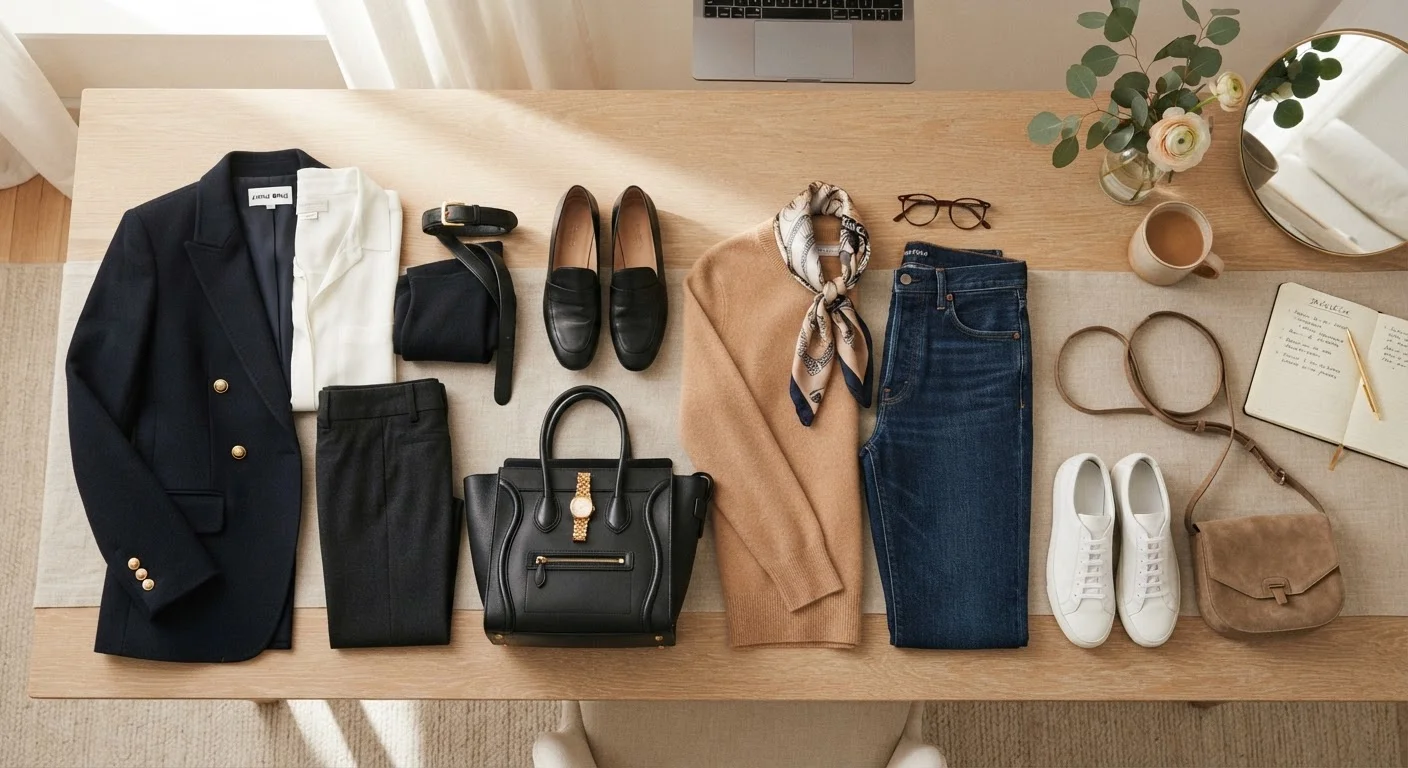
Choose two or three wardrobe staples that work across multiple dress code levels - a well-tailored blazer, a quality pair of dark trousers, and a simple clean-cut shoe are reliable examples. Anchoring your wardrobe this way means you can meet most dress code expectations without starting from scratch for every occasion.
Navigating Uncertainty with Confidence
One of the most common style anxieties today isn't "am I formal enough?" - it's "I genuinely don't know what's expected here." Whether you're starting a new job, attending an industry event, or heading to a gathering with an ambiguous dress code on the invite, uncertainty is now part of the experience.
A practical framework: default to one level above what you think is needed when stakes are high, and one level below when you want to connect socially rather than project authority. Versatile pieces - a well-cut blazer, dark trousers, clean leather or leather-look shoes - bridge most gaps. For a deeper look at dressing confidently when you're unsure of the dress code, we've put together a decision framework that takes the guesswork out of ambiguous situations.
The broader takeaway: dress code evolution hasn't made dressing harder - it's made it more personal. And that, for most of us, is genuinely good news.