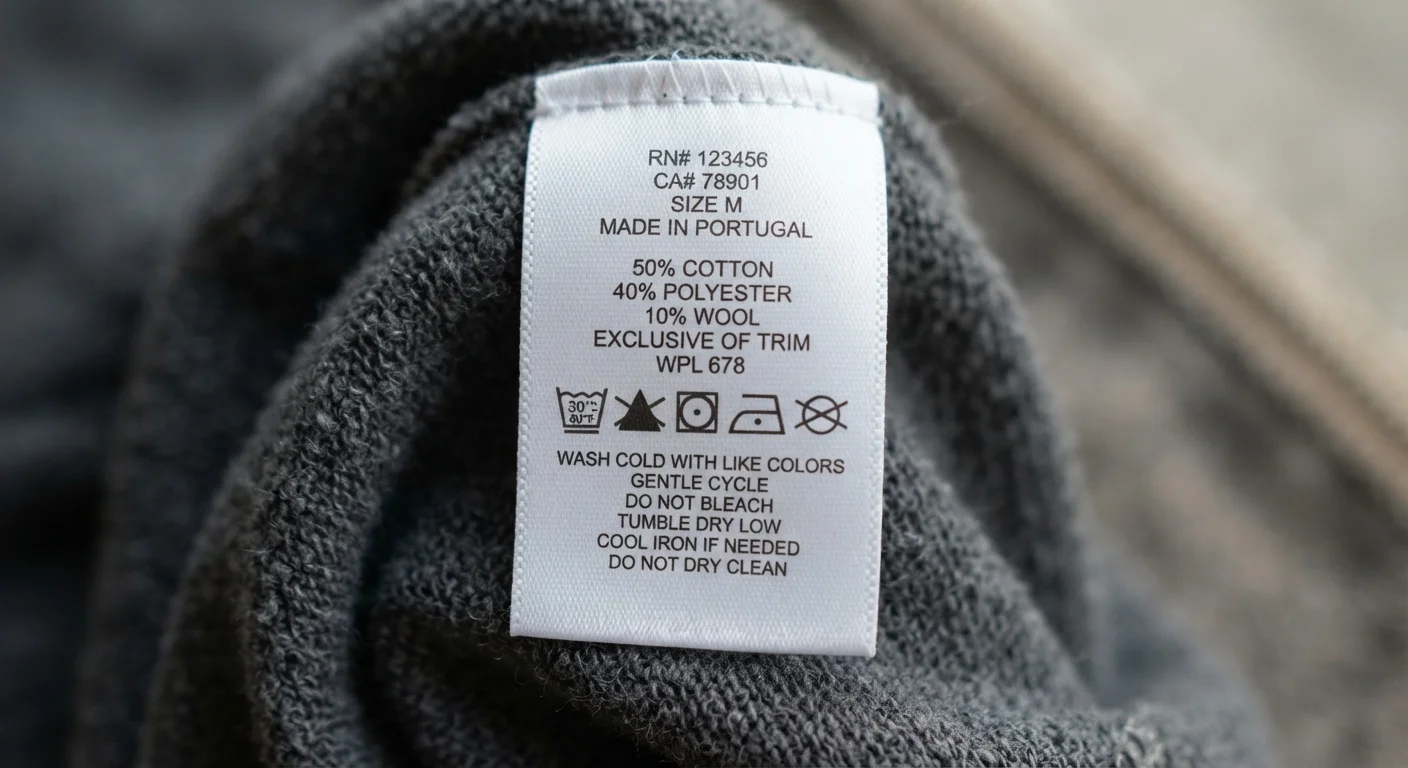
What's Actually on That Tag
Most of us snip out clothing labels the moment they start itching - but before you do, it's worth knowing what those tiny tags are actually telling you. In the U.S., the Federal Trade Commission (FTC) requires that most garments sold domestically carry a permanent label disclosing fiber content, country of origin, manufacturer identification, and care instructions. That's a lot packed into a little rectangle.
| U.S. labeling authority | Federal Trade Commission (FTC) (FTC Textile Labeling Rules) |
| Minimum fiber to disclose | 5% of garment weight (FTC Care Labeling Rule) |
| Care symbol standard (U.S.) | ASTM D5489 (ASTM International) |
| Number of base care symbols | 5 (wash, bleach, dry, iron, dry clean) (ASTM D5489 standard) |
| Label permanence requirement | Must remain legible for the garment's useful life (FTC Care Labeling Rule) |
The fabric content line lists every fiber present at 5% or more by weight, in descending order. So a label reading "60% Cotton, 35% Polyester, 5% Spandex" tells you cotton is the dominant material, with polyester adding durability and spandex providing stretch. Understanding this blend helps you predict how the garment will feel, breathe, and hold up over time. For a deeper dive into how different materials perform day-to-day, see our guide to common fabric types.
Decoding Care Symbols
The pictogram system used on U.S. labels follows the ASTM D5489 standard - a set of symbols developed to communicate laundering instructions visually, regardless of language. Once you learn the five base symbols, you can read almost any care label worldwide.
Fiber content
The percentage breakdown of every material used to make a fabric, listed by weight. U.S. law requires disclosure of any fiber making up 5% or more of the garment.
ASTM D5489
The American standard for care labeling symbols used on textile products. It defines the pictograms for washing, drying, bleaching, ironing, and dry cleaning.
Delicate / Gentle cycle
A washing machine setting that uses slower agitation and spin speeds to reduce mechanical stress on fragile fabrics or construction details.
Viscose / Rayon
A semi-synthetic fiber made from processed wood pulp. It's soft and drapey but loses significant strength when wet, making gentle handling essential.
Elastane / Spandex
A highly elastic synthetic fiber blended in small amounts into fabrics to add stretch and recovery. Heat degrades its elasticity over time.
Dry clean only
A care instruction indicating the garment should be processed by a professional dry cleaner using chemical solvents rather than water-based washing.
- Washtub (with water) - Indicates machine or hand washing. The number inside, if present, is the maximum water temperature in Fahrenheit or Celsius. A hand dipping into the tub means hand wash only.
- Triangle - Addresses bleaching. An empty triangle means any bleach is acceptable; lines inside it restrict you to non-chlorine bleach; a crossed-out triangle means no bleach at all.
- Square with circle inside - Tumble drying instructions. Dots inside indicate heat level: one dot for low, two for medium, three for high. An X through it means lay flat or hang to dry.
- Iron - Dots represent heat settings (one = low/synthetics, two = medium/wool, three = high/cotton/linen). An X means do not iron.
- Circle - Dry cleaning. A plain circle means professional dry clean; letters inside give the cleaner specific solvent instructions. An X means do not dry clean.
When a symbol has a single horizontal bar underneath it, use the gentle cycle or reduced agitation. Two bars means use the delicate cycle. These nuances matter more than most people realize - common damage like shrinking and pilling often traces directly back to ignored care instructions.
Fabric Blends and Why They Matter
Pure natural fibers and pure synthetics each have trade-offs. Blends exist to balance those trade-offs in practical ways. Here's a quick reference for what common compositions signal:
65%+
Of U.S. apparel contains polyester
Polyester is the world's most widely used textile fiber, according to Textile Exchange fiber market reports.
~60°F
Water temp that prevents most shrinkage
Washing in cool water (around 60°F / 15°C) significantly reduces the risk of heat-related fiber shrinkage for most natural fabrics.
Up to 30%
Shrinkage possible in untreated wool
Wool fibers can felt and shrink dramatically in hot water due to their scaly surface structure - a key reason care labels matter.
- 100% Cotton - Breathable, soft, prone to shrinking and wrinkling. Machine wash warm is usually fine, but check for pre-shrunk labeling.
- Cotton-polyester blends - More wrinkle-resistant and faster drying than pure cotton; slightly less breathable. A workhorse for everyday wear.
- Wool or wool blends - Warm, moisture-wicking, and naturally odor-resistant, but often require cool water or dry cleaning. For home care guidance, see caring for delicate fabrics at home.
- Rayon / Viscose - Drapes beautifully but weakens when wet; hand wash cold or dry clean.
- Spandex / Elastane (Lycra) - Always a minority fiber (typically 2-10%) added for stretch. Avoid high heat, which breaks down elastic fibers over time.
- Linen - Naturally stiff but softens with washing; wrinkles easily, which is part of its charm. Usually machine washable on a gentle cycle.
Fabric composition also has a direct relationship to how clothing fits and moves - something worth keeping in mind when you're shopping. Our article on everything that affects clothing fit covers this in more detail.
When Labels Are Missing or Worn
If a label has been removed or become unreadable, you can often identify fabric by feel and burn test (performed safely by a textile professional), or look up the original product listing from the retailer or manufacturer. When in doubt, default to the most conservative care option: cold water, gentle cycle, air dry. This approach protects nearly any fabric type.