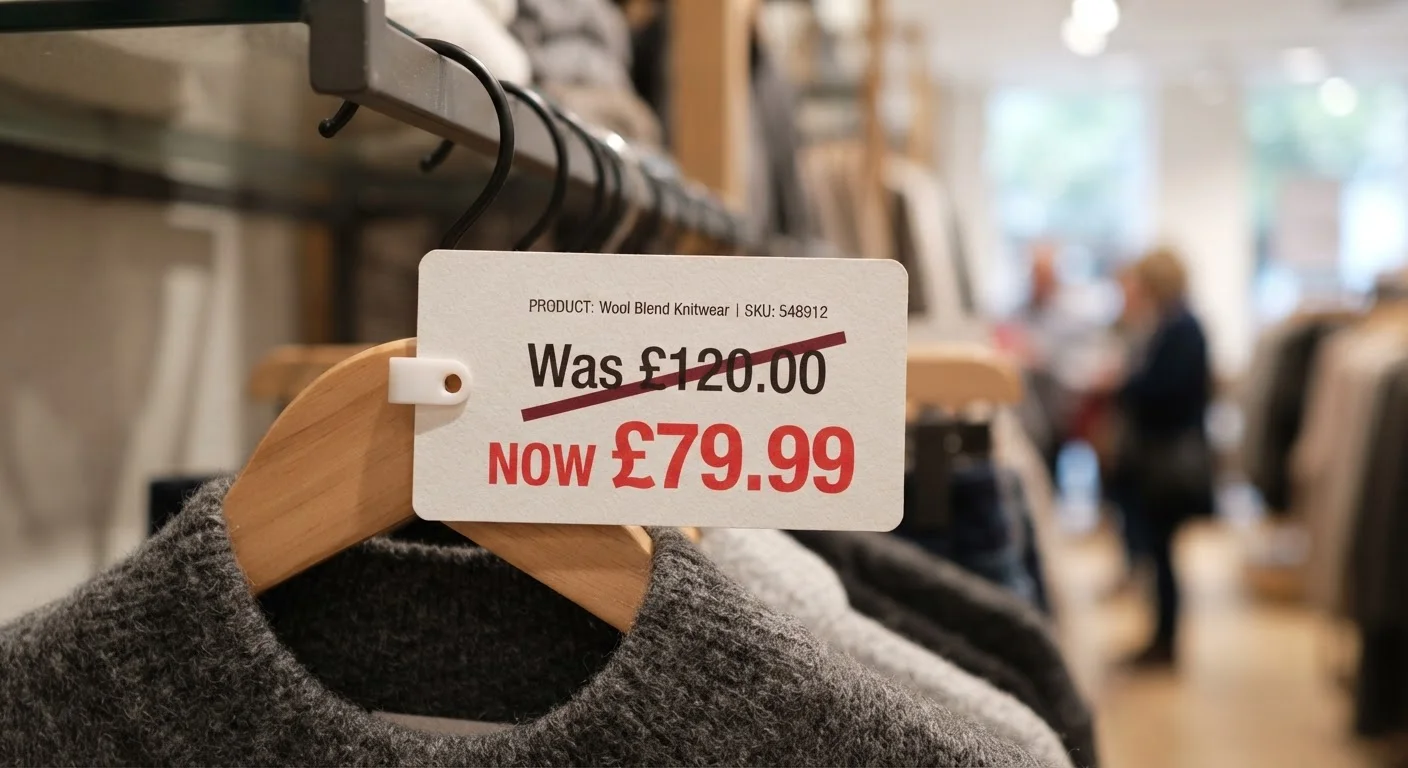
How Retailers Define - and Stretch - 'Sale'
Walk through any store or browse any retail site and you'll encounter a cascade of sale signals: red tags, percentage-off banners, limited-time countdowns. The word "sale" feels like a fact. It isn't. It's a marketing label retailers apply with significant latitude.
Most legitimate sales involve a genuine reduction from a price the item was recently and actually sold at. But many do not. The three most common departures from a real discount are:
- Inflated reference prices: Setting an artificially high "original" price before applying a markdown, so the percentage discount looks larger than it is.
- Perpetual sales: Items that are almost never sold at the supposed full price - meaning the "sale" price is effectively the regular price.
- Compare-at pricing: Citing a price from another retailer (or an unspecified market) rather than the store's own former price.
For a deeper look at how phantom pricing works in practice, see our article on fake markdowns and pricing illusions.
State Laws Vary on Reference Pricing
Several states - including California, New York, and Illinois - have specific statutes governing how long a former price must be held before it can be used in a sale advertisement. Requirements range from a minimum number of days to a minimum volume of sales. If you believe a sale advertisement is deceptive, your state attorney general's consumer protection office is the appropriate contact.
The Reference Price Problem
The believability of any sale depends entirely on the credibility of the starting price. FTC guidelines state that a "former price" should be one at which goods were openly and honestly sold in the recent past - not a price briefly listed and never transacted. Many state laws echo this, requiring that a reference price be held for a set minimum period before a markdown is advertised.
In practice, proving a reference price was legitimate is difficult for individual shoppers. Retailers are rarely required to display transaction histories at point of sale. This is why price-tracking tools - browser extensions or dedicated apps that log a product's price over time - are among the most practical defenses a shopper has.
87%
Shoppers who factor sale labels into purchase decisions
A Civic Science consumer survey found the vast majority of U.S. shoppers say sale or discount labels meaningfully influence their likelihood to buy an item.
~33%
Share of 'sale' items never sold at the reference price
Research published by academics studying major U.S. retailers found a significant proportion of promoted 'sale' items had little or no transaction history at the stated original price.
The core question to ask: Was this item routinely sold at the stated original price, or was that price set to make the discount look impressive? If an item is on sale 80% of the time, the sale price is the real price.
When 'On Sale' Is the Honest Truth
Not all sales are theater. Genuine discounts occur regularly - at end of season, during inventory clearance, after a product line is updated, or when a retailer absorbs cost reductions from suppliers. These tend to share identifiable characteristics:
- The discount is time-bounded and tied to a clear business reason (season change, model year update).
- The item's price history shows it was consistently sold at or near the reference price before the sale.
- The markdown percentage is modest and plausible rather than suspiciously dramatic.
For concrete signals that a discount reflects genuine value rather than marketing packaging, our guide on spotting a genuinely good deal walks through specific criteria worth checking.
Use Price History Before You Buy
Before accepting a sale price at face value, look up the item's price history using a browser extension or price-tracking tool. If the 'sale' price matches the item's typical going rate over the past 60-90 days, no real discount has occurred. A consistent pattern of the same 'sale' price is a clear signal the reference price is inflated.
Labels That Complicate the Picture
Several retail terms travel alongside "sale" and deserve individual scrutiny:
- Clearance
- Indicates the retailer wants to move inventory - often end-of-line or seasonal stock. The price may be genuinely reduced, but it's not guaranteed to be lower than a competitor's everyday price. Clearance items sometimes reappear in other store locations or online at higher prices.
- Closeout
- Suggests the item is being discontinued. Can represent real value, but quality or availability of returns and warranties may differ.
- Flash Sale / Limited Time Offer
- Time pressure is the core mechanic. Urgency is manufactured to accelerate purchasing. The price itself may or may not be genuinely lower than usual.
Our retail pricing glossary decodes these and other commonly misread terms in plain language.
It's also worth remembering that buying something at a discount you didn't need isn't savings - it's spending. The myths around discounts and savings article addresses this distinction directly.