How Each Mechanism Actually Works
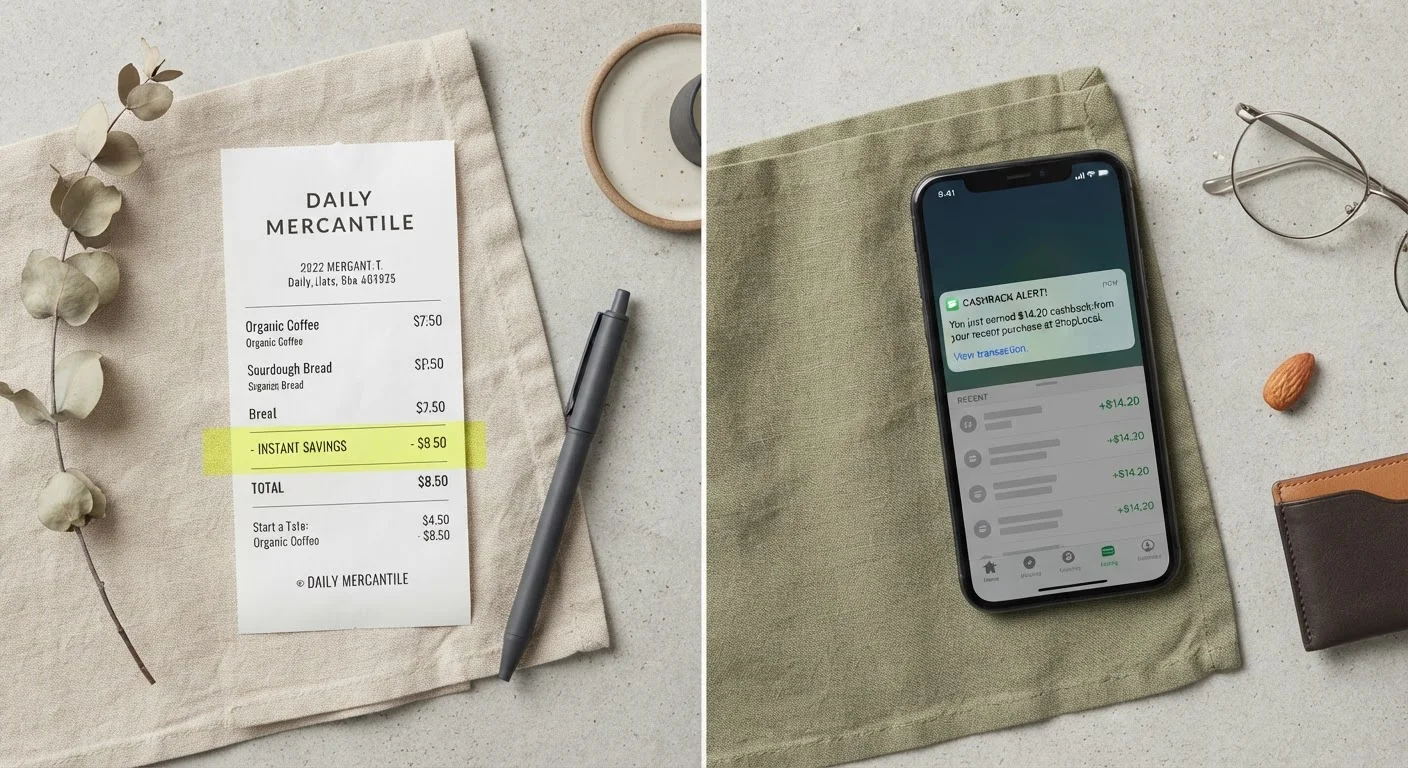
Understanding the difference between cashback and an instant discount starts with following the money through the transaction. An instant discount is applied directly to the price before or at checkout - the item costs less, your payment is lower, and the savings are settled the moment you complete the purchase. There is no secondary step required.
Cashback, by contrast, is a deferred credit. You pay full price (or a pre-discounted price), and a percentage of that spend is later returned to you - through a card statement credit, a platform wallet, a bank deposit, or reward points. The return is conditional: it typically requires you to meet program terms, hold an active account, and initiate or wait for a redemption cycle.
For a deeper breakdown of how these relate to related savings types, see the difference between a discount, a rebate, and a coupon.
| Criterion | Cashback | Instant Discount |
|---|---|---|
| When savings are received | After purchase (days to weeks) | At checkout, immediately |
| Certainty of savings | Conditional on program terms | Guaranteed at point of sale |
| Effect on purchase price | None - you pay full price upfront | Reduces price before payment |
| Risk of forfeiture | Yes - expiry, thresholds, returns | No - applied and settled instantly |
| Tracking required | Yes - balance, redemption, expiry | No - visible on receipt |
| Typical availability | Cards, apps, platform programs | Sales, promo codes, coupons |
Where Cashback Loses Value in Practice
The headline cashback percentage rarely tells the full story. Several structural factors erode what you ultimately receive:
- Minimum redemption thresholds: Some programs require you to accumulate $20-$25 before you can withdraw earnings. If you don't hit that threshold before an account closes or terms change, the balance may be forfeited.
- Expiration windows: Cashback balances can expire after 12-24 months of account inactivity, or upon program restructuring.
- Category restrictions: Elevated cashback rates often apply only to specific merchant categories. Spending outside those categories earns a fraction of the advertised rate.
- Return policy friction: If you return a cashback-eligible item, the associated cashback is typically reversed - but you may have already spent or redeemed it.
These conditions mean a 10% cashback offer and a 10% instant discount are not equivalent. The instant discount delivers its full value immediately and unconditionally; the cashback offer delivers a potential 10% subject to conditions you must actively manage.
~30%
Cashback rewards never redeemed
Industry estimates suggest a significant portion of earned cashback and reward balances go unredeemed due to expiration or account inactivity, reducing their practical value.
2-5%
Typical cashback rate range
Most standard cashback programs return between 2% and 5% on eligible purchases, with higher rates often restricted to specific spending categories.
When Cashback Is the Smarter Choice
Cashback isn't without merit - it suits specific shopping patterns well. If you consolidate regular, planned purchases through a single platform or card, and you have the discipline to redeem before expiration, cashback can return meaningful value over time. It also stacks in situations where no instant discount is available: a 2% cashback card used on a full-price purchase is still better than nothing.
Cashback programs also function differently from loyalty point schemes, which carry their own valuation complexity. For more on that distinction, see why loyalty points rarely equal their implied cash value.
The key test: Would you make this purchase at full price even without the cashback? If yes, the cashback is a genuine bonus. If the cashback is motivating a purchase you'd otherwise skip, it's functioning as a marketing incentive rather than a savings mechanism - and the math rarely favors you. See why buying more to save more often costs you more for the broader pattern.
Cashback on Returns: A Common Catch
If you purchase an item using a cashback program and later return it, the retailer or card issuer will typically claw back the cashback earned on that transaction. If you've already redeemed that cashback into a balance you've spent, you could end up financially worse off than if you'd taken a straightforward discount. Always factor in your likelihood of returning an item when weighing deferred reward structures.
Making a Clear-Headed Comparison at Checkout
When both options are on the table simultaneously - for example, a retailer offering an instant discount while your credit card provides cashback on the same purchase - evaluate them separately and in sequence. The instant discount reduces your taxable purchase amount (relevant for sales-tax calculations in many states), whereas cashback is applied post-transaction and doesn't affect the amount charged.
If you're deciding between a store that offers 15% cashback and a competitor with a 12% upfront sale price reduction, the competitor's discount is likely the stronger choice for most consumers - the certainty and immediacy of the savings outweigh the higher headline number attached to deferred cashback.
Some retailers allow you to combine discount methods at checkout. Stacking discounts legally and effectively explains which combinations are typically permitted and how to apply them without violating program terms.
For a broader look at how structured rewards programs compare to simply paying a lower price, see loyalty programs vs. simply paying less.
This article is for general informational purposes only and does not constitute financial or purchasing advice tailored to your individual circumstances. Terms for cashback programs and discount offers vary by provider; always review program conditions before relying on projected savings.