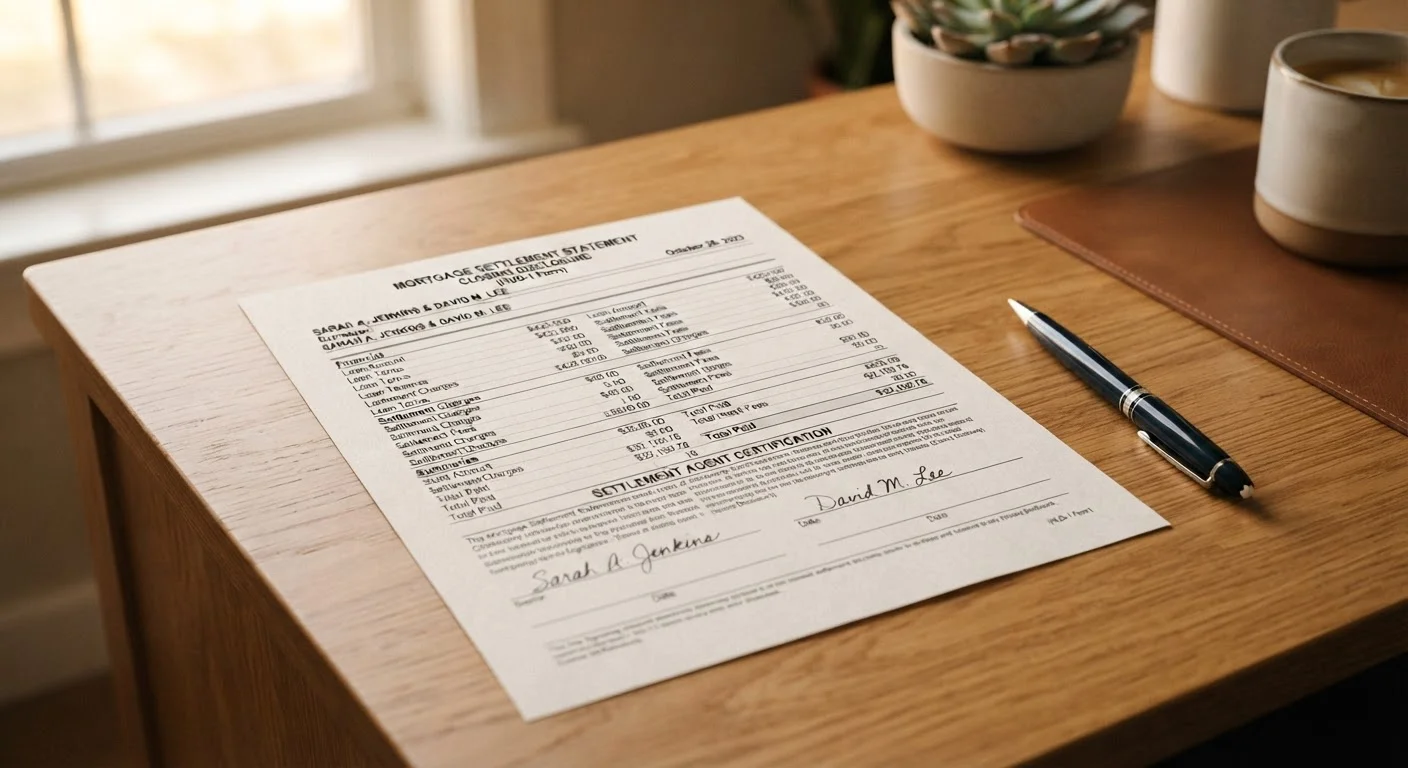
Why Your Settlement Statement Can Feel Overwhelming
The settlement statement - formally called the Closing Disclosure - arrives at least three business days before closing and lists every fee, prepaid item, and credit involved in your transaction. For most buyers, it's the first time they've seen many of these charges named and priced. The document isn't designed to be intimidating; it's federally mandated to be transparent. But the terminology can make it feel otherwise.
This reference decodes each common line item in plain language so you know exactly what you're paying for - and whether a charge looks reasonable. For a full walkthrough of how the Closing Disclosure is structured page by page, see how to read your Closing Disclosure.
| Typical total closing costs (buyer) | 2%-5% of the purchase price (Consumer Financial Protection Bureau (CFPB)) |
| Closing Disclosure delivery requirement | At least 3 business days before closing (TRID rule, CFPB) |
| Loan Estimate delivery requirement | Within 3 business days of application (RESPA / TRID, CFPB) |
| Typical lender origination fee | 0.5%-1% of the loan amount (General industry range) |
| Owner's title insurance | Optional but recommended for buyers (CFPB homebuyer guidance) |
| FHA upfront mortgage insurance premium | 1.75% of the base loan amount (HUD FHA guidelines) |
Lender Fees: What You're Paying the Bank
Lender fees compensate the institution originating your loan. They are generally negotiable, and comparing them across lenders is one of the most effective ways to reduce closing costs.
Closing Disclosure
A federally required five-page document provided to borrowers at least three business days before closing. It itemizes all loan terms, monthly payments, and closing costs.
Origination Fee
A lender charge covering the administrative cost of creating your mortgage. It may be expressed as a flat dollar amount or a percentage of the loan amount.
Discount Points
Prepaid interest paid upfront to reduce the mortgage interest rate. Each point equals 1% of the loan amount.
Escrow Account
An account held by the lender or servicer that collects portions of your monthly payment to cover future property tax and homeowners insurance bills.
Title Insurance
A one-time premium that protects against financial loss from defects in a property's title, such as undisclosed liens or ownership disputes discovered after closing.
Prepaid Interest
Interest charged for the days between your closing date and the end of that month, collected upfront because your first full mortgage payment won't be due until the following month.
Transfer Tax
A state or local tax assessed when real property changes ownership. The rate and responsibility for payment vary significantly by jurisdiction.
Recording Fee
A government charge to officially enter the deed and mortgage into public land records, establishing legal ownership.
- Origination fee: A broad charge covering the lender's cost to process and underwrite your loan. Often expressed as a percentage of the loan amount - typically 0.5% to 1%.
- Discount points: Optional prepaid interest you pay upfront to buy down your interest rate. One point equals 1% of the loan amount and typically lowers the rate by 0.25%, though the exact reduction varies by lender and market conditions.
- Application fee: Some lenders charge this to cover initial processing. Not all lenders assess it, and it is sometimes refundable if the loan doesn't close.
- Underwriting fee: Compensates the underwriter who evaluates your financial risk profile and approves the loan.
- Rate lock fee: Charged by some lenders to guarantee your interest rate for a set period while the loan processes.
Lender fees must be disclosed on the Loan Estimate you receive within three business days of application. Compare that document to your Closing Disclosure - certain fees cannot legally increase between those two documents.
Third-Party and Government Fees
These charges go to service providers and government entities, not your lender. Some are fixed by local law; others vary by the provider you choose.
- Appraisal fee: Pays a licensed appraiser to value the property. Typically $300-$600, though higher for large or complex homes.
- Title search fee: Covers a search of public records to confirm the seller has clear ownership and no hidden liens exist.
- Title insurance (lender's policy): Protects the lender - not you - if a title defect surfaces after closing. Usually required by lenders.
- Owner's title insurance: Optional but strongly recommended; protects your equity if a prior ownership dispute arises.
- Settlement or closing fee: Paid to the title company or closing attorney who coordinates the closing and disburses funds.
- Recording fees: Charged by the county or municipality to officially record the deed and mortgage in public records.
- Transfer taxes: State or local taxes on the transfer of property ownership. Amounts vary significantly by location and are sometimes split between buyer and seller.
- Survey fee: Pays a licensed surveyor to confirm property boundaries. Not required in every transaction but commonly requested by lenders or buyers.
To understand which of these fees fall to the buyer versus the seller by convention, see the breakdown of buyer and seller closing costs.
2%-5%
Typical buyer closing costs as share of purchase price
The Consumer Financial Protection Bureau (CFPB) cites this range as a general benchmark for buyers to budget against.
$6,000+
Average closing costs paid by U.S. homebuyers
Estimates from industry surveys vary; costs differ significantly by loan size, state, and local tax rules.
3 days
Minimum notice before closing for Closing Disclosure
Federal law (TRID rule) guarantees buyers at least three business days to review the Closing Disclosure before signing.
Prepaids and Escrow: Money You're Paying in Advance
Prepaids and escrow deposits are often the most misunderstood section of a settlement statement because they aren't fees for services - they're money collected in advance for ongoing obligations.
- Prepaid interest: Interest that accrues from your closing date through the end of that calendar month. Because your first mortgage payment isn't due until roughly six weeks after closing, the lender collects this gap upfront.
- Prepaid homeowners insurance: Lenders typically require the first year's premium paid at or before closing, often as a condition of funding.
- Escrow account deposit (initial): Your lender may establish an escrow account to collect future property tax and insurance payments monthly. At closing, you fund this account with an initial deposit - usually two to three months' worth of each payment - to create a buffer against timing gaps.
- Mortgage insurance premium (MIP or PMI): If your down payment is less than 20% on a conventional loan, private mortgage insurance may be prepaid or included in your monthly payment. FHA loans carry an upfront mortgage insurance premium (UFMIP) that appears as a closing cost line item.
Prepaids increase your cash-to-close figure but are not profit for anyone - they go toward obligations you'll owe regardless. The total financial picture of buying a home beyond the purchase price is covered in detail at the true cost of buying a home.
You Can Request a Fee Explanation
If any line item on your Closing Disclosure is unclear or different from your Loan Estimate, you have the right to ask your lender or closing agent for a written explanation before you sign. Certain fees - particularly lender fees - cannot increase from the Loan Estimate without a valid change-of-circumstance reason. Don't hesitate to ask questions; it's your legal right under federal mortgage disclosure rules.
This article is for general informational purposes only and does not constitute financial, legal, or mortgage advice. Actual closing costs vary by location, lender, loan type, and transaction. Consult a licensed real estate attorney, HUD-approved housing counselor, or mortgage professional for guidance specific to your situation.