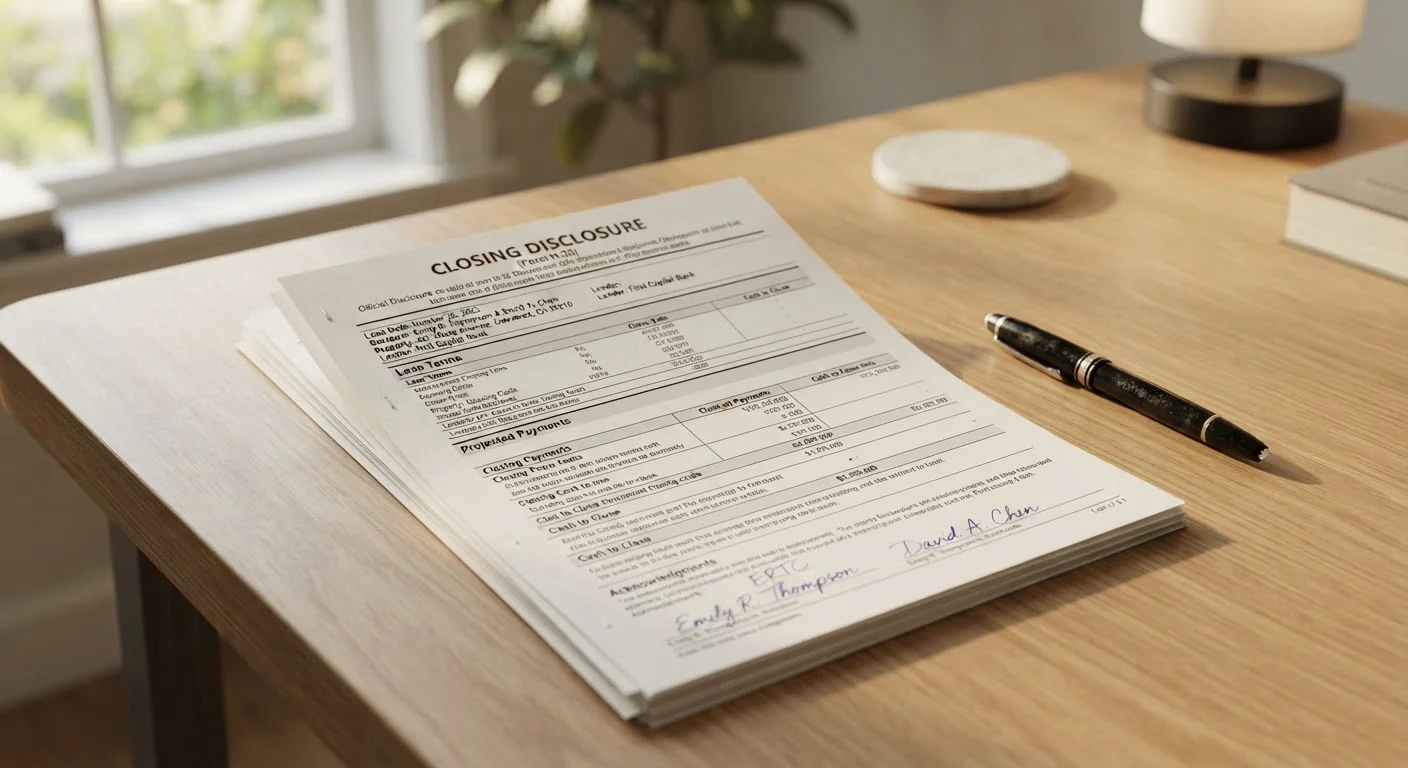
What the Closing Disclosure Is - and Why It Matters
The Closing Disclosure (CD) is a standardized, five-page federal form your lender is required to deliver at least three business days before your mortgage closing. It replaces the older HUD-1 Settlement Statement for most residential loans and reflects the final, binding terms of your loan - not estimates.
Think of it as the authoritative record of every dollar changing hands. Before you sit at the closing table, compare it line by line against the Loan Estimate you received earlier in the process. Discrepancies in certain fee categories are regulated: some charges cannot increase at all, others are capped at a 10% aggregate increase, and a third category can change without limit. Knowing which is which protects you from unexpected costs. See our step-by-step walkthrough of closing day for broader context on how this document fits into the process.
| Form name | Closing Disclosure (CFPB Form H-25) (Consumer Financial Protection Bureau) |
| Required delivery window | At least 3 business days before closing (TRID Rule, 12 CFR §1026.19) |
| Total pages | 5 pages |
| Predecessor document | HUD-1 Settlement Statement (Replaced for most loans in October 2015) |
| Zero-tolerance fees (cannot increase) | Lender fees, appraisal, credit report (CFPB TRID guidelines) |
| 10% tolerance fees | Title services selected from lender list, recording fees (CFPB TRID guidelines) |
Page-by-Page Breakdown of the Closing Disclosure
Page 1 - Loan Terms and Projected Payments: The top box shows your loan amount, interest rate, monthly principal-and-interest payment, and whether your rate or payments can rise. A checked "YES" next to any of those fields means you need to read the explanation carefully. The Projected Payments table below breaks down what you'll pay each month - principal, interest, mortgage insurance, and estimated escrow - across different loan phases.
Page 2 - Closing Cost Details: This is the most detail-dense page and deserves the most attention. It is divided into three sections:
• Section A: Origination Charges - fees paid directly to your lender, such as points and underwriting. These cannot increase from your Loan Estimate.
• Section B: Services You Could Not Shop For - appraisal, credit report, flood determination. Also cannot increase.
• Section C: Services You Could Shop For - title insurance, settlement agent fees. These can change only if you chose a provider not on the lender's approved list.
Sections E through H cover prepaid items, escrow setup, and other costs like transfer taxes and recording fees.
Page 3 - Cash to Close and Summaries: The Calculating Cash to Close table shows exactly how your final number was reached - starting from total closing costs, then subtracting your down payment, credits, and any seller concessions. The Summaries of Transactions section breaks out the full ledger for both borrower and seller. For a line-by-line explanation of each cost category, see Closing Costs Decoded.
Pages 4 & 5 - Loan Disclosures and Contact Information: Page 4 covers liability protections (assumption policy, demand feature, negative amortization), escrow account details, and partial payment policy. Page 5 lists lender and settlement agent contact information plus a summary of your loan calculations, APR, and total interest percentage over the life of the loan.
Closing Disclosure (CD)
A five-page federal form listing the final terms and costs of a mortgage loan. Lenders must provide it at least three business days before closing under the TRID rule.
Annual Percentage Rate (APR)
The true yearly cost of borrowing, expressed as a percentage. It includes the interest rate plus certain lender fees, making it higher than the note rate and useful for comparing loan offers.
Total Interest Percentage (TIP)
The total amount of interest you will pay over the full life of the loan, expressed as a percentage of the loan amount. A high TIP on a long-term loan is normal but worth understanding before you sign.
Escrow Account
An account held by the lender into which you make monthly contributions for property taxes and homeowner's insurance. The lender pays these bills on your behalf when they come due.
Origination Charges
Fees paid directly to your lender for processing and underwriting the loan. These include any discount points you pay to lower your interest rate and cannot increase from your Loan Estimate.
Cash to Close
The total funds you must bring to the closing table, calculated as total closing costs plus your down payment, minus any credits, deposits already paid, or seller concessions.
Loan Estimate
A three-page form provided early in the mortgage process showing estimated loan terms and costs. The Closing Disclosure should be compared against it to identify any impermissible fee increases.
Prepaid Items
Costs collected at closing for expenses that will come due shortly after - typically prepaid homeowner's insurance, prepaid interest covering days before your first payment, and the initial escrow deposit.
The Numbers Most Buyers Overlook
Two figures on Page 5 are frequently misunderstood. The Annual Percentage Rate (APR) is higher than your note rate because it folds in certain fees - use it to compare loan offers on an apples-to-apples basis. The Total Interest Percentage (TIP) expresses the total interest you'd pay over the full loan term as a percentage of the loan amount. A 30-year loan at a moderate rate can have a TIP above 60%, which surprises many first-time buyers.
Also review the escrow section carefully. Your monthly escrow payment covers property taxes and homeowner's insurance, and lenders are allowed to collect a cushion - typically up to two months of payments - as a reserve. If the initial escrow deposit on Page 2 seems large, this cushion is almost always the reason.
Request Clarification Before Closing Day
You have three business days to review the Closing Disclosure before you're expected to sign. If any figure differs from your Loan Estimate in a way you don't understand, contact your lender or settlement agent in writing and ask for an explanation. Certain changes - like a significant increase in lender fees - may legally require a new three-day waiting period. Don't let time pressure discourage you from asking questions.
This article is for general informational purposes only and does not constitute financial, legal, or mortgage advice. Consult a licensed mortgage professional or HUD-approved housing counselor for guidance specific to your situation.