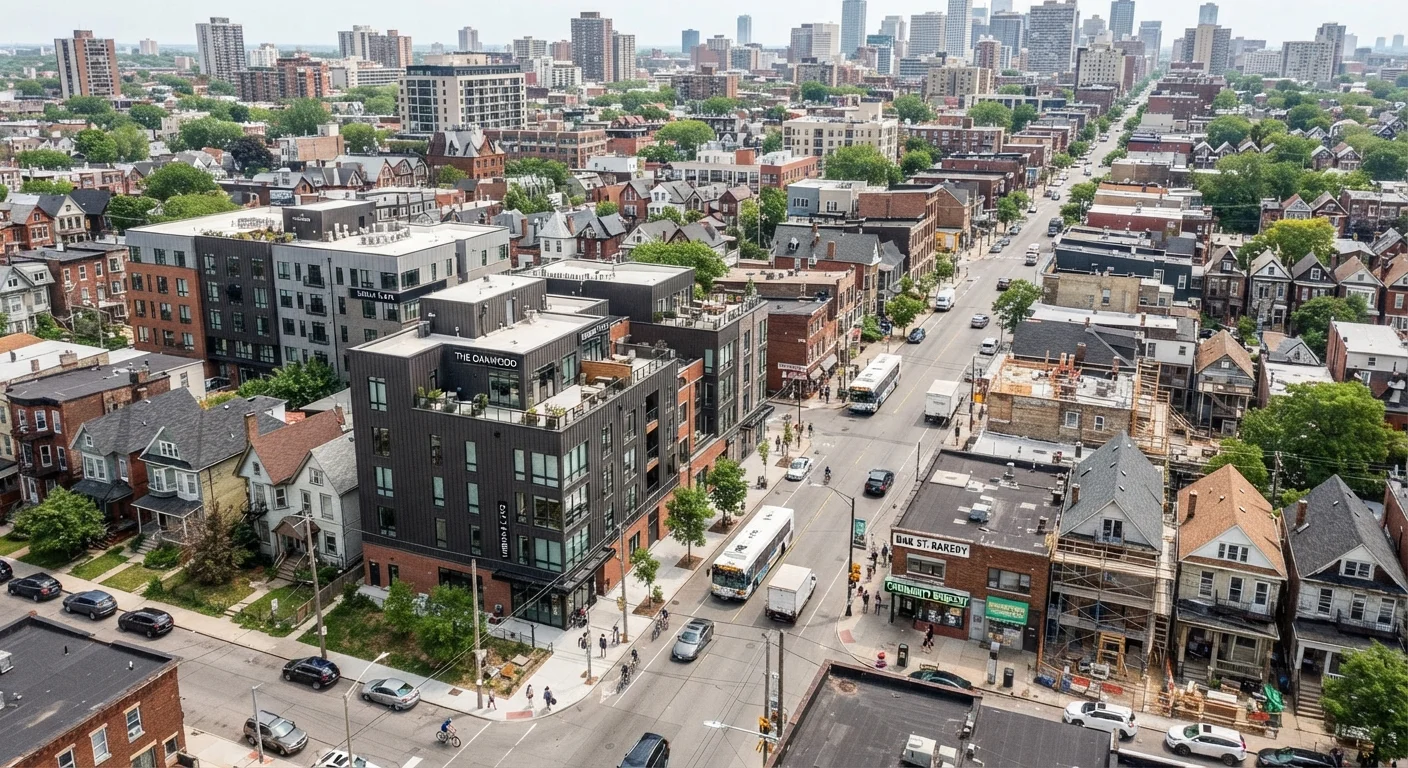
What Gentrification Actually Means
The word 'gentrification' entered mainstream use in the 1960s, coined by British sociologist Ruth Glass to describe the displacement of working-class London residents by middle-class newcomers. In the United States, the concept took on sharper edges, intersecting with the country's history of racial segregation, redlining, and urban disinvestment.
At its core, gentrification describes a neighborhood-level economic shift: capital flows in, property values rise, and the existing population - especially renters - often cannot afford to stay. The process is rarely sudden. It typically unfolds over years or decades, driven by a combination of private investment decisions, municipal policy, and broader economic pressures such as tight housing supply in desirable cities.
Understanding the term matters for renters, buyers, and homeowners alike, particularly when evaluating how a neighborhood is changing and what those changes might mean for daily life. See also our discussion of urban, suburban, and rural trade-offs for broader context on how location shapes everyday experience.
A Note on the Research
Studies on gentrification's effects on displacement are methodologically complex, and findings vary depending on city, time period, and how 'displacement' is measured. Direct displacement (being forced to move) is harder to document than indirect displacement (being unable to afford to move in). Readers should treat broad claims about gentrification's effects - positive or negative - with appropriate context-sensitivity.
How Gentrification Unfolds in Practice
Gentrification typically follows recognizable stages, though no two neighborhoods are identical. In early stages, artists, young professionals, or lower-income pioneers move into affordable but underserved areas - drawn by cheap rent and central location. Small businesses follow. Property investors begin acquiring buildings. Renovation activity increases.
As the neighborhood gains visibility and desirability, rents begin climbing. Existing tenants may face non-renewal of leases, building conversions, or rent hikes they cannot absorb. Long-standing local businesses - often anchors of community identity - are replaced by higher-margin establishments catering to newer, wealthier residents.
~7-10%
Annual rent growth in high-gentrification tracts
Research published in urban economics journals has documented rent growth significantly above citywide averages in rapidly gentrifying census tracts.
1 in 5
Urban neighborhoods that experienced gentrification
A 2019 analysis by the National Community Reinvestment Coalition found that approximately one in five eligible urban neighborhoods gentrified between 2000 and 2013.
54%
Proportion of gentrified tracts that were majority non-white
The same NCRC analysis found more than half of gentrifying neighborhoods in large US cities had been majority non-white at the start of the study period.
Infrastructure investment often increases during this period: parks improve, public transit gets attention, crime rates may fall. These are real benefits. The contested question is who actually gets to enjoy them. Research from institutions including the National Bureau of Economic Research has found that displacement risks for low-income renters are measurable and concentrated in high-appreciation markets.
Homeowners in gentrifying areas occupy a different position. Rising property values build equity, and many long-term owners benefit financially - though property tax increases can impose unexpected strain, particularly on retirees and others on fixed incomes.
Why Gentrification Is Widely Contested
The debate over gentrification is genuinely complex, not merely political. Reasonable people - urban planners, economists, community advocates, and residents - disagree because the evidence itself is mixed and the distributional effects are unequal.
“The question is not whether neighborhoods should change - they always do - but whether the people who lived through the hard years get to share in what comes next.”
— Urban Policy Research Perspective, Representative framing from community development scholarship
Proponents of neighborhood investment argue that rising property values fund better schools through local tax bases, that crime reduction benefits everyone, and that density and mixed-income communities are desirable urban outcomes. They point out that opposing all investment in lower-income areas risks entrenching poverty.
Critics counter that when investment arrives without deliberate policies protecting existing residents, the people who weathered decades of disinvestment are precisely the ones priced out before the benefits materialize. Communities of color, who were often confined to these neighborhoods by historical discrimination, disproportionately bear this cost. The experience of renters versus owners in the same neighborhood reflects these stakes clearly.
The core tension is one of equity: investment itself is not harmful, but investment without protections can be.
How to Evaluate a Neighborhood That May Be Changing
For prospective renters and buyers, understanding whether a neighborhood is gentrifying - and at what stage - is a practical consideration, not just an ideological one. A few concrete steps help ground the evaluation:
- Track rent trends over time. Local listing data and sources like the Census Bureau's American Community Survey can show income and rent changes across census periods.
- Look at business turnover. New openings catering to higher-income demographics alongside the closure of long-established local businesses are a visible signal.
- Review recent permit and construction activity. Local building permit records show where renovation investment is flowing.
- Assess displacement pressures if you're renting. Research whether the area has rent stabilization protections, and understand your lease rights before committing to a home.
For buyers, a gentrifying neighborhood may represent genuine long-term value appreciation - but that should be weighed honestly alongside its community context. Our overview of renting vs. owning financial trade-offs covers the broader financial picture worth considering alongside neighborhood dynamics.
If You're Renting in a Changing Neighborhood
Before signing a lease in a neighborhood with visible price pressure, research whether local rent stabilization ordinances apply to your unit - many cities exempt newer buildings or single-family homes. Understanding your rights before a lease dispute arises is far more useful than learning them during one. Local tenant rights organizations can provide free guidance specific to your jurisdiction.
This article is for general informational and educational purposes only. It does not constitute legal, financial, or investment advice. Readers should consult qualified professionals regarding decisions specific to their circumstances.