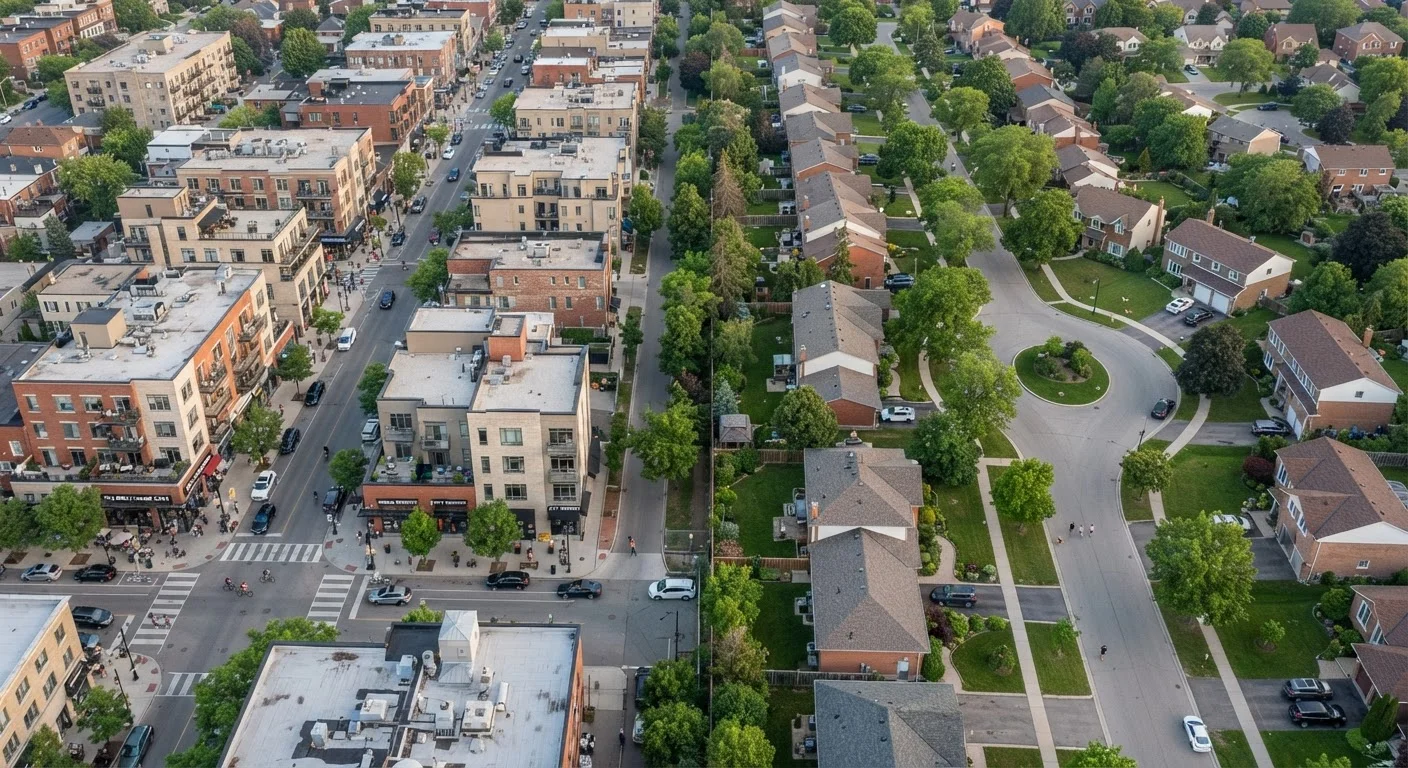
What You're Actually Comparing
The city-versus-suburb debate is rarely about aesthetics. It's a practical calculation involving housing costs, commute time, school access, daily convenience, and the kind of community fabric you want around you. Understanding what each setting genuinely offers - and what it requires - is the starting point for making a decision that holds up over time.
As the broader framework for urban, suburban, and rural trade-offs makes clear, the differences between these environments go well beyond price and square footage. They shape daily routines, social habits, transportation costs, and long-term financial outcomes. No two city neighborhoods are alike, and suburbs vary just as widely - from walkable inner-ring communities to car-dependent exurbs an hour from the nearest downtown.
| Criterion | City Neighborhood | Suburb |
|---|---|---|
| Housing cost per sq. ft. | Generally higher | Generally lower |
| Average living space | Smaller units typical | Larger homes typical |
| Transportation | Transit & walkable | Car-dependent in most areas |
| Commute to employment centers | Shorter for most jobs | Longer; varies by location |
| Public school access | Varies widely by district | Often well-funded; still varies |
| Walkable amenities | High density of services | Limited; car trip usually required |
| Outdoor/private space | Limited; shared parks | Yards and green space typical |
| Social density | High foot traffic, activity | Quieter, lower density |
| Best life stage fit | Singles, young couples, retirees | Families, remote workers |
Cost, Space, and the Housing Math
Urban neighborhoods typically command a premium on a per-square-foot basis. A two-bedroom apartment in a walkable city district may cost significantly more per month than a three-bedroom home in a comparable suburb. However, that comparison omits critical expenses. Car ownership - insurance, fuel, maintenance, and parking - can add thousands of dollars annually to suburban living costs, partially closing the gap.
~$10,000+
Annual average cost of car ownership in the U.S.
According to AAA's annual "Your Driving Costs" study, the average annual cost of owning and operating a vehicle - including depreciation, insurance, and fuel - exceeds $10,000, a figure often overlooked in city-versus-suburb cost comparisons.
27 min
Average U.S. one-way commute time
The U.S. Census Bureau's American Community Survey consistently reports that the average one-way commute for American workers is approximately 27 minutes, though suburban-to-urban commutes frequently exceed this average.
28%
Share of remote-capable workers fully remote post-pandemic
Pew Research Center surveys have found that roughly a quarter to a third of workers in remote-capable jobs work from home full-time, a shift that materially changes how households evaluate location trade-offs.
Suburbs offer more square footage for the dollar in most U.S. markets, which matters most for households that need dedicated office space, multiple bedrooms, or outdoor areas. City dwellers often offset smaller square footage through access to public parks, gyms, and shared commercial spaces. When building a complete budget, factor in transportation costs alongside housing - the budgeting basics that account for total household expenditure are as relevant here as anywhere.
Schools, Safety, and Local Services
For families with children, school district quality is often the decisive variable. Suburban school districts in many U.S. regions are funded through local property taxes, which can result in well-resourced schools in higher-value areas. That said, many urban districts have strong magnet programs, charter options, and well-regarded neighborhood schools. Research specific schools - not just district averages - using publicly available data from state education departments and tools like GreatSchools or the National Center for Education Statistics.
Safety perceptions often favor suburbs, but the reality is more nuanced. Crime rates vary enormously block by block in both urban and suburban settings. Walkable city neighborhoods with active street life can feel and be quite safe, while some suburban areas face property crime challenges. The factors that actually define neighborhood quality - including walkability scores, transit access, and local services - provide a more reliable framework than surface impressions alone.
Local services tell a different story by setting. Urban residents typically have healthcare, grocery stores, pharmacies, and entertainment within walking distance or a short transit ride. Suburban residents may drive 15-30 minutes for equivalent access, which becomes a meaningful time and cost factor for households with limited mobility, older adults, or those managing chronic health needs.
How Life Stage Changes the Calculation
The right environment for a 28-year-old renting a studio near their employer is rarely the right environment for that same person at 38 with two children and a remote job. Life stage is the most underweighted variable in this decision.
Early career and single households typically benefit from urban proximity - shorter commutes, walkability, and social density support both professional networking and quality of life. The cost premium is often offset by reduced transportation expenses and the value of time not spent commuting.
Families with young children often shift toward suburbs when school quality, outdoor space, and safety become primary concerns. This is the classic transition, and it's common for good reason - but it's worth stress-testing assumptions. Some urban neighborhoods have excellent schools and family-friendly infrastructure that rival suburban alternatives.
Remote workers represent a newer profile that has genuinely reshuffled the math. Without a daily commute, the suburban trade-off of distance from employment centers disappears. Many remote workers have moved outward - or to smaller towns entirely - precisely because location flexibility removes the cost of proximity. See the honest trade-offs of moving to a smaller town if that option is on your radar.
Empty-nesters and retirees frequently reconsider suburban living once children leave home. The large house, the lawn, and the car dependency that served a family of four can become burdens for a couple of two. Urban neighborhoods - or walkable inner suburbs - often suit this stage better, offering social engagement, reduced maintenance, and access to healthcare without driving.
Before committing to either setting, use a structured approach to assess the specific community you're considering. The neighborhood evaluation checklist covers transit, noise, local services, and safety in practical detail.
Neither Choice Is Permanent
Where you live now doesn't have to be where you live in five years. Many households move once or twice as life stages change - from a city apartment to a suburban home when children arrive, and sometimes back toward urban living in later years. Renting before buying in an unfamiliar area gives you time to evaluate a neighborhood's real-world qualities. For a closer look at how tenure status shapes your relationship to a community, see how renting vs. owning changes your neighborhood experience.