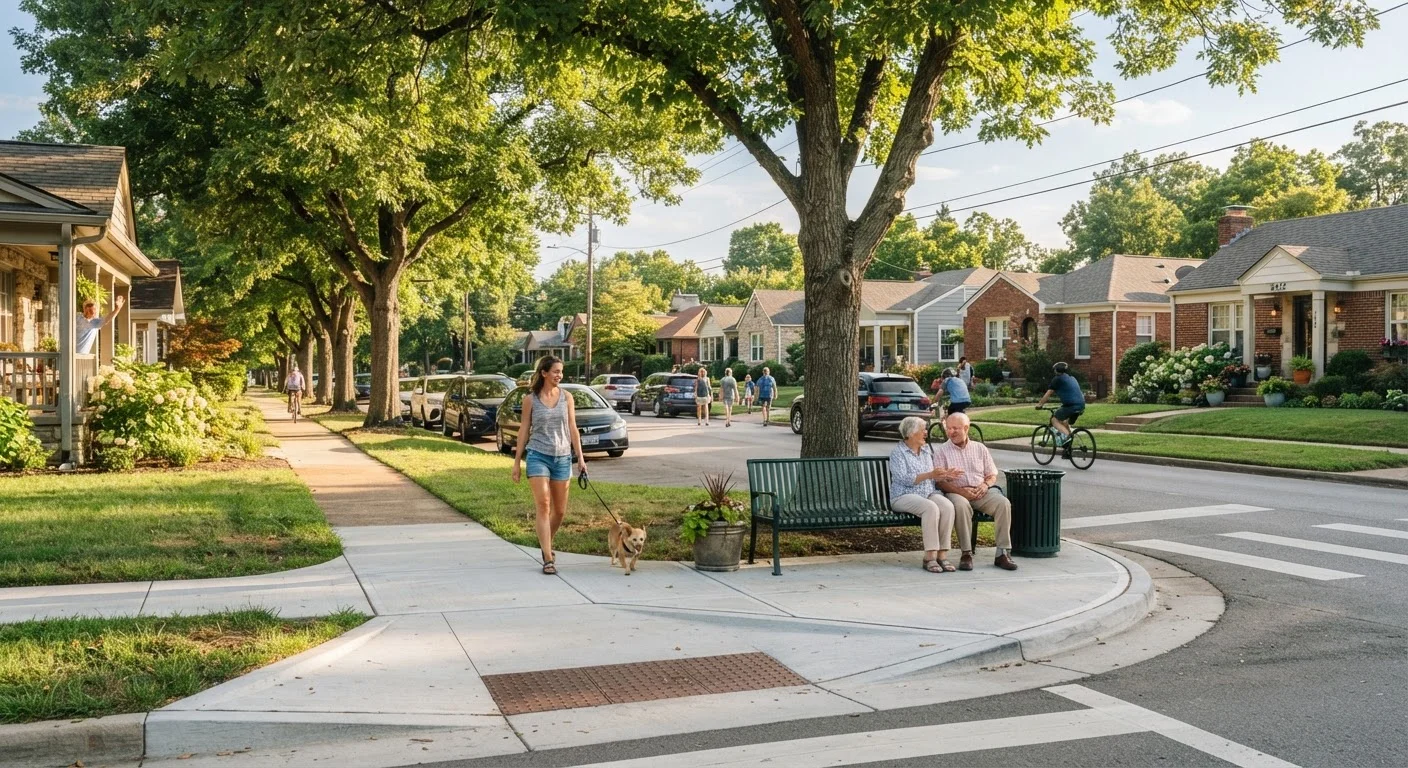
Why Neighborhood Choice Is a Long-Term Health Decision
Most people planning to age in place focus on the home itself - grab bars, step-free entries, wider doorways. But the neighborhood surrounding that home shapes daily life just as profoundly. A community that works well at 55 may create real hardship at 75 if it lacks accessible transit, nearby healthcare, or safe places to walk.
The concept of an age-friendly community - popularized by the World Health Organization's Age-Friendly Cities framework and adopted by hundreds of U.S. municipalities - recognizes that physical, social, and service environments all interact to support or undermine healthy aging. You don't need to move to a designated age-friendly city to benefit from this thinking; you can apply its criteria to any neighborhood you're evaluating.
For a broader neighborhood evaluation framework, see our neighborhood assessment checklist. The considerations below go deeper on factors that carry particular weight as you age.
Walkable Access to Everyday Errands
The ability to walk to a grocery store, pharmacy, or post office without getting in a car is one of the most practical measures of age-friendliness. As driving becomes more difficult - whether due to vision changes, medication effects, or reduced reaction time - walkable access to essentials preserves independence in a way that no amount of home modification can replicate.
Look for a neighborhood with a Walk Score above 70, continuous sidewalks without major gaps, and destinations reachable within a comfortable 10-15 minute walk on level ground. Research consistently links walkable neighborhoods to better long-term health outcomes, including lower rates of cardiovascular disease and better weight management.
Walkable errands preserve independence long after driving becomes difficult.
Accessible, Reliable Public Transit
Even in car-dependent regions, the presence of accessible bus lines, paratransit services, or ride-share programs can be decisive. Look for transit stops with benches and shelters, low-floor buses, and routes that connect to medical facilities and shopping districts. In areas without strong fixed-route transit, check whether the county or municipality offers demand-responsive paratransit - door-to-door service for older adults and people with disabilities - as a backup option.
Transit availability is often overlooked during the home search because buyers are driving themselves to showings. Ask local senior services agencies or the Area Agency on Aging (every U.S. region has one) about transportation options specifically available to older residents.
Paratransit programs can fill critical gaps when fixed-route buses don't serve your needs.
Proximity to Healthcare
Easy access to a primary care physician, specialists, urgent care, and a full-service hospital becomes less optional with age. Before committing to a neighborhood, map the distance to the nearest primary care practice, cardiology or orthopedics clinic, pharmacy, and emergency room. Aim for primary care within 5 miles and a hospital within 15-20 minutes by car or transit - though your personal health needs may warrant tighter thresholds.
Also investigate whether the area has a shortage of primary care providers accepting new Medicare patients, a common issue in rural and some suburban markets. For a systematic way to assess local health services and other amenities together, our guide to mapping local amenities walks through the process step by step.
Map your distance to primary care, specialists, and an emergency room before you commit.
Safe, Well-Maintained Pedestrian Infrastructure
Sidewalk quality, lighting, and crossing safety are often invisible to younger buyers but become central to daily safety as balance, vision, and reaction time shift with age. Cracked or uneven pavement is a fall hazard; poorly timed crosswalks create stress at intersections; absent curb cuts limit mobility for anyone using a cane, walker, or wheelchair.
During neighborhood visits, walk several blocks and note: Are sidewalks continuous and level? Are intersections equipped with accessible pedestrian signals and audible countdowns? Is street lighting adequate at night? Flat terrain with minimal steep grades is also worth prioritizing - hills that feel invigorating today can become barriers in later years.
Cracked sidewalks and absent curb cuts are fall hazards that escalate in significance with age.
Access to Green Space and Outdoor Recreation
Parks, trails, and natural areas support physical activity and mental wellbeing in measurable ways. For older adults, accessible green space - flat, paved paths; benches at regular intervals; shade - encourages regular movement without requiring gym memberships or special equipment. Research has linked regular time outdoors to reduced depression risk, lower cortisol levels, and higher reported quality of life.
Look for parks within a 10-minute walk that offer accessible, maintained paths. Our in-depth piece on green space and where you live explores the broader research behind why proximity to parks is worth factoring into any housing decision.
Accessible parks with paved, flat paths encourage daily movement without special equipment.
Social Infrastructure and Community Connection
Social isolation is one of the most significant and underappreciated health risks facing older adults. Neighborhoods that offer senior centers, libraries with active programming, faith communities, volunteer organizations, and regular neighborhood events provide the social scaffolding that supports cognitive health and emotional resilience over time.
When evaluating a community, look beyond the physical environment: Does the local library offer programs for older adults? Is there a senior center within reasonable distance? Are neighbors visible and interactive - front porches, community gardens, block associations? These signals suggest a neighborhood where social engagement is part of daily life rather than an effort requiring special coordination.
Social infrastructure - libraries, senior centers, faith communities - is as important as physical amenities.
Neighborhood Stability and Long-Term Affordability
Aging in place on a fixed or reduced income requires a stable cost environment. Rapidly gentrifying neighborhoods may see property taxes, rent, and service costs rise faster than income does. Research the area's property tax trajectory, the availability of senior property tax exemptions or freezes (many states and counties offer these), and the overall cost of living relative to your projected retirement income.
It's also worth considering whether the neighborhood's character - local businesses, walkable amenities, transportation links - is likely to be maintained or improved over your planning horizon. Our article comparing established neighborhoods versus new developments explores how infrastructure maturity and community character differ between these two settings.
Senior property tax exemptions exist in many jurisdictions - research them before you commit.
Making Your Evaluation Count
No neighborhood will be perfect across every dimension, and priorities differ depending on your current health, mobility, and social preferences. The goal is to identify trade-offs consciously rather than discover them after you've settled in.
Talk to the Area Agency on Aging
Every region in the U.S. has an Area Agency on Aging (AAA), a federally funded organization that coordinates services for older adults locally. Before settling on a neighborhood, contact the local AAA to ask about transportation programs, in-home support services, senior center locations, and any formal age-friendly initiatives underway in the area. Their knowledge of gaps in local services can be as informative as their knowledge of what's available.
Consider visiting a prospective neighborhood at different times of day and on foot, even if you currently drive everywhere. Pay attention to sidewalk continuity, the distance to a pharmacy or grocery store, and whether you see other older adults out and about - their presence is often a reliable signal of livability.
The home and the neighborhood work together. Our guide to aging-in-place home modifications covers the interior half of this equation. Pairing a well-adapted home with a neighborhood that genuinely supports independence gives you the strongest foundation for aging well on your own terms.
This article is for general informational purposes only and does not constitute financial, legal, or medical advice. Consult qualified professionals regarding decisions specific to your circumstances.