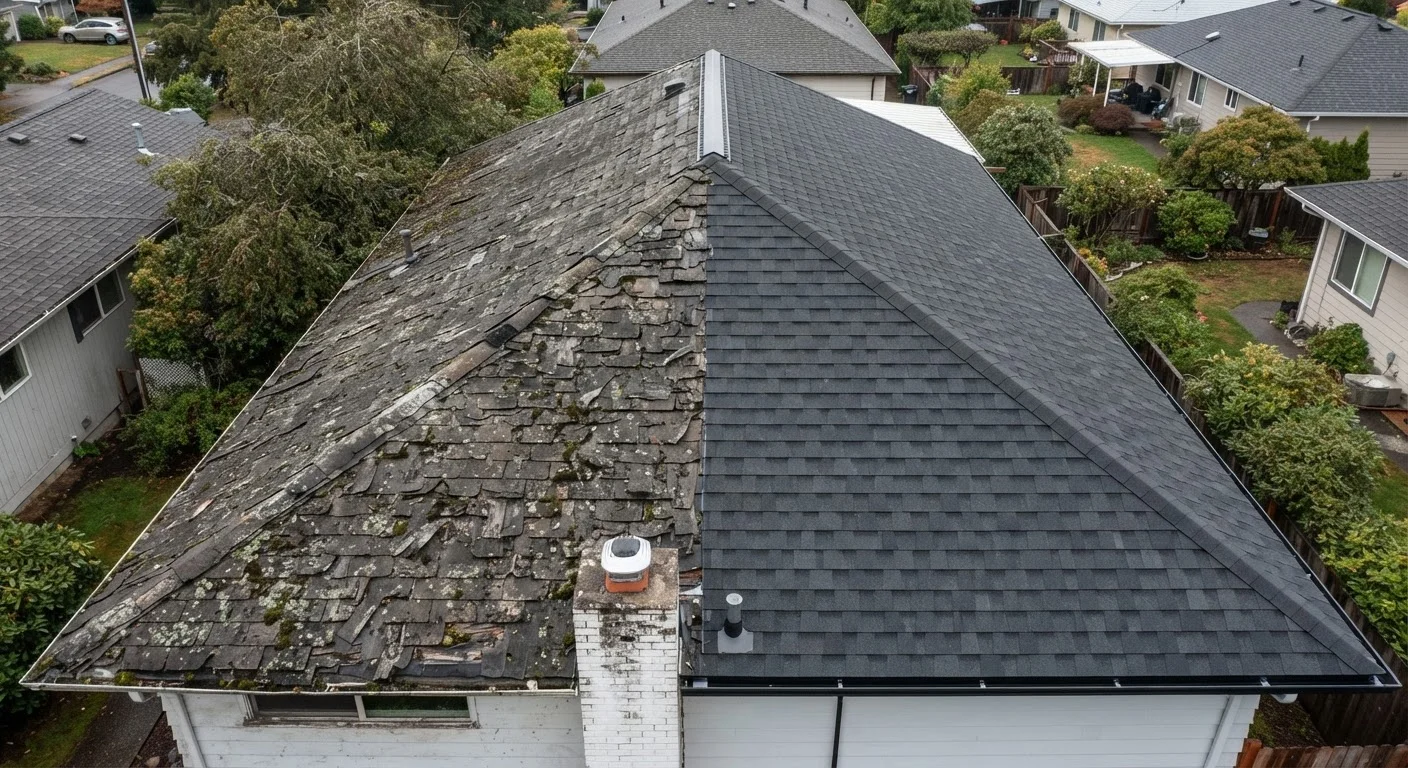
How to Read the Damage: Repair Signals vs. Replacement Red Flags
Not all roof problems are equal, and the most costly mistake a homeowner can make is misreading the severity. Repair-worthy issues tend to be isolated: a handful of missing or cracked shingles after a storm, a single flashing failure around a chimney or skylight, or minor moss growth confined to one shaded section. These are surface-level problems on an otherwise structurally sound roof.
Replacement red flags are systemic. Look for shingles that are curling at the edges or cupping upward across multiple roof sections - both indicate shingles have lost flexibility and are near failure. Heavy granule accumulation in gutters signals the protective coating is shedding across the whole surface, not just one area. Interior water stains in multiple rooms, or stains that reappear after a previous repair, suggest moisture is infiltrating through compromised decking rather than a single point of failure.
The most serious indicator is a sagging roofline or soft spots when walking on the roof (a task best left to a professional). Sagging points to decking or structural rafter damage - a condition that escalates quickly and cannot be resolved with surface repair alone. Before assuming the worst, always consult a licensed roofing contractor. For broader guidance on how to triage structural versus surface-level home problems, see our article on prioritizing structural vs. cosmetic repairs.
| Criterion | Roof Repair | Roof Replacement |
|---|---|---|
| Typical cost range | Lower upfront cost | Significantly higher upfront cost |
| Best roof age | Under 15 years | 15+ years or end-of-lifespan |
| Damage scope | Isolated, localized areas | Widespread or systemic deterioration |
| Lifespan extension | Minimal to moderate | Full new lifespan (20-30 years) |
| Deck/structural damage | Usually not present | Often present or discovered during work |
| Insurance coverage likelihood | Strong for sudden/storm damage | Depends on age and policy terms |
| Home sale impact | Neutral to slightly positive | Strongly positive; removes buyer concern |
| Permit typically required | Often not required | Commonly required; verify locally |
The Financial Decision: When Repair Costs Signal It's Time to Replace
Roofing contractors and home inspectors commonly reference a practical guideline: if the cost of repairing damage exceeds roughly 50% of a full replacement, the economics typically favor replacement. This isn't a universal rule, but it reflects a sound principle - repeated repairs on a deteriorating system compound in cost without extending the roof's lifespan.
20-30 yrs
Typical lifespan of asphalt shingle roofs
The Asphalt Roofing Manufacturers Association notes that real-world lifespan varies significantly with climate, attic ventilation, and installation quality.
~50%
Repair-to-replacement cost threshold
Many roofing professionals and home inspectors use the guideline that repair costs exceeding roughly half of replacement cost often justify full replacement instead.
1 in 20
U.S. homes filing a roofing insurance claim annually
Roofing damage is among the most common homeowner insurance claims, driven largely by hail and wind events across storm-prone regions.
Roof age is the other critical variable. Asphalt shingles - the most common roofing material in the U.S. - typically carry a manufacturer-stated lifespan of 20 to 30 years, though real-world performance depends heavily on climate, attic ventilation, and installation quality. A 10-year-old roof that sustains storm damage is a very different financial proposition than a 22-year-old roof with the same damage. For the older roof, a repair buys months, not years.
Insurance adds another dimension. Insurers distinguish between sudden, accidental damage - typically covered - and gradual deterioration, which is not. If you file a claim for a repair on a roof an adjuster deems near end-of-life, you may receive a depreciated payout that doesn't cover actual repair costs anyway. Understanding your policy's provisions before calling a contractor is worthwhile. This dynamic is similar to decisions explored in our overview of extended warranty vs. self-insuring repair costs, where the age and condition of a depreciating asset shape the risk calculus significantly.
What to Ask During a Roofing Inspection
A credible roofing inspection is the foundation of any sound decision. Ideally, get two independent assessments from licensed contractors - not just one - before committing to either path. Here are the questions that matter most:
- What is the estimated remaining lifespan of my current roof? A qualified roofer should be able to give a reasoned estimate based on material, age, and current condition.
- Is the damage isolated, or are there signs of systemic deterioration? Ask them to explain - and show you, via photos - exactly what they're observing.
- Is the roof decking (the wooden substrate beneath the shingles) intact? Deck damage changes the scope and cost of any project significantly.
- Would a repair extend the roof's functional life, or is this a short-term patch? A reputable contractor will tell you honestly if a repair is buying meaningful time or just delaying the inevitable.
- Are permits required for this work in my jurisdiction? In many municipalities, full roof replacements require a permit and inspection. Skipping this step can create issues during a future home sale or insurance claim.
Roof work - whether repair or replacement - is not a typical DIY undertaking due to fall risks, structural complexity, and code requirements. Our framework for deciding when to DIY vs. hire a professional is a useful reference before picking up tools. Regular inspections also help catch problems early - something covered thoroughly in our guide to annual home maintenance tasks that prevent expensive repairs.
This article provides general educational information about roofing decisions and is not a substitute for a professional inspection or personalized advice from a licensed roofing contractor. Costs, timelines, and code requirements vary by region. Always verify local permit and licensing requirements before beginning any roofing project.