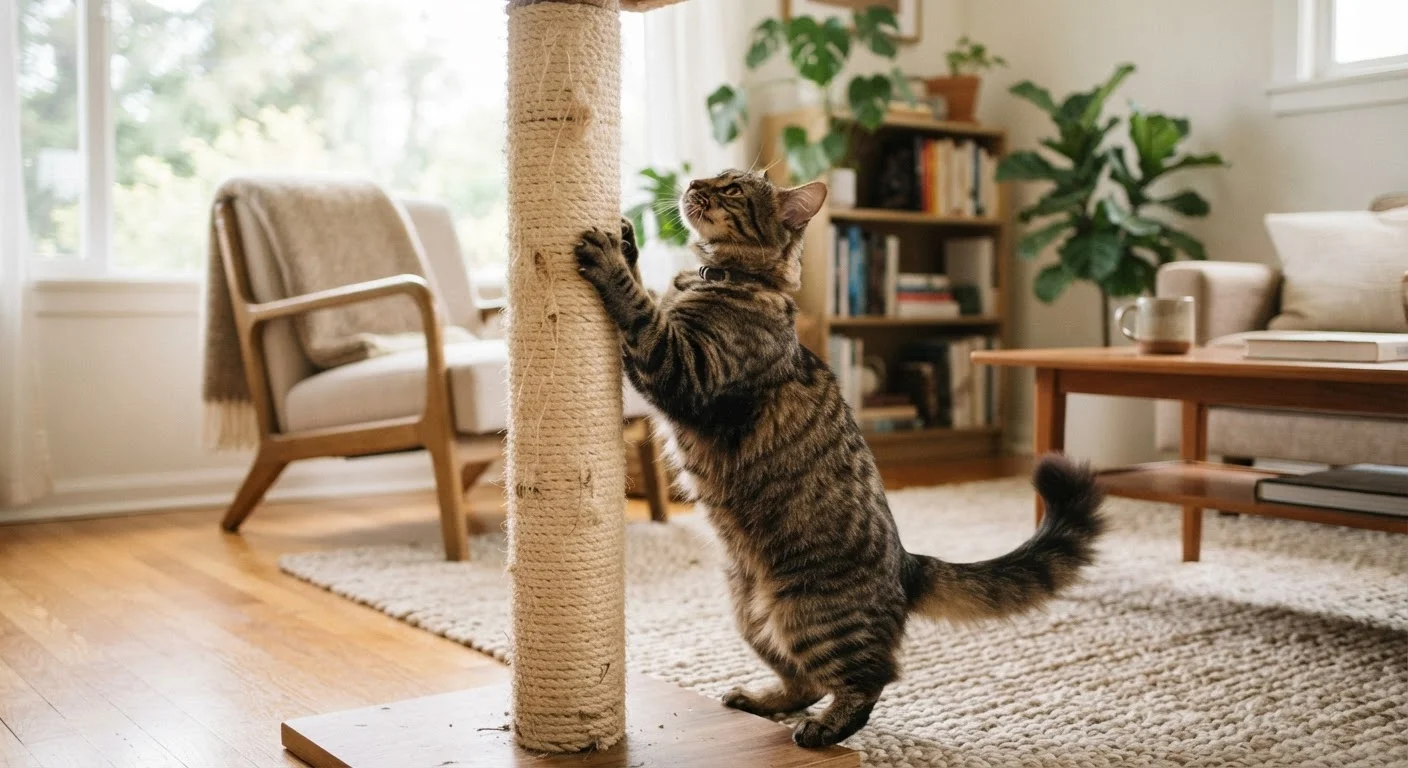
Why Cats Scratch - and Why You Can't Simply Stop Them
Scratching serves several essential functions for cats. It stretches the muscles of the back, shoulders, and forelimbs; removes the outer sheath of the claw to expose a sharper layer underneath; and deposits scent from glands in the paw pads, leaving a territorial marker. Stress, excitement, and play arousal can all trigger scratching as well.
Because scratching meets genuine physical and behavioral needs, punishing a cat for doing it rarely works and can damage the trust between you and your pet. The effective approach - supported by veterinary behaviorists - is to make an appropriate scratching surface more appealing than your couch, not to make scratching itself aversive.
For cats who show additional signs of stress-related or displacement behaviors, a broader look at their environment often helps. Our guide to keeping indoor cats engaged covers enrichment strategies that address the root of many behavior challenges.
Think Like Your Cat's Location Preferences
Cats tend to scratch in socially prominent spots - near sleeping areas, by entry points, or wherever household activity is highest. A scratch post tucked in a corner of a spare room rarely gets used. Start with placement in the main living area and move the post gradually (a few inches per day) once the behavior is well established, if you want it in a less central location.
What You'll Need Before You Start
Gathering the right materials before training begins will give you the best chance of success from day one.
What you will need
Sisal rope scratch post (tall)
Provides a durable, preferred scratching surface that allows full-body vertical stretch.
Corrugated cardboard flat scratcher
Offers a horizontal scratching alternative for cats who prefer flat or angled surfaces.
High-value training treats
Used for immediate positive reinforcement the moment the cat interacts with the post.
Catnip or silver vine spray
Applied to the post surface to increase initial attractiveness for cats that respond to these plants.
Double-sided furniture tape
Applied to furniture surfaces the cat currently scratches to deter continued use during retraining.
Wand or string toy
Used to draw the cat toward the post and encourage paw contact during play sessions.
Step-by-Step: Training Your Cat to Use the Post
Follow these steps in order. Cats learn through repetition and positive association, so patience and consistency across days and weeks matter more than any single session.
Choose the right post for your cat
Select a post that is tall enough for your cat to fully stretch vertically - at least 28 inches for most adult cats. Sisal rope is the most commonly preferred texture, but corrugated cardboard and carpet work for some cats. Stability is non-negotiable: a wobbly post will be abandoned immediately after one bad experience. If your cat already scratches a horizontal surface like a rug, also consider a flat or angled scratcher.
Place the post where your cat already scratches
Locate the spot your cat currently scratches most - typically the arm of a sofa or a specific carpet area - and position the post directly in front of it or immediately beside it. This is the single most important placement decision. Cats return to the same locations repeatedly because of scent markers they've already deposited. Meeting them there dramatically increases post adoption.
Make the post appealing with scent and play
Sprinkle or spray a small amount of dried catnip onto the post surface, or use a catnip-infused spray if your cat is responsive to it (note: roughly 30-50% of cats have little reaction to catnip - this is genetic and normal). You can also dangle a wand toy near the base of the post to draw your cat toward it during play. Do not force your cat's paws onto the post; this tends to cause aversion, not adoption.
Reinforce immediately when your cat uses the post
The moment your cat touches the post with its paws - especially when actively scratching - deliver a small, high-value treat within two to three seconds. This timing is critical for the cat to associate the post with the reward. Verbal praise in a calm, positive tone can accompany the treat. Repeat this every time you observe your cat using the post, especially during the first two to three weeks.
Redirect - don't punish - when furniture scratching occurs
If you catch your cat scratching furniture, calmly interrupt the behavior with a gentle hand clap or a short verbal cue like "no," then immediately guide your cat toward the post and encourage interaction with a toy or treat. Never use physical punishment, spray bottles aimed at the cat's face, or loud noise designed to frighten - these methods can create anxiety and damage your relationship without teaching the cat what it should do instead.
Protect furniture temporarily during the transition
Use double-sided tape, aluminum foil, or commercially available furniture protector films on the specific areas your cat targets. These textures are aversive to most cats' paws and discourage scratching without any confrontation. Once your cat is reliably using the post for several weeks, you can gradually remove the deterrents. Avoid covering the entire piece of furniture - target only the exact spots your cat uses.
Avoid Declawing as a Solution
Declawing (onychectomy) involves the surgical removal of the last bone of each toe and is considered by many veterinary organizations to carry significant risks of long-term pain, behavioral changes, and complications. It is banned or heavily restricted in numerous countries and regions. If scratching is a persistent problem, consult a veterinarian or certified applied animal behaviorist for humane, effective alternatives.
Troubleshooting: When Your Cat Still Ignores the Post
If your cat shows little interest after a week of consistent effort, reassess two key variables: location and texture. A post placed in a back hallway will rarely compete with a well-positioned sofa corner. Similarly, some cats strongly prefer horizontal surfaces - a flat cardboard scratcher on the floor may outperform a vertical post for these individuals.
Also review whether the post is tall enough. A post should allow your cat to fully extend its body when scratching - many commercially available posts are too short to accomplish this. A minimum height of 28-32 inches is a useful benchmark for most adult cats.
If scratching escalates suddenly or is accompanied by other behavioral changes, consult your veterinarian. Behavioral shifts can sometimes signal underlying health concerns. The same principle applies when training cats to accept other care routines - our teeth-brushing guide walks through a similarly gradual desensitization approach that transfers well to scratch training.
This article provides general pet care information and is not a substitute for professional veterinary advice. If your cat's scratching behavior is sudden, excessive, or accompanied by other changes, consult a licensed veterinarian or certified applied animal behaviorist.