Why Indoor Activity Matters More Than You Think
Indoor cats live longer on average than cats who roam outdoors - but that safety comes with a trade-off. Without the stimulation of hunting, exploring, climbing, and patrolling territory, house cats can quickly become sedentary. The consequences are well-documented: obesity, muscle loss, stress-related behavior problems, and boredom-driven destructive habits.
Unlike dogs, cats don't broadcast their need for movement. They may sleep 14-16 hours a day, which is normal - but the waking hours matter enormously. A cat that moves purposefully, hunts during play, and uses its environment actively is a healthier, more contented animal. Building reliable enrichment into your home doesn't require expensive equipment or hours of effort. It requires understanding how cats are wired and setting up an environment that works with those instincts.
This is part of a broader picture of good daily cat care. Our guide to building a healthy pet routine covers how physical activity fits alongside feeding schedules, grooming, and preventive health habits.
Schedule Daily Interactive Play Sessions
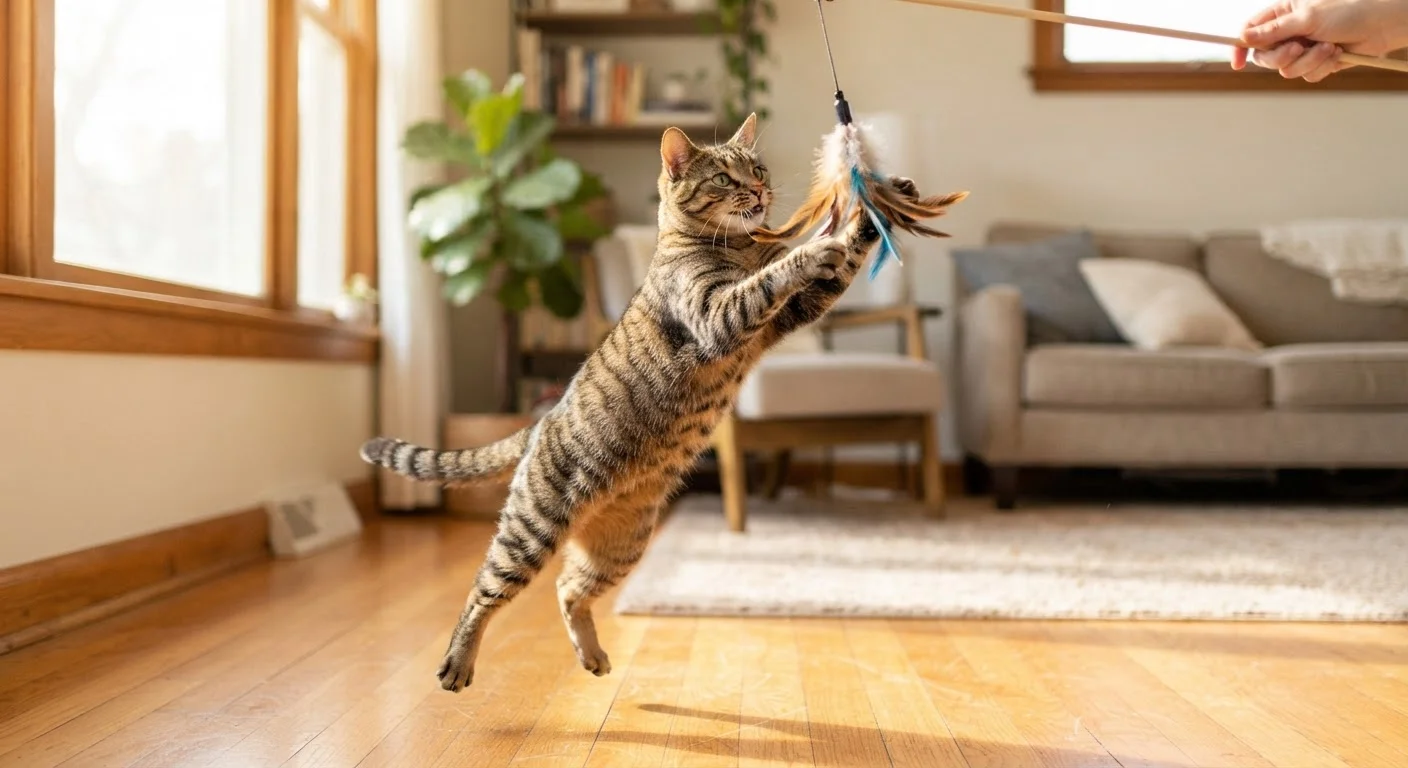
A wand toy, a laser pointer, or a simple string moved by your hand engages instincts no autonomous toy can fully replicate. During interactive play, you control the prey - making it dart, freeze, hide, and flee - which triggers the full predatory sequence: stalk, chase, pounce, and catch. This cycle is deeply satisfying for cats and provides genuine aerobic activity.
Aim for at least two sessions daily of 10-15 minutes each. End each session by letting your cat "catch" the toy and then offering a small food reward. This mimics the hunt-catch-eat sequence and prevents the frustration that can build when a cat never successfully captures its prey.
Letting your cat 'catch' the toy at session's end prevents frustration and completes the hunting cycle.
Add Vertical Space to Your Home
In the wild, cats climb to survey territory, escape threats, and reach prey. Indoors, vertical space is one of the most underutilized enrichment tools available. Cat trees, wall-mounted shelves, and window perches give your cat a three-dimensional environment to navigate - and navigating it burns energy.
Cats that have access to multiple vertical levels move significantly more throughout the day than those limited to floor-level furniture. Place vertical structures near windows when possible: bird feeders or a bird bath visible from a perch can provide hours of passive visual stimulation, often called "cat TV."
Vertical structures give cats a three-dimensional environment to explore, dramatically increasing daily movement.
Use Puzzle Feeders and Food-Dispensing Toys
Cats in the wild spend a significant portion of their waking hours foraging and hunting for food. Delivering meals in a standard bowl takes about 30 seconds and satisfies none of that drive. Puzzle feeders - containers that require batting, rolling, or pawing to release kibble - turn mealtime into problem-solving that engages both mind and body.
Start with simpler designs if your cat is new to food puzzles, then increase difficulty as they build confidence. Even placing dry food portions inside a muffin tin covered with tennis balls is a low-cost version of the same concept. The goal is effort before reward, which reflects how cats are naturally wired to eat.
Puzzle feeders engage a cat's problem-solving instincts while turning every meal into a physical activity.
Rotate Toys Regularly to Prevent Habituation
Cats habituate quickly - a toy that's endlessly available becomes invisible. The solution is rotation: keep only two or three toys out at a time and swap them every few days. Toys that have been "away" for a week feel novel again when reintroduced, especially if you reactivate them with a sprinkle of dried catnip or a bit of motion.
You don't need a large collection. A rotating set of six to eight different toy types - crinkle balls, feather toys, mylar balls, small stuffed mice - provides adequate variety. Store retired toys in a sealed bag to preserve any scent, which makes reintroduction more effective.
A toy out of sight for a week feels brand new again - rotation costs nothing and pays off in sustained engagement.
Create Opportunities for Hunting and Foraging
Beyond puzzle feeders, you can hide small portions of your cat's daily food allowance in different locations around the home - under a folded towel, inside a paper bag with a hole cut in it, or behind a furniture leg. This encourages your cat to move through the home using its nose, which is a form of mental and physical enrichment that closely mirrors natural foraging behavior.
Rotate hiding spots daily so your cat must actively search rather than go straight to a memorized location. This kind of environmental enrichment has been shown in behavioral research to reduce stress-related behaviors and increase general activity levels in indoor cats.
Hiding food around the home encourages cats to move purposefully and use their nose the way nature intended.
Provide Scratching Surfaces Throughout the Home
Scratching is not just a nail-maintenance behavior - it's a full-body stretch that engages a cat's forelimbs, shoulders, and back. Cats that scratch on appropriate surfaces regularly are engaging in a low-intensity but meaningful physical activity. Both horizontal and vertical scratching surfaces serve slightly different muscle groups, so offering both types is beneficial.
Place scratching posts near sleeping areas (cats often scratch after waking) and near furniture your cat has shown interest in. Our guide to redirecting scratching behavior explains how to make the transition from furniture to appropriate surfaces straightforward and humane.
Scratching is a full-body stretch - providing appropriate surfaces supports physical health, not just furniture protection.
Building a Routine That Sticks
The most effective indoor enrichment plans aren't one-time setups - they're consistent daily rhythms. Cats are creatures of habit, and a predictable play schedule actually increases engagement because cats begin to anticipate and prepare for the activity. Aim for at least two interactive play sessions per day, each lasting 10-15 minutes, timed around your cat's most naturally active windows: early morning and early evening align with crepuscular hunting instincts.
Make Play a Reliable Daily Ritual
Set a specific time for interactive play - right before breakfast and dinner works well, aligning with cats' crepuscular rhythms and the hunt-eat sequence. Cats that anticipate playtime often become more active in the lead-up, which adds even more movement to their day. Consistency over intensity is what builds lasting results.
Keep in mind that enrichment works best when it's layered - no single toy or setup will meet all of a cat's needs. Combine interactive play, solo-play opportunities, vertical space, and feeding enrichment for the fullest effect. If your cat also scratches furniture, redirecting that behavior is part of the same enrichment picture. Our guide to scratch post training explains how to channel that instinct appropriately. For a broader view of feline pet health and behavior, explore our full resource hub.
This article is for general informational purposes only and is not a substitute for veterinary advice. If you have concerns about your cat's weight, health, or behavior, consult a licensed veterinarian.