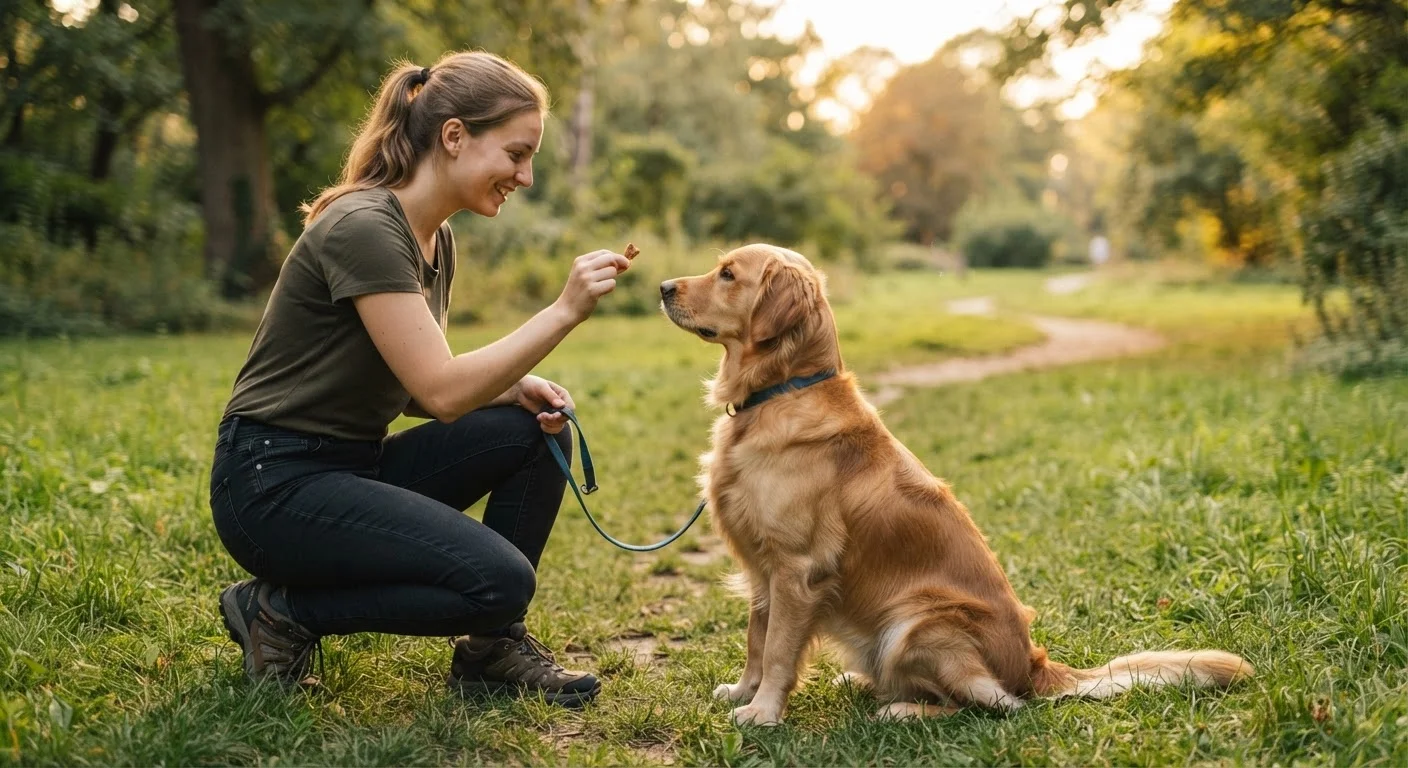
Why Timing Is the Foundation of Effective Training
When your dog sits on cue and you reach into your treat pouch five seconds later, you may feel like you're rewarding a solid sit. Your dog, however, is learning something different - whatever it was doing the moment the treat landed in its mouth. If it shuffled forward or glanced away, that's the behavior being strengthened.
This is how operant conditioning works. Animals learn through associations between a behavior and its immediate consequence. The shorter the gap between action and reward, the clearer the message. Behavioral research consistently places the effective reinforcement window at one to two seconds. Beyond that, the association weakens substantially.
This isn't a flaw in the animal - it's simply how associative learning operates across species. Understanding it is the first step toward training that actually builds the behavior you want. As described in our overview of positive reinforcement vs. correction-based training, reward-based methods only reach their potential when the reward is delivered with precision.
How to Sharpen Your Timing and Prevent Common Errors
The single most effective tool for closing the timing gap is a marker signal - a distinct sound, such as a clicker or a short verbal cue like "yes," delivered the instant the correct behavior occurs. The marker serves as a precise bookmark: it tells the animal exactly which action earned the reward, even if the treat takes another second or two to arrive.
Building this skill takes deliberate practice. Try the following:
- Pre-load your treats. Have several small pieces ready in your palm before you begin a session so you're not fumbling in a pouch mid-rep.
- Practice marking without a dog. Watch a video of an animal performing a behavior and click the moment it occurs. Review the footage to check your accuracy.
- Train in short bursts. Fatigue degrades timing. Sessions of three to five minutes preserve your focus - and your pet's. Consistency matters more than intensity in building reliable behavior.
- Set up the environment to help. Minimizing distractions reduces the time your pet spends disengaged, making it easier to catch clean behavior in the moment. See how to set up your home to support training goals for practical guidance.
Accidental Reinforcement Is Easy to Miss
Timing errors don't just slow progress - they can actively strengthen the behaviors you're trying to eliminate. If your pet is jumping, barking, or pawing when a treat appears, that behavior is being reinforced regardless of your intention. Pause, wait for calm or a deliberate cue, then mark and reward. When training feels like it's going backward, review your delivery timing before assuming the pet isn't learning.
Once your timing is reliable with treats, you can begin fading food lures so that performance doesn't depend on the treat being visible. Precise timing during the lure-fading phase is especially important - imprecise marking during that transition is a common reason dogs revert to treat-dependent responses.
This article is for general educational purposes only. For personalized training guidance, especially for animals with behavioral concerns, consult a certified professional trainer or veterinary behaviorist.