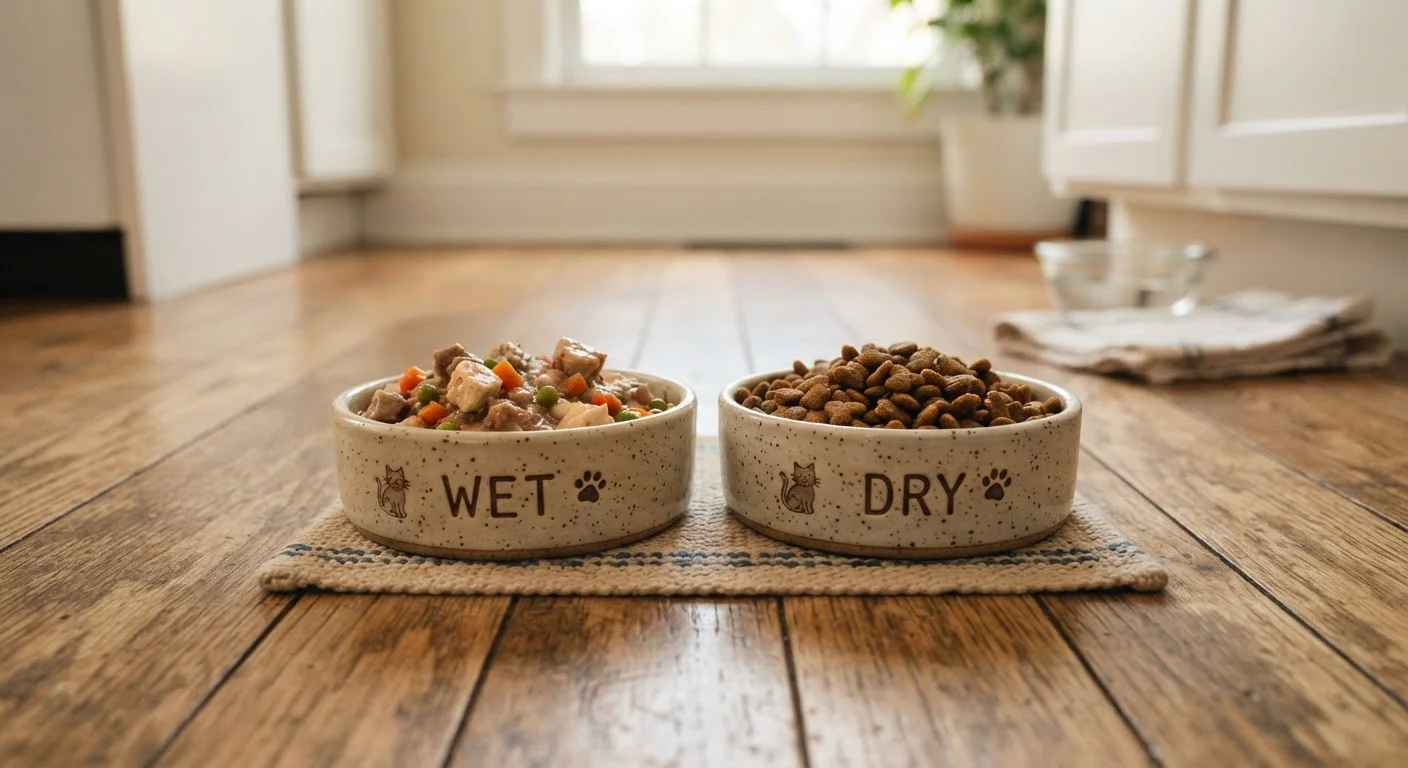
What Sets These Two Formats Apart
The core difference between wet and dry cat food is moisture content. Wet food - sold in cans or pouches - is typically 75-80% water by weight. Dry kibble, by contrast, contains only about 10% moisture. This single variable has cascading effects on nutrition, palatability, caloric density, and how a cat's body processes the food.
Cats evolved as desert-adapted hunters who historically obtained most of their water from prey. They have a naturally low thirst drive, which means they often don't compensate well when fed a dry-only diet. This biological reality is a central argument for wet food in veterinary nutrition circles. That said, the debate isn't one-sided - each format has genuine strengths depending on the individual cat.
For a broader look at how these differences play out across all pets, see our comparison of wet and dry food across species.
| Criterion | Wet Cat Food | Dry Cat Food (Kibble) |
|---|---|---|
| Moisture content | ~75-80% | ~10% |
| Urinary/kidney support | Strong - increases fluid intake | Limited - concentrated urine risk |
| Caloric density | Lower per serving | Higher per serving |
| Dental benefit | Minimal | Modest (standard); better with dental formulas |
| Palatability | Generally high - strong aroma | Variable - less aromatic |
| Cost per serving | Higher | Lower |
| Storage ease | Refrigerate after opening; discard within 48 hrs | Shelf-stable for weeks when sealed |
| Weight management | Easier - high volume, lower calories | Requires careful portioning |
Hydration, Urinary Health, and Kidneys
Cats fed predominantly dry diets tend to produce more concentrated urine, which increases the risk of urinary crystal formation and can place greater long-term strain on the kidneys. Wet food meaningfully increases total daily fluid intake without requiring a cat to drink more from a bowl - a significant practical advantage.
For cats already managing chronic kidney disease (CKD) or a history of feline idiopathic cystitis (FIC), veterinarians frequently recommend wet food as part of disease management. The hydration benefit is well-supported by veterinary literature, though the degree of benefit varies by cat and by the specific health condition involved.
75-80%
Moisture in typical wet cat food
Compared to roughly 10% in dry kibble, this difference substantially increases a cat's daily fluid intake without extra water bowl visits.
~50%
Of cats' fluid needs met by wet food alone
Veterinary nutrition research suggests cats fed wet food may meet a significant portion of daily hydration requirements from food itself.
3x
Greater urine dilution on wet diet
Studies in feline urology have associated wet food diets with more dilute urine, which is considered protective against struvite and calcium oxalate crystal formation.
Owners feeding dry-only diets can encourage water intake by offering running water fountains, multiple water stations, or adding a small amount of water or low-sodium broth to kibble - though these strategies rarely match the hydration delivered by wet food directly.
Dental Health, Calories, and Practical Trade-Offs
Dry food is often associated with dental health benefits - the idea being that crunchy kibble mechanically scrubs plaque from teeth. There is some evidence to support a modest effect, particularly with specially formulated dental diets that carry the Veterinary Oral Health Council (VOHC) seal. Standard kibble, however, offers only limited dental benefit; many cats swallow pieces whole without significant chewing. Tooth brushing and dental treats remain more reliable dental care strategies regardless of food type.
Caloric density is another meaningful difference. Dry food packs more calories per cup, making portion control critical - especially for indoor cats prone to weight gain. Wet food's high water content means cats eat a larger volume for fewer calories, which can support satiety and healthy weight maintenance. For more on how feeding schedules interact with weight management, our article on free-feeding vs. scheduled meals for cats covers the key considerations.
AAFCO Labeling: What to Look For
Regardless of whether you choose wet or dry food, look for a product that states it meets AAFCO nutritional profiles for your cat's life stage - either 'kitten,' 'adult,' or 'all life stages.' This label indicates the food has been formulated to meet established minimum nutritional standards. It does not guarantee ingredient quality, but it is the baseline benchmark most veterinarians use when evaluating commercial cat foods.
From a cost and storage standpoint, dry food is considerably more economical and remains fresh in an airtight container for weeks. Wet food costs more per serving and must be refrigerated after opening, with most open cans discarded within 24-48 hours.
Many popular beliefs about cat feeding - including ideas about grain-free diets or raw food - deserve scrutiny. Our cat nutrition myths article unpacks the evidence on common misconceptions.
Making the Right Call for Your Cat
There is no single correct answer to the wet vs. dry debate - the right choice is shaped by your cat's age, health history, weight, and preferences, as well as your household's budget and routine. Kittens, seniors, and cats with diagnosed urinary or kidney conditions often benefit most from wet food's moisture contribution. Healthy adult cats with no urinary concerns may do well on a quality dry diet, provided they drink adequate water.
A combination approach - wet food at scheduled mealtimes alongside a measured daily portion of dry kibble - is one that many veterinary nutritionists consider practical and well-rounded. It captures hydration benefits while making cost and storage manageable. Whatever you choose, the most important step is selecting a food that meets the Association of American Feed Control Officials (AAFCO) nutritional guidelines for your cat's life stage, and confirming the plan with your veterinarian.
This article is for general informational and educational purposes only and is not a substitute for personalized veterinary advice. Always consult a licensed veterinarian before making significant changes to your cat's diet, particularly if your cat has an existing health condition.