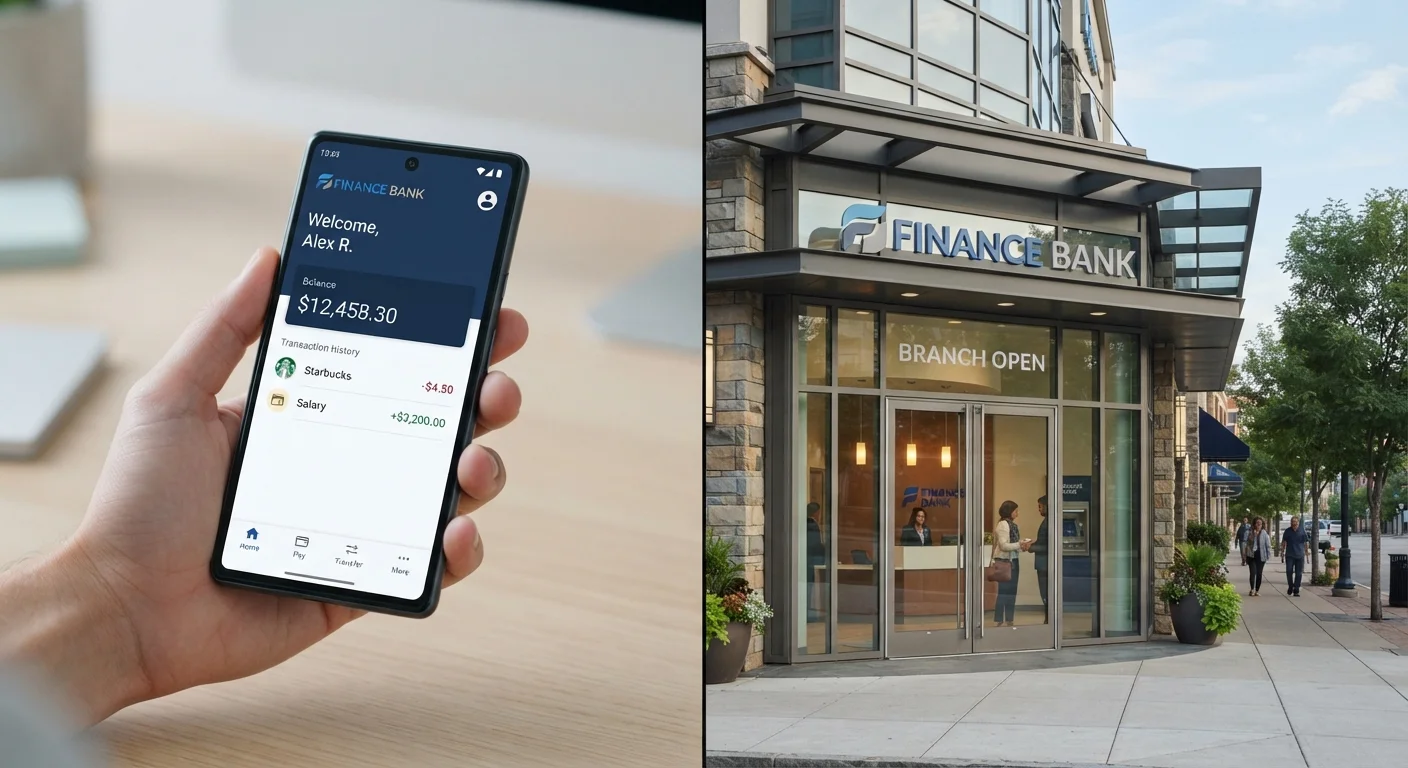
How Each Model Works
Online banks operate without physical branches, delivering virtually every service - account opening, transfers, customer support - through a website or mobile app. Because they carry far lower overhead than traditional institutions, they pass those savings to customers through better rates and reduced fees. Most online banks are FDIC-insured, offering the same federal deposit protection as any traditional bank.
Brick-and-mortar banks maintain physical branch networks alongside digital tools. They employ relationship managers, tellers, and on-site loan officers, allowing customers to conduct business in person. This model typically costs more to run, which is often reflected in lower savings yields and a broader fee schedule. For context on how a member-owned alternative compares, see our article on credit unions vs. traditional banks.
Where Online Banks Have the Edge
The most measurable advantage of online banking is yield. Online banks have historically offered annual percentage yields (APYs) on savings accounts that significantly outpace the national average offered by traditional banks - sometimes several times higher - because their cost structure is leaner.
5×+
Online vs. traditional savings APY gap
The FDIC regularly reports that the national average savings rate at traditional banks is a fraction of the yields commonly advertised by online-only institutions.
$144/yr
Avg. monthly fee cost at traditional banks
A $12 average monthly maintenance fee, common at large traditional banks, totals roughly $144 annually if not waived - money that stays in your pocket at most online banks.
Fee structures also tend to be more consumer-friendly. Monthly maintenance fees, minimum balance requirements, and overdraft charges are less common at online institutions. For consumers focused on growing savings while minimizing drag, this distinction matters considerably over time. If you're thinking about whether to concentrate accounts in one place, our piece on keeping all your accounts at one bank explores the trade-offs honestly.
ATM access is often addressed through large fee-free ATM networks or monthly reimbursement of ATM fees charged by other institutions, though policies vary - always verify before committing.
Check FDIC Coverage Before You Open
Before depositing money at any institution - online or traditional - confirm it carries FDIC insurance by searching the FDIC's BankFind tool at fdic.gov. Coverage protects up to $250,000 per depositor, per ownership category, per insured bank. Don't assume coverage; verify it directly.
Where Traditional Banks Hold Their Ground
Cash handling remains one of the clearest gaps for online-only customers. Depositing cash is straightforward at a branch or in-bank ATM, but online banks frequently have no direct cash deposit mechanism - a genuine inconvenience for gig workers, small business owners, or anyone paid regularly in cash.
In-person service still matters for complex financial decisions. Sitting across from a loan officer to discuss a mortgage, or meeting with a banker to resolve a disputed account, carries a dimension that phone or chat support cannot fully replicate. Traditional banks also tend to offer a wider product suite under one roof: safe deposit boxes, cashier's checks, notary services, and business banking solutions.
| Online Banks | Brick-and-Mortar Banks | |
|---|---|---|
| Savings APY | Typically much higher | Often near or at national average |
| Monthly fees | Rare or none | Common; waivable with conditions |
| Cash deposits | Limited or unavailable | Straightforward at branch or ATM |
| In-person service | Not available | Full branch network |
| Mobile & digital tools | Usually excellent | Varies; improving industry-wide |
| Product breadth | Focused on core accounts | Loans, safe deposit, notary, business |
| ATM access | Large network or fee reimbursement | Proprietary network; fees outside it |
| FDIC insurance | Yes (verify per institution) | Yes |
For transactions like wire transfers that sometimes require branch verification, understanding how money movement works can also guide your choice - our guide on wire transfers vs. ACH transfers breaks down when each method applies.
Making the Decision That Fits Your Life
Start by auditing your actual banking behavior. How often do you deposit cash? Do you value walking into a branch, or do you handle everything from your phone? Are you carrying a balance in savings where a higher APY would meaningfully compound over time?
Many households land on a hybrid model: an online high-yield savings account to maximize interest, paired with a local checking account for everyday cash needs and in-person services. This approach requires a bit more coordination but captures genuine advantages from both sides. Managing your broader financial picture - including where your accounts live - connects directly to the goals covered in our saving and debt hub.
Whichever path you choose, confirm that any institution you consider is FDIC-insured (or NCUA-insured for credit unions), review the fee schedule carefully before opening an account, and read the terms governing overdraft coverage and ATM access. This article provides general information; your specific needs may warrant a conversation with a licensed financial professional.
This article is for general informational and educational purposes only and does not constitute personalized financial advice. Consult a qualified financial professional for guidance specific to your circumstances.