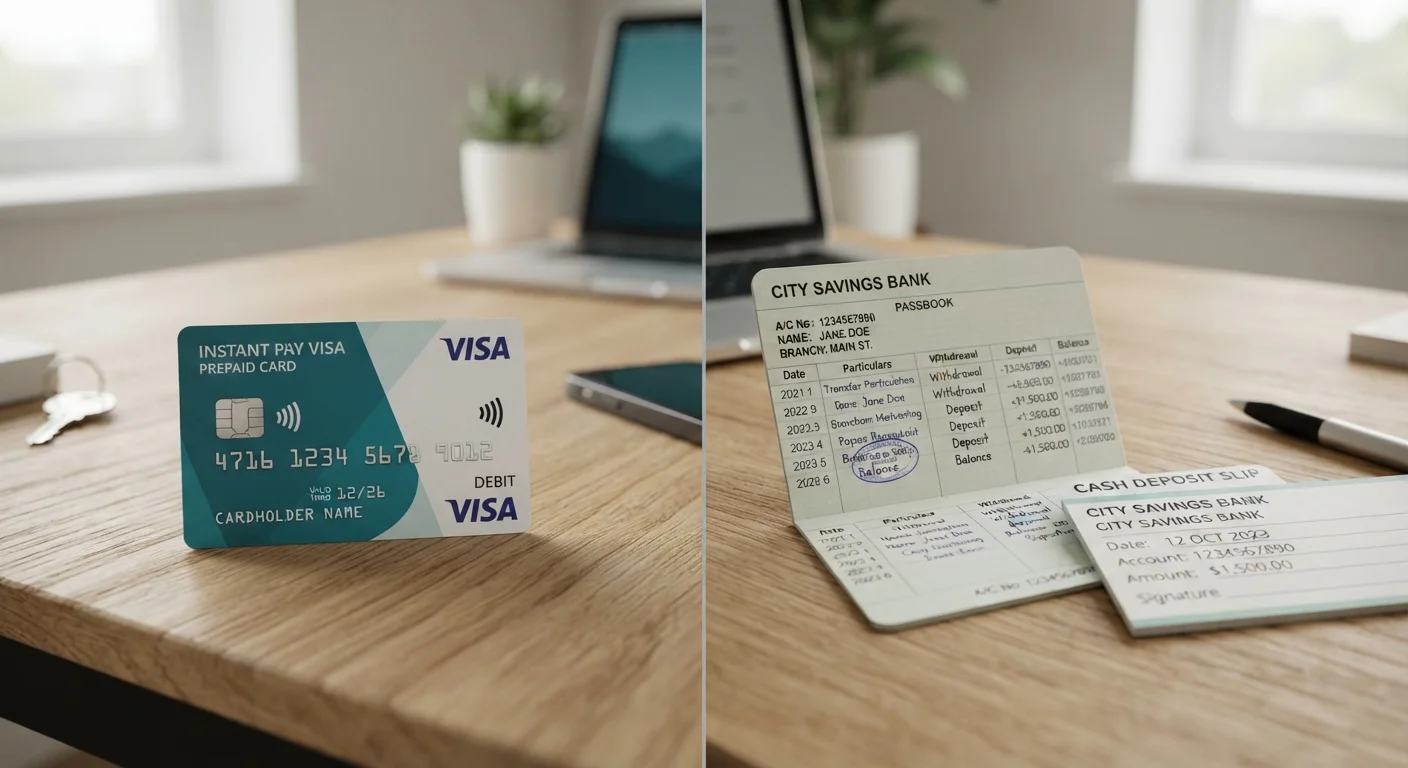
How Prepaid Cards and Bank Accounts Actually Work
A prepaid debit card is a spending card you load with funds in advance. It carries a payment network logo (such as Visa or Mastercard) and can be used wherever those networks are accepted. It requires no bank account and no credit check, making it accessible to nearly anyone.
A bank or credit union deposit account - checking or savings - is a regulated financial product held at an insured institution. It ties your money to a legal account structure governed by federal and state rules, giving you access to a defined set of consumer protections and financial tools.
The two may look alike at checkout, but the underlying architecture is very different. A prepaid card is essentially a stored-value instrument. A deposit account is a legal claim on funds held by a regulated institution. That distinction drives almost every difference covered in this article.
If you are exploring bank accounts for the first time, see our plain-language guide to opening your first account for a practical walkthrough.
Deposit Insurance: The Protection Prepaid Cards Often Lack
One of the most significant gaps is deposit insurance. Accounts at FDIC-member banks are insured up to $250,000 per depositor, per institution, per account category. Credit unions offer equivalent protection through the National Credit Union Administration (NCUA). If the institution fails, your insured funds are protected.
Prepaid cards are generally not deposit accounts and are therefore not automatically FDIC-insured. Some prepaid card issuers voluntarily hold customer funds in pooled accounts at FDIC-member banks and advertise "pass-through" insurance, but the coverage is conditional, subject to specific record-keeping requirements, and not identical to holding your own named deposit account. If those requirements aren't met, the insurance may not apply.
$250,000
FDIC insurance limit per depositor
The Federal Deposit Insurance Corporation insures deposits up to this amount per depositor, per insured bank, per account ownership category.
~5.9M
US households using prepaid cards as primary payment tool
According to FDIC survey data, millions of underbanked households rely primarily on prepaid cards, often due to lack of access to traditional accounts.
Bottom line: if the company behind your prepaid card becomes insolvent, your funds may be at risk in ways that would not apply to a federally insured deposit account.
Fraud Protections: Where the Rules Diverge
Federal rules under Regulation E govern electronic fund transfers and set limits on consumer liability for unauthorized transactions. Bank-issued debit cards tied to deposit accounts carry relatively robust protections - if you report fraud within two business days, your liability is capped at $50. Delays increase potential liability, but the framework is well-established.
Prepaid cards received expanded Regulation E protections under a 2016 Consumer Financial Protection Bureau (CFPB) rule, but important differences remain. Registration matters significantly: many protections only kick in if the card is registered in your name with the issuer. Unregistered prepaid cards carry almost no guaranteed fraud recovery path.
Unregistered Prepaid Cards Offer Almost No Protection
If your prepaid card is not registered in your name with the issuer, you may have little or no recourse if the card is lost, stolen, or used fraudulently. Always register your prepaid card immediately after purchase and keep a record of the card number. Without registration, consumer protections under Regulation E generally do not apply.
For a broader look at how debit and credit payment methods compare on fraud exposure, see our article on debit cards vs. credit cards.
Features Bank Accounts Offer That Prepaid Cards Cannot
Beyond insurance and fraud rules, deposit accounts provide a range of financial capabilities that prepaid cards simply don't replicate:
- Interest earnings: Savings accounts and money market accounts can earn interest on your balance. Prepaid cards typically earn nothing.
- Credit history: Having and managing a bank account can support your financial profile, and some checking accounts pair with credit-building products. Prepaid card use does not appear on credit reports.
- Direct deposit and ACH transfers: While some prepaid cards now accept direct deposit, bank accounts offer broader, more reliable ACH access for payroll, bill pay, and transfers.
- Overdraft options: Banks may offer overdraft protection or linked accounts; prepaid cards decline transactions when the balance runs out - which avoids overdraft fees, but can also leave you without access to funds you need.
- Check writing: Most checking accounts include access to paper checks, which remain necessary for rent, certain bills, and legal payments.
| Feature | Prepaid Debit Card | Bank/Credit Union Deposit Account | |
|---|---|---|---|
| FDIC/NCUA Insurance | Conditional, not automatic | Up to $250,000 per depositor | |
| Fraud Protection (Reg E) | Limited; requires registration | Established liability caps | |
| Interest Earnings | Generally none | Available on savings accounts | |
| Credit History Impact | None | Supports financial profile | |
| Monthly Fees | Common; varies by issuer | Many no-fee options available | |
| ATM Access | Often with fees | Often free with network ATMs | |
| Direct Deposit / ACH | Available on some cards | Standard feature | |
| Check Writing | Not available | Standard on checking accounts |
Before opening any account, our pre-application checklist can help you compare fee structures and deposit insurance side by side.
The Hidden Cost of Prepaid Card Fees
Prepaid cards frequently carry a layered fee structure that can erode balances meaningfully over time. Common charges include monthly maintenance fees, per-transaction fees, ATM withdrawal fees, cash reload fees, inactivity fees, and even fees to check your balance. Some cards charge to receive a paper statement.
By contrast, many banks and credit unions - particularly online institutions and community banks - now offer no-fee or low-fee checking accounts with no minimum balance requirements. These accounts were partly developed in response to consumer demand for accessible banking, and they directly compete with the market prepaid cards have historically served.
If fee comparison between bank types interests you, see our analysis of online banks vs. brick-and-mortar banks.
Look for Second-Chance Checking Accounts
If a negative banking history has made it difficult to open a standard account, many banks and credit unions offer "second-chance" checking accounts designed for consumers rebuilding their financial standing. These accounts often have modest fees, no overdraft exposure, and report to ChexSystems - giving you a path back to a full deposit account. Ask your local bank or credit union whether such a product is available.
This article is for general informational purposes only and does not constitute financial, legal, or tax advice. Consult a qualified financial professional for guidance specific to your situation.