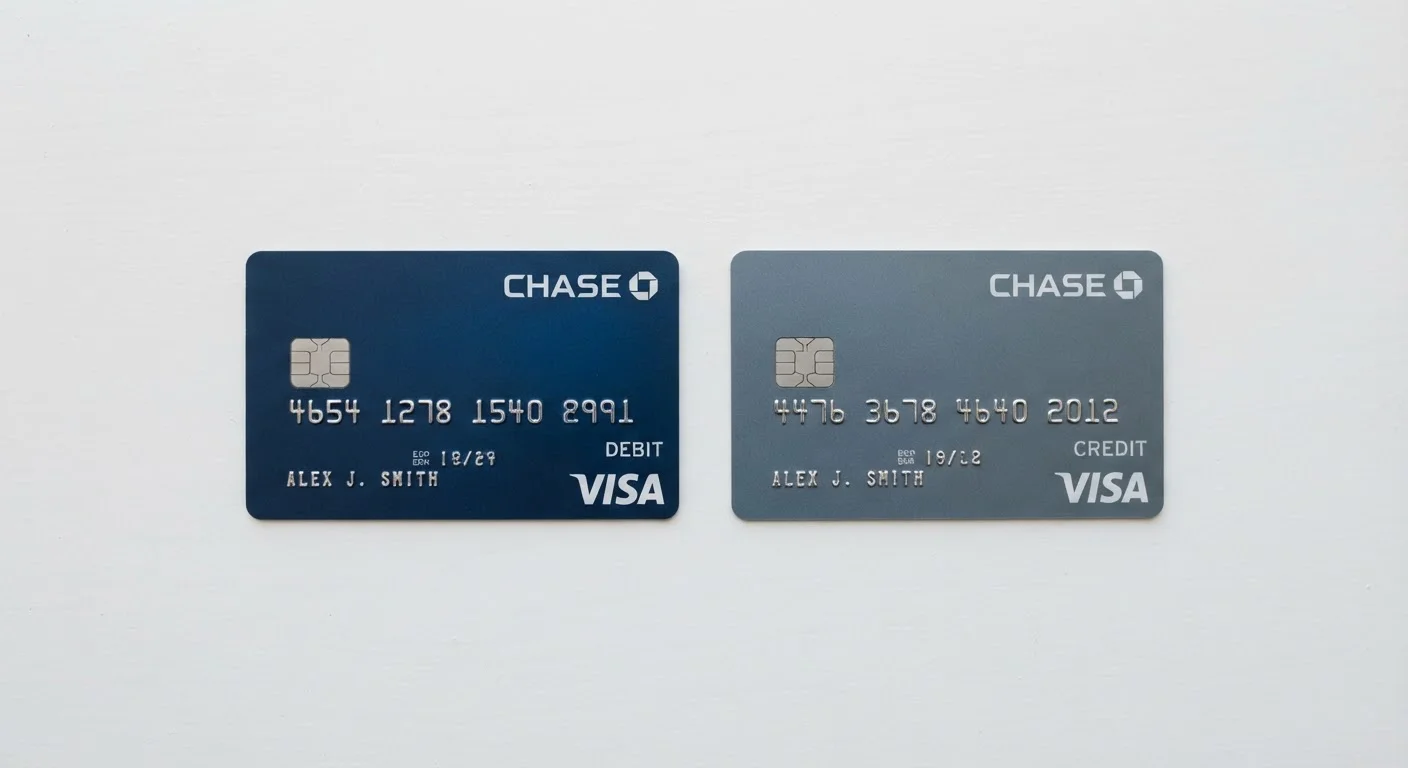
How Each Card Actually Works
Despite looking nearly identical in your wallet, debit and credit cards operate on fundamentally different financial rails.
A debit card is directly linked to your checking account. When you swipe or tap, the funds are pulled from your existing balance - usually within one to two business days. If the money isn't there, the transaction is typically declined (unless you've opted into overdraft coverage, which can trigger fees).
A credit card, by contrast, lets you borrow from your card issuer up to a preset limit. You receive a monthly statement and choose to pay the full balance, the minimum, or something in between. Carrying a balance triggers interest charges, usually calculated using an Annual Percentage Rate (APR) - the annualized cost of borrowing. For a deeper look at how credit card interest and payments interact, see how responsible credit card use works.
This structural difference - spending money you have versus borrowing money you'll repay - drives nearly every other trade-off between the two card types.
| Criterion | Debit Card | Credit Card |
|---|---|---|
| Funding source | Your checking account balance | Issuer's line of credit |
| Fraud liability (federal) | Up to $500+ depending on timing | Capped at $50; often $0 |
| Builds credit history | No | Yes, if reported to bureaus |
| Risk of interest charges | None | Yes, if balance carried |
| Overdraft / overspending risk | Yes, if opted into overdraft | May exceed limit; fees possible |
| Rewards programs | Rare and limited | Common on many cards |
| Purchase protections | Generally minimal | Extended warranty, travel, etc. |
Fraud Protection: Where the Gap Is Significant
One of the most consequential differences between debit and credit cards is how U.S. federal law treats unauthorized charges.
Under the Fair Credit Billing Act (FCBA), credit card holders are liable for no more than $50 in unauthorized charges, and most major issuers voluntarily extend that to $0 liability. Critically, disputed charges are not withdrawn from your bank account while the investigation is underway - you're disputing borrowed money, not your own savings.
Debit cards fall under the Electronic Fund Transfer Act (EFTA), which provides tiered protections based on how quickly you report fraud. Reporting within two business days caps liability at $50; waiting up to 60 days can expose you to $500 in losses; reporting after 60 days may result in unlimited liability for losses in some circumstances. Because a debit card is tied to your checking account, a fraudulent transaction directly reduces funds you may need for rent, utilities, or groceries - even temporarily during a dispute.
$500
Max debit fraud liability after 2 business days
Under the Electronic Fund Transfer Act, delayed fraud reporting on a debit card can expose consumers to up to $500 in losses - far more than credit card rules typically allow.
$50
Max credit card fraud liability under federal law
The Fair Credit Billing Act caps consumer liability at $50 for unauthorized credit card charges, and most major issuers reduce this to $0 voluntarily.
If you regularly shop online, understanding the dispute process can help. See how credit card chargebacks work for a practical breakdown.
Credit Building and Long-Term Financial Impact
Debit card activity is not reported to credit bureaus. No matter how consistently you use your debit card or how diligently you manage your checking account, it will have zero direct effect on your credit score.
Credit cards, when used responsibly, do the opposite. Your payment history and credit utilization ratio - the percentage of your available credit limit you're using - are among the most influential factors in standard credit scoring models. Paying your statement balance on time and keeping utilization low demonstrates creditworthiness to lenders, landlords, and even some employers.
For those starting from scratch, a secured credit card - which requires a refundable deposit - can be a structured entry point. Learn how secured credit cards work before deciding if one fits your situation.
Credit Utilization and Your Score
Credit utilization - the ratio of your current balance to your total credit limit - is a major factor in most scoring models. Keeping this ratio below 30% is a commonly cited guideline, though lower is generally better. A high balance relative to your limit can meaningfully lower your score even if you always pay on time. This is one reason carrying a large balance, even briefly, can have visible score effects.
This credit-building advantage does come with real risk. Carrying a balance month to month means paying interest, and minimum payments can extend debt for years. Anyone using a credit card purely for credit-building purposes should plan to pay the full statement balance each month.
Spending Behavior and Budgeting Considerations
The mechanics of each card type can genuinely influence how you spend. Research in behavioral economics suggests that spending feels more abstract when it doesn't involve an immediate, visible reduction in a bank balance - a dynamic relevant to credit card use. Whether or not that pattern applies to you personally, it's worth being intentional.
Debit cards impose a hard constraint: you cannot spend money you don't have (absent overdraft). For someone working on budgeting basics, this mechanical guardrail can reinforce discipline.
Credit cards require active management - tracking your running balance, understanding your statement cycle, and setting up autopay to avoid missed payments. For consumers who want to use credit for its protections and potential rewards without accumulating debt, that discipline is non-negotiable.
Both cards can coexist in a thoughtful financial plan. Some consumers use a credit card for recurring bills and online purchases (for the fraud protection), while relying on a debit card for discretionary day-to-day spending to stay grounded in their actual cash position. For a fuller comparison of payment approaches, see paying with credit vs. cash or debit.
This article is for general informational and educational purposes only and does not constitute personalized financial advice. Consult a qualified financial professional for guidance specific to your situation.