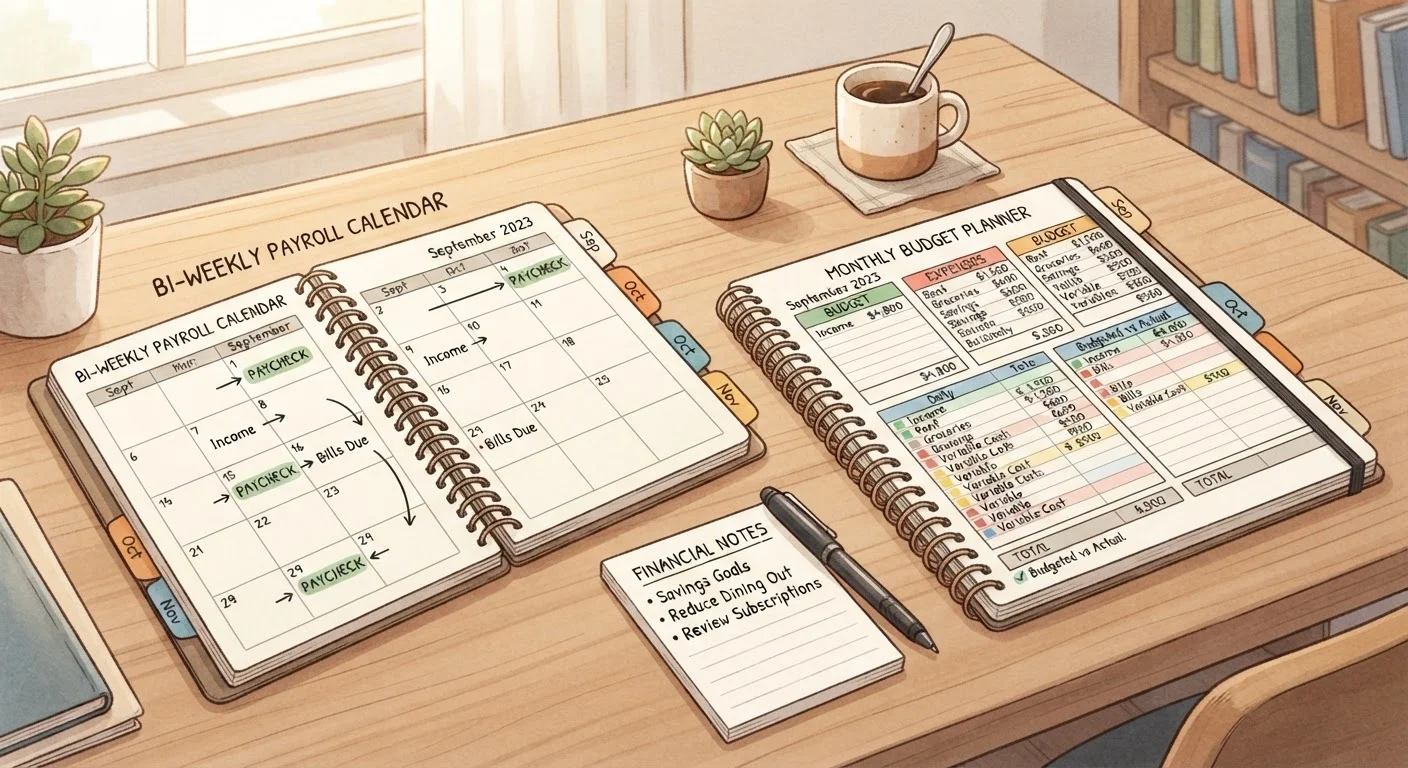
What Each Approach Actually Means
Paycheck budgeting means you plan your spending and savings allocations each time a deposit hits your account. If you are paid biweekly, you build a small budget for roughly a two-week window: which bills are due in that stretch, how much goes to groceries and gas, and what gets set aside before any discretionary spending happens.
Monthly budgeting means you plan across a full calendar month-tallying all expected income and all anticipated expenses from the 1st to the 30th or 31st, regardless of when your paychecks actually land. Most widely discussed frameworks, including the 50/30/20 rule and zero-based budgeting, default to a monthly cadence. See our overview of major budgeting frameworks for context on how these approaches fit together.
Understanding discretionary versus non-discretionary spending is foundational to either method-because you cannot allocate money effectively until you know which expenses are fixed obligations and which are flexible choices.
How Pay Frequency Shapes Your Choice
Your employer's pay schedule is not a minor detail-it directly determines which method is more practical.
- Weekly or biweekly pay: You receive income in chunks throughout the month. A monthly budget can feel abstract because your bank balance rises and falls several times before any calendar month closes. Paycheck budgeting keeps each cycle manageable.
- Semi-monthly pay (twice per month on fixed dates): This bridges both worlds. Because pay dates are predictable and monthly bills can be split neatly between two paychecks, many semi-monthly earners find monthly budgeting relatively easy to mirror.
- Monthly pay: A single large deposit makes monthly budgeting a natural match. The risk is treating the full balance as available spending money rather than rationing it across four or five weeks.
If your income varies from period to period, neither a rigid paycheck nor a rigid monthly plan fits cleanly. Our guide on budgeting for irregular or freelance income covers methods specifically designed for that situation.
| Paycheck Budgeting | Monthly Budgeting | |
|---|---|---|
| Best pay frequency match | Weekly or biweekly pay | Semi-monthly or monthly pay |
| Spending control | Tight cycle-by-cycle control | Broader month-level control |
| Overdraft risk management | Lower - bills matched to deposits | Higher if not actively rationed |
| Handling irregular expenses | Harder - must plan across cycles | Easier - full month visible at once |
| Big-picture financial view | Fragmented across pay periods | Clear monthly snapshot |
| Setup complexity | Moderate - refresh each pay period | Moderate - one plan per month |
| Goal tracking (savings, debt) | Requires monthly rollup | Built into monthly structure |
Practical Strengths and Weaknesses
Paycheck budgeting strengths: It creates a direct link between income and spending decisions, making it harder to accidentally overspend before key bills are due. It also helps prevent the common mistake of spending freely early in the month because the bank balance looks healthy.
Paycheck budgeting weaknesses: It can fragment your view of irregular expenses-things like car registration, annual insurance premiums, or holiday costs-that don't fit neatly into a two-week window. Our article on planning for annual and irregular expenses explains how to handle these lumpy costs so they don't blindside you.
Monthly budgeting strengths: A full-month view makes it easier to see total cash flow, track progress toward savings goals, and align with reporting cycles for credit cards and loans. It also pairs naturally with a monthly budget review habit that helps you course-correct before the next cycle begins.
Monthly budgeting weaknesses: When multiple paychecks fund a single monthly plan, it takes discipline to resist spending money already in the account that is earmarked for later bills. Without a sub-tracking system, it is easy to feel richer in week one than you actually are.
Try a Two-Week Test Before Committing
Rather than overhauling your entire financial system at once, track your spending against one paycheck cycle using the paycheck method, then compare it to how a monthly plan would have looked. This side-by-side test often reveals which cadence feels more natural and which gaps each approach leaves uncovered. Small adjustments based on real data are more durable than large system changes made in theory.
Combining Both Approaches
Many people find a hybrid approach most effective: use a monthly framework to account for all fixed obligations-rent or mortgage, insurance, loan payments, and savings targets-then divide remaining discretionary spending into per-paycheck allowances. This preserves the big-picture clarity of monthly budgeting while giving you the day-to-day guardrails of paycheck budgeting.
Tracking monthly cash flow alongside your net worth is a useful discipline regardless of which primary method you use, since it reveals whether your spending habits are building or eroding your overall financial position over time.
If saving is a priority, consider pairing whichever cadence you choose with a pay-yourself-first strategy-moving savings to a separate account the moment each paycheck arrives, before any discretionary spending occurs. This works within both monthly and paycheck-based structures.
For managing the mechanics of either approach, explore our comparison of spreadsheet versus app-based budgeting tools to find a format that fits your workflow. Building any sustainable budget also connects to longer-term goals covered in our saving and debt hub.
This article is for general informational and educational purposes only and does not constitute personalized financial advice. Consult a qualified financial professional for guidance tailored to your individual circumstances.