The Core Distinction: What Triggers Your Coverage
Liability insurance doesn't just cover what goes wrong - it covers what goes wrong under specific conditions. The most consequential condition is the policy trigger: the event that activates coverage. Two fundamentally different trigger models exist in liability insurance, and understanding them is essential for anyone holding a professional liability, general liability, or medical malpractice policy.
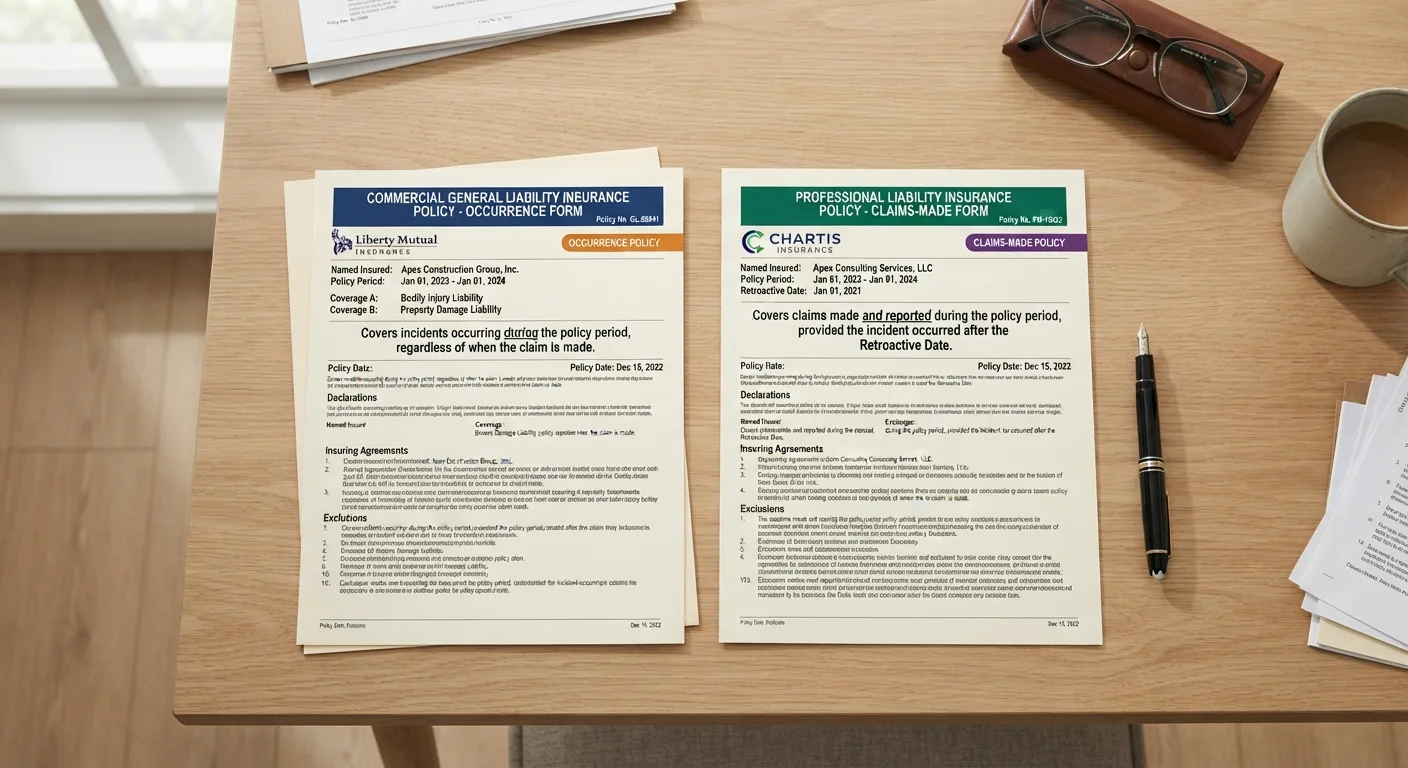
An occurrence policy is triggered by the date the incident itself took place. If a contractor caused property damage in March and the homeowner files a claim two years later, the contractor's occurrence policy that was active in March responds - even if that policy has since expired or been replaced.
A claims-made policy is triggered by the date the claim is reported. The policy that is active when the claim lands on the insurer's desk is the one that must respond. If no policy is active at that moment - or if the claim falls outside any permitted reporting window - coverage does not apply. For a broader look at how liability coverage works across different contexts, see our guide on how liability coverage works.
| Criterion | Occurrence Policy | Claims-Made Policy |
|---|---|---|
| Coverage trigger | Date the incident occurred | Date the claim is reported |
| Active policy required at claim time? | No - prior policy responds | Yes - policy must be active |
| Tail risk management | Built into the policy | Requires tail endorsement (ERP) |
| Typical premium structure | Generally higher upfront | Often lower initially, rises over time |
| Impact of letting policy lapse | Lower risk - past incidents still covered | High risk - uncovered claims if no tail purchased |
| Common use cases | General liability, auto, homeowners liability | Medical malpractice, professional liability, E&O |
| Switching insurers mid-career | Simpler - coverage follows the incident date | Requires careful retroactive date management |
Why the Gap Between Incident and Claim Creates Real Risk
In many liability scenarios - professional services, construction defects, medical procedures - the harm isn't discovered immediately. A patient may develop complications months after a procedure. A software error may surface during an audit a year after implementation. This lag between incident and claim is called the tail risk, and it's where the two policy types diverge most sharply.
With an occurrence policy, tail risk is built into the coverage model. The insurer who was on the risk when the incident happened remains responsible for covered claims arising from it, indefinitely.
With a claims-made policy, tail risk becomes the policyholder's responsibility to manage. The standard tool for managing it is a tail endorsement, also called an extended reporting period (ERP). This add-on - purchased when a claims-made policy ends - gives the policyholder a window (commonly one to five years, or unlimited in some cases) to report claims arising from incidents that occurred while the original policy was active.
1-5 years
Typical extended reporting period (tail) duration
Most insurers offering claims-made policies provide tail endorsement options ranging from one year to unlimited, depending on the policy terms.
~200-350%
Estimated cost of unlimited tail vs. annual premium
Industry guidance generally estimates unlimited tail coverage costs roughly two to three-and-a-half times the final annual premium, though amounts vary significantly by insurer and profession.
Failing to purchase tail coverage when leaving a claims-made policy can expose professionals to uncovered claims from their entire prior practice history. This is one of the most common - and costly - errors in professional liability management.
When Switching Policies or Insurers Gets Complicated
Policyholders sometimes switch between occurrence and claims-made coverage, or move from one insurer to another mid-career. Each transition carries coverage continuity risks worth understanding.
If you move from a claims-made policy to an occurrence policy, incidents from your claims-made years remain protected - but only if a tail endorsement was purchased or if the new insurer provides prior acts coverage (sometimes called a retroactive date provision). Without one of these, incidents that occurred during the claims-made years but are reported after the switch could be uninsured.
If you move from an occurrence policy to a claims-made policy, past incidents are generally covered by your former occurrence carrier, since those policies follow the incident date. The transition is typically cleaner in this direction.
Understanding how your insurer caps payouts is equally important. Our article on aggregate vs. per-occurrence limits explains how both limits work together to define your real coverage ceiling.
Retroactive Dates on Claims-Made Policies
Most claims-made policies include a retroactive date - the earliest incident date the policy will consider for coverage. Any incident occurring before this date is excluded, even if reported during the active policy period. When obtaining a new claims-made policy, verify that the retroactive date aligns with the start of your professional practice or the date your prior occurrence coverage ended. Gaps between the retroactive date and your actual history of practice can leave you exposed.
This article is for general informational and educational purposes only and does not constitute personalized insurance, legal, or financial advice. Coverage terms, conditions, and availability vary by insurer, policy, and jurisdiction. Always read your policy documents carefully and consult a licensed insurance professional before making decisions about your coverage.