Two Numbers on One Policy - and Why Both Matter
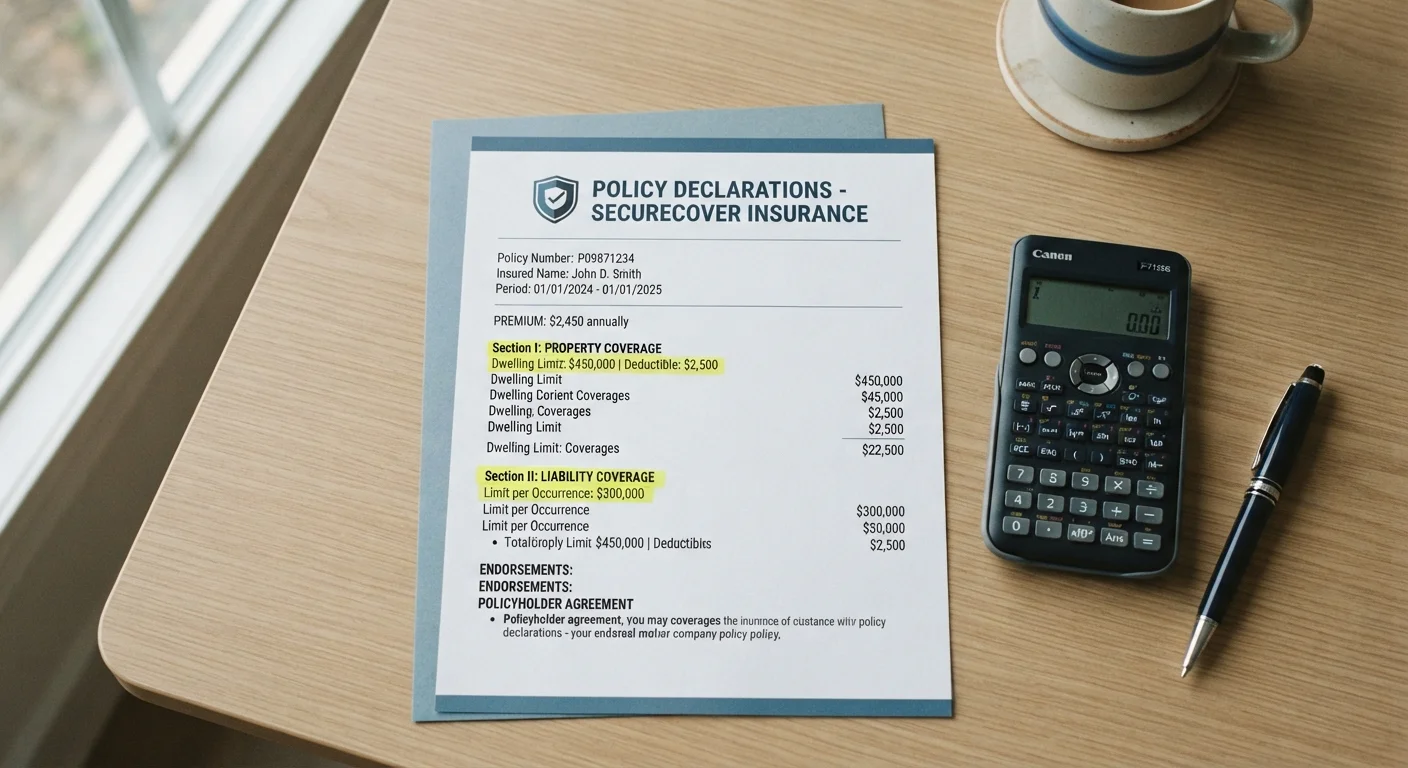
When you read a liability or commercial insurance policy, you will almost always see two different limit figures printed on the declarations page. Most people focus on the larger number and move on. That is a mistake.
The per-occurrence limit is the maximum your insurer will pay arising out of a single event, accident, or claim. The aggregate limit is the maximum the insurer will pay in total across all claims filed during the policy period - typically one year. Both numbers cap your coverage, but in different dimensions: one horizontally (per event) and one vertically (across time).
Understanding how these two limits interact is foundational to evaluating whether a policy gives you real protection. For a broader look at how limits work in general, see what coverage limits really mean.
| Criterion | Per-Occurrence Limit | Aggregate Limit |
|---|---|---|
| What it caps | Payout from a single incident | Total payouts across the policy period |
| Resets when | Each new, separate claim | Policy renews (typically annually) |
| Risk of exhaustion | Only if one claim is very large | After multiple claims accumulate |
| Most relevant for | Evaluating single-event risk | Evaluating year-long risk exposure |
| Appears on declarations page | Yes, labeled per-occurrence or per-claim | Yes, labeled aggregate or general aggregate |
| Can be exhausted mid-year | No - resets per incident | Yes - stops coverage until renewal |
How Each Limit Works in Practice
Consider a small business with a general liability policy carrying a $1 million per-occurrence limit and a $2 million aggregate limit.
- A customer slips and falls, resulting in a $700,000 settlement. The insurer pays $700,000 - within the per-occurrence cap. The aggregate pool now has $1.3 million remaining.
- A second unrelated incident later in the year results in a $900,000 judgment. The insurer pays $900,000 - still within the per-occurrence cap. The aggregate is now reduced to $400,000.
- A third claim arrives for $600,000. Even though it is under the per-occurrence limit, only $400,000 remains in the aggregate - so the business is responsible for the remaining $200,000 out of pocket.
This is the critical point: the aggregate limit can run out before the policy year ends. After that, coverage stops regardless of how legitimate the next claim may be.
Sub-Limits Can Further Narrow Coverage
Many policies contain sub-limits - internal caps that apply to specific claim categories within the broader per-occurrence or aggregate limit. For example, a policy might have a $1 million per-occurrence limit overall but a $250,000 sub-limit for advertising injury claims. Sub-limits are easy to overlook and can leave a coverage gap even when your headline limits look adequate. Always check the policy's coverage schedule for any built-in sub-limits before assuming the main figures tell the whole story.
The policy period almost always resets both limits at renewal. However, a claim filed in one period that carries into the next is typically counted against the period when the incident occurred - not when the claim is resolved. This timing issue is explored further in our article on occurrence vs. claims-made policy triggers.
Common Contexts Where These Limits Appear
Per-occurrence and aggregate limits are most visible in liability insurance - general liability, professional liability, and umbrella policies - but the logic applies across coverage types.
- General liability (business): Both limits are standard on the declarations page and are heavily scrutinized in vendor contracts.
- Homeowners liability: A single occurrence limit usually applies; aggregate language is less common but may appear in umbrella add-ons.
- Health insurance: The concept maps loosely onto out-of-pocket maximums, though the terminology differs. See how deductibles and out-of-pocket maximums interact for that parallel.
- Workers' compensation: Some policies use per-accident and policy limits that function similarly.
For a comprehensive overview of how limits apply across different coverage categories, the coverage types hub is a useful starting point.
2×
Recommended aggregate-to-occurrence ratio
Insurance professionals commonly suggest the aggregate limit be at least twice the per-occurrence limit for businesses facing recurring liability exposure.
~40%
Small businesses with inadequate liability limits
Industry surveys have consistently found that a significant share of small businesses carry liability limits that do not reflect their actual risk exposure or contractual requirements.
Choosing Limits That Reflect Your Actual Exposure
Neither limit type is inherently better - they serve different functions. What matters is that both are set at levels that realistically match what you could owe if things go wrong.
A useful rule of thumb: the aggregate limit should be at least twice the per-occurrence limit for businesses or households that could realistically face more than one significant claim in a year. A policy with a $1 million per-occurrence limit and a $1 million aggregate offers far less real-world protection than those numbers suggest, because a single maximum claim exhausts all remaining coverage instantly.
When reviewing any policy, ask these questions:
- What is the per-occurrence limit, and does it cover the worst plausible single incident?
- What is the aggregate limit, and would it hold up if two or three claims occurred in the same year?
- Are there sub-limits - lower caps that apply to specific claim types within those larger figures?
For guidance on setting amounts that reflect your real risk profile rather than just a round number, see how to choose coverage limits that match your exposure.
This article is for general informational purposes only and does not constitute personalized insurance, financial, or legal advice. Coverage terms, limits, and regulations vary by provider, policy, and state. Always read your actual policy documents and consult a licensed insurance agent or adviser for guidance specific to your situation.